As Crime Mounts, Mexicans Turn to Vigilante Justice

As Crime Mounts, Mexicans Turn to Vigilante Justice

Graphic photos of the alleged thief’s corpse were splashed over the front pages of Mexican tabloids beneath headlines such as “Dead Rat” and “Military Justice.” The confessed shooter, retired general Alejandro Flores, was widely hailed as a hero for firing at the 30-year-old man who had tried to force his way into the military man’s Mexico City home. “Of course he did the right thing,” wrote Felipe Alcocer in one on-line forum on the incident. “I wish everyone would act in the same way and get rid of this anti-social scum.”

Given Mexico’s widespread breakdown in security, the praise for Flores’ Feb. 5 act of self-defense is unsurprising. The conviction rate in the thousands of murders and kidnappings afflicting the nation every year is estimated to be as low as 5%. Women and children are also increasingly among those killed by criminal gangs. And the limits on the legal system’s ability to stem the tide of violent crime has produced a growing, shadowy movement for vigilante justice. In recent months, at least three new clandestine groups have promised to hunt down and murder criminals to help restore order. As in the killing of the alleged thief by Flores, such groups have been cheered on in public forums. “My sincerest congratulations to these brave men with their courage and determination,” wrote a reader of Mexican newspaper Milenio. “God help them with their noble cause.”

It is too early to say whether these self-proclaimed avengers will become a significant force in Mexico’s battle with crime. Some of them may simply be angry citizens sending out messages not backed by any action. Others could be fronts for drug gangs, who want to present themselves as public guardians while running their own criminal rackets. But whomever is really behind these particular groups, the growing demand for justice by any means necessary raises concerns about the security situation in Mexico if the government remains unable to suppress the crime wave.

The most widely publicized vigilante campaign has emerged across the Texas border in Ciudad Juarez, which has become Mexico’s deadliest city with 1,600 murders last year. A self-styled Juarez Citizens’ Command sent an e-mail to local media in January saying it will give the government until July 5 to restore order or execute one criminal a day. Signed by “Comandante Abraham,” the group claims it is financed by local businessmen, and includes university students, entrepreneurs and professionals in its ranks. It offers to cooperate with military intelligence and says it supports the government, but argues that the elected politicians have failed.

A second shadowy group, called the Popular Anti-Drugs Army, materialized among farming towns in the southern state of Guerrero in November. Displaying blankets with written messages on bridges and buildings, the group claims to be made up of family men who have come to together to force drug dealers off the street. “We invite the people to join our struggle and defend our children who are the future of Mexico,” it said on one of the blankets. Unlike the Juarez group, the Guerrero “Army” has been linked to several killings, including the decapitation of an alleged drug dealer in December. Local press allege the group is commanded by a rancher whose children were targeted by the gangs.

Sociologist Rene Jimenez notes that vigilante justice has already become a reality in several parts of the country. “The state is failing to keep control in certain areas so people take justice into their own hands,” he said. “This vigilantism shows that the conflict is entering a new phase. Violence will breed more violence.”

There are certainly some unfortunate precedents: Self-proclaimed anti-gang vigilantes became a key part of the civil war in Colombia, where they morphed into paramilitary armies with thousands of members. These groups fought leftist guerrillas and allied with the government to bring down major drug traffickers such as the notorious Pablo Escobar. Many of the paramilitary leaders later confessed they had funded their own activities by dealing drugs, but claimed they virtually stopped anti-social crime in areas under their control. Gustavo Duncan, who authored a book on the Colombian paramilitaries, says similar organizations could emerge in Mexico amid the breakdown in state authority. “While Mexico may not ever get as bad as Colombia, some of the factors are very similar,” Duncan notes. “When the state cannot keep control in certain areas, it leaves a vacuum for these type of organizations to step in and in many ways they become the state.”


Boy, 11, accused of killing father’s pregnant girlfriend

Police say Kenzie Marie Houk's daughter found her shot to death in her bed on Friday.
An 11-year-old boy is facing adult charges in the shooting death of his father’s pregnant girlfriend, authorities said Saturday.

Police say the boy shot Kenzie Marie Houk, who was eight months pregnant, once at pointblank range in her farmhouse in western Pennsylvania. The boy, whose name was withheld by CNN because he is a juvenile, was charged with one count each of criminal homicide and homicide of an unborn child in the death of Houk, 26, Lawrence County District Attorney John Bongivengo told CNN. Houk’s 4-year-old daughter found her in her bed Friday, according to police. The child alerted landscapers working near the home, who then called police. “This is someting that you wouldn’t even think of in your worst nightmare, that you’d have to charge an 11-year-old with homicide,” Bongivengo said, according to CNN affiliate WTAE. “It’s heinous, the whole situation.” Under Pennsylvania law, anyone over the age of 10 accused of murder or homicide is charged as an adult. If convicted, the boy faces a maximum sentence of life in prison, Bongivengo said. Authorities said the boy is the son of the victim’s live-in boyfriend at the home in Wampum, about 35 miles northwest of Pittsburgh.

Don’t Miss
WTAE: Boy, 11, Kills Dad’s Pregnant Girlfriend, DA says

“At this point, we don’t believe it’s accidental,” Bongivengo said. The weapon was a youth model 20-gauge shotgun, designed for use by children, that belonged to the boy, according to investigators. Bongivengo told reporters the household has no history of child abuse, but that an investigation is ongoing. Calls to the boy’s public defender, Dennis Elisco, went unanswered Saturday.

Mine blast traps 96 in China: state media


A mine blast in northern China trapped nearly 100 miners on Sunday, state-run media reported.

LOS ANGELES, California (CNN) — One major contender’s chances at Oscar gold may be damaged due to its sensitive subject matter. “The Reader,” which is up for five Oscars — including best actress (for star Kate Winslet) and best picture — is being slammed by “Explaining Hitler” author Ron Rosenbaum, who’s asked Academy members to shun the post-World War II drama because the film “asks us to empathize with an unrepentant mass murderer.” Rosenbaum, who wrote his commentary for Slate.com, said that’s not his only reason. “It gives the impression that ordinary German people only learned the terrible things that happened in the death camps in the East after the war,” he said in an interview with CNN. “In fact, ordinary German people participated in Hitler’s final solution, the extermination of the Jews — it was no secret.” Read Rosenbaum’s essay Based on the German book with the same title, “The Reader” stars Winslet as Hanna Schmitz, a former Nazi prison guard living in postwar Germany. She meets and has a secretive affair with teenager Michael Berg (David Cross), who often reads aloud to her at her request. Unbeknownst to Michael, Hanna is illiterate. Their affair ends abruptly when she mysteriously disappears.

Eight years later, Michael is a law student. One day, while observing Nazi war criminals on trial, he’s shocked to find Hanna as a defendant in the courtroom. The court finds her guilty of killing 300 Jewish women during the war and sentences her to life in prison. While behind bars, Michael sends her books on tape, which, over time, help Hanna finally learn to read. Therein lies the problem for Rosenbaum. “What essentially it did,” said Rosenbaum, “was celebrate the enrichment of a life of a mass murderer when she learned how to read. … Imagine if there were a film about Charles Manson learning how to play chess and what a better guy it made him.” However, others in the Jewish community are applauding the film, including Ken Jacobson, deputy national director of the Anti-Defamation League. Jacobson says “The Reader” opens itself up to criticism, but is worthy of an Oscar at the same time. “I think it conveys a series of messages that actually are very powerful about the Holocaust, and it’s not in the usual way,” Jacobson told CNN.

Don’t Miss
Will ‘Slumdog’ have its day at Oscars

Full list of Academy Award nominees

Special Report:  Academy Award Spotlight

“As time goes on, as we have Holocaust deniers emerging more and more, we need people to be able to relate personally to what happened,” said Jacobson. “I think this film does this in a very powerful way.” The Weinstein Company, the studio behind “The Reader,” says it is proud of the film. “It is sad that some people misinterpreted the film’s message,” the company said in a statement. “It is not about the Holocaust,” the company added, “it is about what Germany did to itself and its future generations.” Will Rosenbaum’s piece, and the backlash he touched off, affect “The Reader’s” Oscar chances Sunday Entertainment reporter Tom O’Neil, who follows awards shows for the Los Angeles Times’ TheEnvelope.com, doesn’t think so. Given “The Reader’s” five nominations, he believes Hollywood has already embraced the film. “Oscar has taken special notice of ‘The Reader’ because it’s not just your average Holocaust movie,” said O’Neil. “It doesn’t beg for forgiveness when dealing with Nazis. It makes you think.” Still, Rosenbaum says any further accolades for the drama would be unfortunate. “I would be very disappointed in the intelligence level of Hollywood if it gave the best picture award to ‘The Reader,’ ” he said.

NAACP calls for firing of N.Y. Post cartoonist


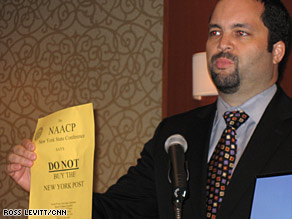
Leaders of the NAACP on Saturday called for the firing of the New York Post cartoonist whose drawing lampooning the federal stimulus bill has drawn charges that it’s racist and encourages violence toward President Obama.

Speaking at the civil rights group’s annual meeting in New York, NAACP President Benjamin Todd Jealous said that if Sean Delonas is not fired, the group will call for protests of the paper and Fox television affiliates, which are owned by Post parent company News Corp. “There is consensus that if the Post does not … get rid of the journalists who are responsible for this bit of hate speech seeing the light of day, that we will move this from a local, regional issue to a very national issue,” Jealous said. The group also called for the cartoonist’s editor to be fired. Many critics said the cartoon played on historically racist images by appearing to compare Obama, the nation’s first black president, to a chimpanzee that had been shot by police officers.

Don’t Miss
Racism row over chimp cartoon sparks debate

New York Post apologizes for, defends chimp cartoon

Chimp attack victim moved to Cleveland Clinic

The cartoon references the mauling of a Connecticut woman by a chimpanzee who was later shot and killed by police. In its caption, one of the officers says, “They’ll have to find someone else to write the next stimulus bill.” Obama had signed the bill the day before the cartoon ran. On its Web site Thursday, the paper offered a qualified apology, saying it was “most certainly not our intent” to express racism, but also accusing some of jumping at a chance to attack a paper they already disliked. Watch reaction to the Post’s apology » “To them, no apology is due,” the paper wrote. “Sometimes a cartoon is just a cartoon — even if the opportunists seek to make it something else.” But NAACP Chairman Julian Bond said that explanation rings hollow.

“This is tastelessness taken to the extreme,” he said. “For the publication to suggest the only people who object to it are constant critics of the New York Post is beyond ridiculous. “This was an invitation to assassination of the president of the United States and anyone who was not offended by it doesn’t have any sensibilities.”

BBC: Iran held ‘backroom’ talks with Western diplomats

John Sawers, British ambassador to the U.N., told BBC of Iran approaching Western nations with offer.
Iran offered to stop attacking coalition troops in Iraq nearly four years ago in an attempt to get the West to accept Tehran’s nuclear program, a British diplomat told the BBC in an interview aired Saturday.

“The Iranians wanted to be able to strike a deal whereby they stopped killing our forces in Iraq in return for them being allowed to carry on with their nuclear program — ‘We stop killing you in Iraq, stop undermining the political process there, you allow us to carry on with our nuclear program without let or hindrance,” said John Sawers, now the British ambassador to the United Nations, in the documentary, “Iran and the West: Nuclear Confrontation.” The United States and other Western nations believe Iran is pursuing a nuclear weapons program, but Iran says it is developing nuclear capability to produce energy. Iran also has been accused of sponsoring terrorists and supplying weapons to Iraqi insurgents. The latter prompted a warning from the United States that such behavior by Tehran “would be regarded by us as enemy action,” Philip Zelikow, a State Department counselor, told the BBC. Then, Iran began shopping its offer around Europe, Sawers said. Sawers, Britain’s political director at the time, reveals the behind-the-scene talks from 2005 — when roadside bombing against British and American soldiers in Iraq peaked — were held with British, French and German diplomats at hotels in London, Paris and Berlin. “And then we’d compare notes among the three of us,” Sawers told the BBC. The British government dismissed the offer and Iran’s nuclear enrichment program restarted once again, the BBC reports Iran has denied offering any such deal and reiterated its position Saturday. “Iran’s high officials have repeatedly stated that Iran has not had any part in attacks against American and British forces, and there is no evidence to support these baseless accusations,” Iranian Foreign Ministry spokesman Hassan Qashqavi said, according to the semi-official Mehr News Agency. Interviews with top brass from former President Bush’s administration and British envoys indicate that Iran and the West had neared agreements several times in the past few years, but never reached success. Nick Burns, who was in charge of the Bush administration’s State Department policy with Iran, said taking a tough approach with Iran didn’t seem effective. “We had advocated regime change,” Burns told the BBC. “We had a very threatening posture towards Iran for a number of years. It didn’t produce any movement whatsoever.” The documentary aired a day after the Washington-based Institute for Science and International Security released a report stating that Iranian scientists have reached “nuclear weapons breakout capability.” The report analyzed the finding of the U.N.’s nuclear watchdog agency, the International Atomic Energy Agency (IAEA).

Don’t Miss
Iran ready to build nuclear weapon, analysts say

However, an IAEA official who asked not to be named cautioned against drawing such dramatic conclusions from the data, saying Iran’s stock of low-enriched uranium would have to be turned into highly enriched uranium (HEU) in order to be weapons-grade material. That hasn’t been done, the official said. Meanwhile, Iran’s relationship with the West continues to be strained, though both sides have indicated interest in holding direct talks. President Obama, in his first prime-time news conference held earlier this month, said the United States is looking for opportunities for “face-to-face” talks with Iran after an absence of diplomatic ties for nearly three decades. “There’s been a lot of mistrust built up over the years, so it’s not going to happen overnight,” he said. And Iran’s powerful parliament speaker and former nuclear negotiator, Ali Larijani, has called the Obama administration “an exceptional opportunity for Americans.”

Chandra Levy’s mom says police have enough evidence to convict

Washington intern Chandra Levy's body was found a year after she disappeared in 2001.
Washington police told the mother of slain congressional intern Chandra Levy that an arrest is imminent in her daughter’s 2001 death, Susan Levy told CNN on Saturday.

“I got a call from the Washington police department, just to give me a heads up that there’s a warrant out for the arrest,” Levy said. Police Chief Cathy Lanier of the Metropolitan Police Department did not reveal the suspect’s name when she contacted the parents on Friday, Levy said. She said police told her they have “enough evidence to convict somebody.” A source close to the investigation told CNN the suspect was Ingmar Guandique, who is serving a 10-year prison sentence for two assaults in Washington’s Rock Creek Park that occurred around the time of Levy’s disappearance. Levy’s remains were found in the park. View a timeline of her disappearance » The source would not speak on the record because the investigation is ongoing and the arrest warrant had not been finalized. A California native working as an intern for the Federal Bureau of Prisons, Levy, 24, disappeared May 1, 2001. Her remains were found in May 2002 by a man walking his dog in a remote area of the park. The source said authorities are working to finalize the arrest warrant. Asked about reports that Guandique, a laborer from El Salvador, told a fellow inmate he killed Levy, the source said Guandique “was running his mouth.” Guandique has been imprisoned at the Federal Correctional Institution – Victorville, a medium-security facility north of San Bernardino, California, an official there confirmed to CNN on Saturday. Watch CNN’s Mike Brooks discuss Guandique’s background » He has denied any involvement in her death, the Washington Post reported Saturday. Guandique was mentioned last year in a Washington Post article about the killing. “It’s a bittersweet situation for me as the mother of a daughter who is no longer here. I want justice. I want to know that the person who did it is in jail and will not do it to anybody else,” Levy said. “Every day the elephant is there. Every day you get a knot in your stomach. It doesn’t go away. It’s a life sentence for the families and relatives that miss their loved ones. We have a life sentence of hurt.” Referring to the impending arrest, Chandra’s father told CNN affiliate KXTV that Lanier didn’t say when an announcement would be made, but “she said it would be really soon.” “She didn’t say the name yet, but we think we know who it is. I don’t want to say until it’s official, though,” the father said. The search for Levy and massive publicity that accompanied it stemmed largely from her connection to Rep. Gary Condit, D-California. Condit and Levy, who was from Condit’s district, had an affair, and police questioned Condit many times in connection with her disappearance. Police never named Condit as a suspect. Condit, a member of Congress since 1989, lost the 2002 Democratic primary and left office at the end of his term. He later reportedly moved to Arizona. “For the Levy family, we are glad they are finally getting the answers they deserve. For my family, I am glad that their years of standing together in the face of such adversity have finally led to the truth,” Condit told WJLA on Saturday. Condit’s lawyer, Abbe Lowell, blamed police and media attention on Condit for delays in the arrest. Police never named him as a suspect.

“It is a tragedy that the police and media obsession with former Congressman Condit delayed this result for eight years, and caused needless pain and harm to the families involved,” Lowell said. “This should give the Levys the answer and closure they deserve, and remove the unfair cloud that has hung over the Condits for too long.”

Family of 5 weathers economy with 7 housemates

Some members of the Frankel household gather around the dinner table at their home in New Mexico.
Chris and Georgia Frankel have no idea what it must be like to live alone as a married couple. They started out their life together staying with relatives and later friends.

(CNN) — Chris and Georgia Frankel have no idea what it must be like to live alone as a married couple. They started out their life together staying with relatives and later friends. Those early years proved to be good training because their house in Albuquerque, New Mexico, now has 12 people calling it home. In addition to their three daughters, ages 3, 6 and 17, the couple shares their space with five adults and two teens. The family started taking in people before the economy soured, and now they say they are weathering the downturn better than some, in part because of their unconventional living arrangement. iReport.com: Tell us how you’re surviving In the Frankel household, everyone has pulled together to make the way a little bit easier for them all. They are all there for various reasons, from difficult family situations to trouble with former roommates. Some are there daily, and others come and go based on school schedules and work commitments. Rent — if the person can afford it — is minimal and sometimes even shunned.

Don’t Miss
iReport.com: Tell us your stories

1,200 miles apart and surviving

From $80,000 a year to eviction

“It’s difficult with Georgia, because she doesn’t like to take money from anyone,” said Jamie Cooper, a co-worker of Georgia’s who has lived in the Frankel home for more than a year. “She wants to take care of everyone all the time.” Not that the Frankels are wealthy. Georgia works as an executive assistant at Heel Inc., a homeopathic pharmaceutical firm, and Chris is director of programming for Fitness Anywhere, a company that sells exercise equipment. But even with a lifestyle Chris describes as “living paycheck to paycheck,” the couple say they are fortunate to have a large house (it’s more than 3,800 square feet) that has become a haven for those living there. “People were there for us and helped us when we needed it,” Chris said. “We wanted to do the same.” It was just a few years ago that the family needed care. First, the eldest Frankel daughter got sick and ended up in the hospital. Then Chris’ father moved in while in the final stages of cancer. “We were under the impression that he had six months to live, but he had nine days to live,” Chris recalled. “I went through a battle with depression, and my wife was taking care of the kids and actually taking care of me quite a bit.” Undone by stress and grief, Chris stopped working some of the personal training jobs he held to supplement his income teaching in the exercise science program at the University of New Mexico. The family finances plummeted, he said. “We learned how to get by when there was not enough food in the house for the kids,” Chris said. “We had to beg and borrow money from people to get by.” Gradually, things stabilized, and as times got better, the Frankels found themselves in a position to pay it forward. Rachel Balkovec was the first to move in two years ago. Chris was her professor, and when he offered her a job as a personal trainer during summer break, she declined because she had nowhere to stay. “I said, ‘I have to go home and work and save money. I can’t stay here if I don’t live for free,’ ” said Balkovec, who hails from Omaha, Nebraska. “The next day at school, he was like, ‘Hey, my wife said you can move in whenever you want.’ ” After getting over the surprise of the offer, Balkovec moved in and has been there ever since. “They ended up being like my own family,” said Balkovec, whose boyfriend later moved in also. “[The Frankels] are really open. There is every type of person living in this house. They don’t judge, and they love everyone. They just want to help people.” Everyone agrees that the driving force behind the living arrangement is Georgia. She is a woman with a big heart whose door is always open. It’s not rare for the kids’ friends to be found hanging at the house, and every Thursday, the family hosts a group of local Mormon missionaries for dinner. The couple has converted spare rooms into bedrooms to accommodate everyone, and even with a food bill that averages about $1,000 a month, Georgia swears she wouldn’t have it any other way. “I feel like everyone needs a good environment to live in,” Georgia said. “We have a home we were blessed with, and it has a lot of room for everybody. We work well as a family.” A typical day at the Frankel household is not as hectic as you might imagine. The presence of four bathrooms helps, and everyone’s schedule varies. The group divides up chores and enjoys gathering around the crowded dinner table at the end of the day. A Wii they saved up for has helped the house develop a fondness for a little healthy video game competition on the weekends. And although they may not all share blood, they are bound by respect and affection for each other, they say. Alfredo Loda is a chef who calls Casa Frankel home when he is not working in various parts of the country. Finding work has gotten tougher and tougher, he said, and he has been able to secure only seasonal jobs here and there. Were it not for the Frankels, said the Italian-born chef who speaks three languages, he probably would have left for Europe to try to find work. “This is how people used to live, looking out for and taking care of one another,” said Loda, who cooks and helps with the care of the children as a way to contribute to the household. iReporter Austin Chu posted a clip of the Frankels to share the story of a family he says “embodies what we all need to embody.” iReport.com: Inspiration in Albuquerque Austin and his brother Brian are traveling the United States filming a documentary they have titled “The Recess Ends,” about the country’s current economic plight. Austin Chu said the Frankels are an example of America at its best. “Imagine if every family was like the Frankel family,” Chu said. “In times of real trouble, these are the values we need to hang on to.” Chris Frankel’s job is based in San Francisco, California, and he is on the road quite a bit these days. He said he considered moving his family and selling his house, but the current real estate market and the expense of living in California made it impossible. Instead, he travels with the knowledge that his wife and daughters are in good company. “My kids get to experience different cultures and different kinds of people,” he said. “At the end of the day, if it comes down between saving a dollar or helping someone else out, we have been pretty good about seeing the investment in our friendships and our family. That’s what keeps us going and keeps us pretty happy.”

Taliban, Pakistan make permanent truce in volatile valley

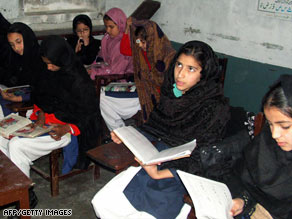
Girls study this week in Pakistan's Swat Valley. Education for girls is an issue in peace talks there.
The Taliban and the government of North West Frontier Province in Pakistan have agreed to a permanent cease-fire in the nation’s volatile Swat Valley, an official said.

Syed Mohammad Javed, commissioner for the Malakand region, which includes Swat Valley, told reporters in Mingora that the two parties had agreed to make permanent a 10-day cease-fire declared earlier this week. Javed said the agreement meant boys schools will reopen on Monday and camps will be set up for Swat residents who have fled the fighting or whose homes had been destroyed. The agreement comes as part of ongoing talks between Sufi Mohammad, a pro-Taliban cleric, and his son-in-law Maulana Fazlullah, the Taliban commander in Swat. Taliban spokesman Muslim Khan confirmed the cease-fire. However, Fazlullah spoke on the radio Saturday, saying although the commissioner announced a permanent cease-fire, the Taliban will meet again after the 10-day truce expires and decide whether it will be extended. Earlier this week, Pakistani government officials announced they had agreed with the Taliban to allow strict Islamic law, or Sharia, to be implemented in the entire Malakand Division. Watch what sharia law requires » It marked a major concession by the Pakistani government in its attempt to hold off Taliban militants who have terrorized the region with beheadings, kidnappings, and the destruction of girls’ schools. The fighting has displaced nearly half of Swat’s population, according to government sources.

Don’t Miss
Suicide bombing kills 27

Journalist killed in Taliban region

Girl poet takes on Taliban

Fazlullah said Saturday the implementation of sharia law was very important for peace. Like Javed, he said schools for boys will be opened soon. He said he was not against education of girls, but against the syllabus of their education. The issue of education for girls was still under discussion, Javed said. Nearly 8,000 people died as a result of militant-related violence in Pakistan in 2008, according to the Pakistan Institute of Peace Studies.

On Saturday, a NATO oil tanker truck was the target of a roadside bombing on its way to Afghanistan. One one person was killed, a local official said. Two other people were wounded in the attack Saturday morning in the Landi Kotal area of Khyber Agency, one of seven semi-autonomous tribal agencies along the Afghan border, said the official, with the Khyber Agency political agent’s office.

Ronaldo free-kick puts United eight clear

Ronaldo celebrates his late free-kick as Manchester United edged closer to retaining the Premier League.
A superb free-kick from Cristiano Ronaldo gave Manchester United a 2-1 home win over Blackburn to move them eight points clear at the top of the Premier League table.

United’s record-breaking run of clean sheets came to an end at Old Trafford, but Ronaldo’s moment ensured Sir Alex Ferguson’s side remain well on course to lift their third successive title. United took a 23rd minute lead when Wayne Rooney celebrated his first start since returning from a hamstring injury, by taking advantage of a mistake from defender Ryan Nelsen to score the opening goal. However, nine minutes later United conceded their first league goal in 1,334 minutes when Roque Santa Cruz slipped the ball into an empty net after goalkeeper Tomasz Kuszczak, standing in for the rested Edwin van der Sar, and Rio Ferdinand got in each others way. Jonny Evans looked to have put United back in front on the stroke of half-time but his header from Nani’s corner was harshly disallowed for a push. Blackburn nearly took a shock second-half lead when Nelsen struck the post when left unmarked in the area and he was made to pay for that miss when Ronaldo curled home a spectacular free-kick from the left on the hour mark. Both sides had half-chances to add to the scoresheet, but United held on to take the victory, although Liverpool can reduce their lead to five points again on Sunday if they beat Manchester City at Anfield. Elsewhere, Nicolas Anelka’s first half-strike gave Chelsea a vital 1-0 victory at Aston Villa in Dutchman Guus Hiddink’s first match in charge, lifting the London side above their opponents and into third place. French international Anelka, the league’s top scorer, struck his 21st goal of the season after 19 minutes to earn the Blues their first win at Villa Park for 10 years and keep alive their faint Premier League title hopes. It was Anelka’s first goal in nine league games and brought an end to Villa’s 13-game unbeaten sequence stretching back to early November.

Football Fanzone

Football fans, the chance to have YOUR say on CNN is here!

Join in the debates now »

Frank Lampard created the goal with a superb piece of skill which enabled him to race clear of Curtis Davies and Stiliyan Petrov before sliding a pass through to Anelka, who showed great composure in dinking the ball over goalkeeper Brad Friedel and into the net. Villa could have levelled in the in the 33rd minute when Ashley Young’s curling free-kick struck the crossbar. Emile Heskey was the first to react to the rebound but he headed well wide. However, that was as good as it got for the home side as Chelsea enjoyed the bulk of the chances in the second half. Didier Drogba could have wrapped up the points after a mistake by Carlos Cuellar, but he lofted his shot over the bar, while Friedel denied Jose Bosingwa from close-range before producing another superb save to keep out Michael Ballack. Meanwhile, fifth-placed Arsenal failed to capitalize on Villa’s defeat, drawing 0-0 at home to Sunderland to lie six points behind Martin O’Neill’s side and in real danger of missing out on the Champions League for the first time since Arsene Wenger took over as manager in 1996. Even Andrei Arshavin’s debut for the club failed to conjure up a goal, as Arsenal played out a third successive Premier League goalless draw — although they did extend their unbeaten run to 13 matches. Elsewhere, Bolton continued their climb away from the relegation zone with a 2-1 home win over West Ham while Stoke remain fourth bottom after conceding an injury time goal to draw 2-2 with Portsmouth in a match where all four goals were scored in the final 15 minutes. Meanwhile, Middlesbrough remain second bottom of the table as they were held 0-0 at home by Wigan, making it a club record 14 Premier League games without victory.

Are Mixed-Race Children Better Adjusted?

Are Mixed-Race Children Better Adjusted?

Americans like answers in black and white, a cultural trait we confirmed last year when the biracial man running for President was routinely called “black”.

The flattening of Barack Obama’s complex racial background shouldn’t have been surprising. Many multiracial historical figures in the U.S. have been reduced to a single aspect of their racial identities: Booker T. Washington, Tina Turner, and Greg Louganis are three examples. This phenomenon isn’t entirely pernicious; it is at least partly rooted in our concern that growing up with a fractured identity is hard on kids. The psychologist J.D. Teicher summarized this view in a 1968 paper: “Although the burden of the Negro child is recognized as a heavy one, that of the Negro-White child is seen to be even heavier.”
But new research says this old, problematized view of multiracial identity is outdated. In fact, a new paper in the Journal of Social Issues shows that multiracial adolescents who identify proudly as multiracial fare as well as — and, in many cases, better than — kids who identify with a single group, even if that group is considered high-status . This finding was surprising because psychologists have argued for years that mixed-race kids will be better adjusted if they pick a single race as their own.
The population of multiracial kids in the U.S. has soared from approximately 500,000 in 1970 to more than 6.8 million in 2000, according to Census data quoted in this pdf. In the early years, research on these kids highlighted their difficulties: the disapproval they faced from neighbors and members of their extended families; the sense that they weren’t “full” members in any racial community; the insecurity and self-loathing that often resulted from feeling marginalized on all sides. That simple but harsh playground question — “What are you” — torments many multiracial kids. Psychologists call this a “forced-choice dilemma” that compels children to claim some kind of identity — even if only a half-identity — in return for social acceptance.
But the new Journal of Social Issues paper suggests this dilemma has become less burdensome in the age of Tiger Woods and Barack Obama. The paper’s authors, a team led by Kevin Binning of the Stanford Graduate School of Business and Miguel Unzueta of the UCLA Anderson School of Management, studied 182 multiracial high schoolers in Long Beach, Calif. Binning, Unzueta and their colleagues write that those kids who identified with multiple racial groups reported significantly less psychological stress than those who identified with a single group, whether a “low-status” group like African-Americans or a “high-status” group like whites. The multiracial identifiers were less alienated from peers than monoracial identifiers, and they were no more likely to report having engaged in problem behaviors, such as substance use or persistent school absence.
The writers theorize that multiracial kids who choose to associate with a single race are troubled by their attempts to “pass,” whereas those who choose to give voice to their own uniqueness find pride in that act. “Rather than being ‘caught’ between two worlds,” the authors write, “it might be that individuals who identify with multiple groups are better able to navigate both racially homogeneous and heterogeneous environments than individuals who primarily identify with one racial group.” The multiracial kids are able to “place one foot in the majority and one in the minority group, and in this way might be buffered against the negative consequences of feeling tokenized.”
In short, multiracial kids seem to create their own definitions for fitting in, and they show more psychological flexibility than those mixed-race kids who feel bound to one choice or another.
Fortunately, all these questions of racial identity are becoming less important, as we inch ever closer to the day when the U.S. has no racial majority. One of these days, after all, we will all be celebrating our multiracial pride.