How to Fix the Housing Market

How to Fix the Housing Market

Here’s a thought: let’s have the government do something to fix the housing market. Now what would that be?

Ideas are flying around Washington. They include tax credits and cheaper mortgages for home buyers as well as leaning on lenders to rewrite mortgage terms for struggling borrowers. But maybe we should ask what, exactly, fixing the housing market means–and prepare ourselves for the limits of what these policies can actually accomplish. Consider our recent track record. Last July, Congress passed a bill to help the housing market. In an effort to churn demand and stabilize home prices, the bill created a $7,500 tax break for first-time home buyers. It also created a program to prevent foreclosures. Unfortunately, no major lenders signed up. Bottom line: only 25 loans have been rewritten. Influencing a $19 trillion market that is coming off one of history’s great asset bubbles is a lot harder than it looks. In December, houses sold for 15% less than they did a year earlier. No act of Congress could change that. Says Wellesley College economist Karl Case: “Let’s not delude ourselves into thinking we’re driving a speedboat when we’re driving a tanker.” So, what does have a shot at working Most proposals on the table are designed to boost demand without distorting the market and at the same time restrain supply by keeping people in their homes. But the harsh reality is that fixing the crisis will require some acknowledgment that there are a number of people out there who shouldn’t be homeowners. Here’s a guide to the latest ideas about what to do: Stimulate but Don’t Manipulate The core issue is that there aren’t enough people buying houses. Usually, when price goes down, demand rises, but in the housing market, falling values make potential buyers fearful, sending them to the sidelines as they wait to see how much cheaper homes will get. If we could restore buyers to the market, the thinking goes, prices would stabilize, delinquent borrowers could sell instead of falling into foreclosure, and the value of the mortgage-related securities contaminating our financial system would stop being such a mystery. Ideas aimed at kick-starting this process include giving everyone who buys a house a tax credit worth 10% of the purchase price and driving down mortgage rates–perhaps to as low as 4%. They’re an effort to push fence sitters off their perch and give a head start to folks who are finding that tighter lending standards mean they can’t borrow as much as they might once have. Such programs are great news for real estate agents and builders. But it’s not clear how much these ideas would help housing overall. Nearly one-fifth of all borrowers owe more than their house is worth. They couldn’t sell their home and pay off their loan even if they wanted to, and that’s not a problem that goes away by simply slowing the pace of the fall.

Are Hugs the New Handshakes?

Are Hugs the New Handshakes?

If White House etiquette is any indication, you should be getting a random hug soon. The Obama family was always cuddly on the campaign trail, and last month the President bestowed no fewer than nine hugs on senior male staffers at a single meeting.

The Hugger in Chief didn’t start the trend. At work and at school, even on first introductions–at least among the latest inhabitants of The Real World–the hug is gaining ground on the handshake. There are many iterations, including the hip-hop hug , the ass-out hug and, for someone you’re really close to, the full frontal . The big squeeze has been on the rise at least since 2006, when the Free Hugs campaign exploded worldwide. It got another boost last year, when hikers from Ohio and Pennsylvania started the Hugs for Humanity project, walking across America to deliver a million hugs. And yet another when John McCain and Sarah Palin embraced, however stiffly, at campaign rallies. Why have we caught the hug bug Mental-health professionals cite everything from increasing population density to community spirit among millennials. Some theories point to 9/11 bringing the country together and to The Sopranos showing that tough guys can hug too. More recently, the hit show Entourage prompted fans to “hug it out, bitch” . “I’d always welcome a hug,” says Aaron Schutte, a senior at Iowa’s Wartburg College and founder of the 2,500-member Facebook group I Love a Good Hug. “Why not” Of course, hugging has its haters. Schools in a handful of states have banned the gesture, with a middle-school principal in Oak Park, Ill., explaining back in 2007 that groups of students–typically girls–were jamming the hallways with “extreme hugging” and making other kids late for class. And let’s not forget the increasing popularity of workplace hugs, which can be especially confusing, notes Susan Dunn, an executive coach in Dallas. “I have to say, ‘O.K., there’s a hug, and then there’s a hug,'” she notes, the kind that can get HR involved. Nearly half the respondents in an October survey on the business-networking site Greenlight Community copped to hugging co-workers. But with the other half still greeting palm to palm, the consequences of a mismatched gesture can be painful–and not just because of the possible harassment suit. On the site Miss Manners, etiquette blogger “Dave” recalled extending a hand to a client who simultaneously went for a hug. The unfortunate outcome “I punched her right in the crotch.” THE FULL FRONTAL Total body contact, heart-to-heart embrace and firm squeeze. For parents, children and good friends THE ASS-OUT HUG Nothing touches below the shoulders. Reserved for the office, bad dates and references to Vince Vaughn THE HIP-HOP HUG A.k.a. the man hug and the hetero hug. Shake with right hand and hug with left, two slaps on the back

Volcano eruption sparks alert in Colombia

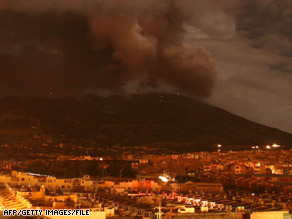
The Galeras volcano is shown on January 17, 2008, from Pasto, Colombia.
A volcano near southwest Colombia’s border with Ecuador erupted on Saturday, leading the government to issue a "red alert" for the region.

There were not believed to be any fatalities or injuries in the blast, which happened at about 7:10 p.m. ET (12:10 a.m. Sunday GMT), said Carlos Lineras of the Colombia Institute for Geology and Mines. The institute issued an evacuation order for about 7,000 people living near the Galeras volcano. The volcano is not in a heavily populated region. Galeras has erupted several times since it became active again in 1989. The only fatalities were in 1993, when nine people — all scientists or tourists in or near the volcano’s crater — were killed.

War of words between Israel and Turkey sparks formal complaint

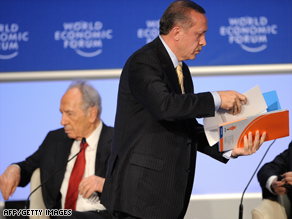
Recep Tayyip Erdogan leaves the stage at a conference last month as Shimon Peres sits, left.
Turkey’s Foreign Ministry summoned Israel’s ambassador to the Turkish capital of Ankara on Saturday to issue a formal complaint over a top Israeli commander’s reported remarks criticizing Turkey.

The complaint is part of the escalating war of words between the two regional allies, stemming from Turkey’s outspoken criticism of the recent conflict in Gaza. The Turkish Foreign Ministry said Saturday that it had requested an “urgent explanation” from Ambassador Gabby Levy for recent remarks reportedly made by a top Israeli military commander. According to the Israeli newspaper Ha’aretz, Maj. Gen. Avi Mizrahi told an international conference that Turkish Prime Minister Recep Tayyip Erdogan should “look in the mirror” before criticizing Israel. Mizrahi pointed to Turkey’s treatment of its long-oppressed Kurdish minority and the ongoing Turkish military occupation in northern Cyprus, Ha’aretz reported. And, in a separate statement issued Saturday, the Turkish military called the Israeli general’s comments “unacceptable,” adding, “We expect the Israeli General Staff, which we think gives importance to relations with the Turkish Armed Forces, to clarify the issue.”

Don’t Miss
Peres, Erdogan in ‘amicable talks’ after Davos spat

Zakaria: Clash reveals passions

Turkish PM cheered after Davos walkout

Hamas: Gaza truce agreement near

Tensions have increased between Turkey and Israel since last month, when Erdogan stormed off stage at a conference in Davos, Switzerland. Erdogan objected to Israeli Prime Minister Shimon Peres’ passionate defense of Israel’s 22-day military operation in Gaza, which left more than 1,300 Palestinians dead. Thirteen Israelis, including 10 soldiers, were killed. For the past decade, Turkey and Israel have enjoyed close military and economic ties. The Israeli military often conducts exercises around the Turkish city of Konya. Israeli tourists flock to Turkey’s Mediterranean Sea resorts, and bilateral trade has increased dramatically since Erdogan’s ruling AK Party first won national elections in 2002. As a result, audience members were shocked last month when Erdogan lost his temper while participating in a panel discussion of the recent Gaza conflict in Davos. Before storming off stage, Erdogan told the Israeli president, “When it comes to killing, you know killing very well. I know how you hit, kill children on the beaches.” Erdogan has been unapologetic about his outburst. While campaigning for municipal elections to be held in Turkey next month, the prime minister told reporters that the results of Israel’s recent elections “painted a very dark picture” for the future of the region, Reuters reported.

5 high-ranking Kurds leave Iraqi president’s party

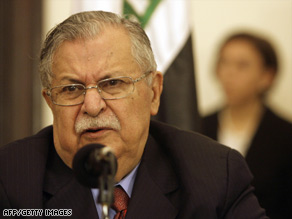
Iraqi President Jalal Talabani could be jeopardized by the resignations of five key members of his party.
The second-highest ranking official in Iraqi President Jalal Talabani’s political party resigned Saturday, along with four other high-ranking Kurdish politicians, officials said.

Khosrat Rasul, the vice president of the Kurdistan Regional Government, resigned, along with four other members of the Patriotic Union of Kurdistan (PUK), according to Kurdish lawmakers. Rasul is a battle-scarred veteran of Kurdish rebellions against former Iraqi President Saddam Hussein. Kurdish members of the Iraqi Parliament say the resignations threaten the delicate balance of power in Iraqi Kurdistan, a semi-autonomous region in northern Iraq. It has been the most stable part of the country since the 2003 U.S.-led invasion.

Don’t Miss
38, mostly women and children, killed in Iraq bombing

Sectarian violence continues in Iraq

“It looks very serious,” said Ala Talabani, the president’s niece and a PUK member, as well as a member of Parliament. She spoke by phone from the Iraqi Kurdish city of Sulaimaniya, long a stronghold of the PUK. “It’s about corruption,” Ala Talabani said of the resignations. “They are asking about the resources and the money. Who is spending it. And who is in charge of the income of the party.” “It’s not good,” said Mahmoud Othman, a member of the Iraqi Parliament and an independent Kurdish politician. “The PUK is one of the main two [Kurdish] players,” he added. “A problem like this will upset the whole situation.” Iraqi Kurdistan broke free from Baghdad’s control after the 1991 Gulf War. Since then, the region has been divided between two rival Kurdish factions, Talabani’s PUK and the Kurdistan Democratic Party, led by Massoud Barzani. For several years throughout the 1990s, the groups battled each other in the mountains and valleys of northern Iraq. Those historic divisions faded somewhat following the United States’ overthrow of Hussein. For the past five years, the Kurds have worked together in Baghdad to enhance the Kurdish region’s position in Iraq. Kurdish politicians deftly took advantage of divisions between Sunni and Shi’a Arab factions. They successfully lobbied to maintain Kurdistan’s militia of pesh merga fighters. Demands to expand the Kurdish zone of control and win the right to exploit oil deposits in Kurdish territory have increased tensions between Kurdish and Arab politicians. The resignation of Rasul and his allies threatens the power base of Talabani, the first Kurdish president in Iraqi history. “If it is not fixed by Talabani by tomorrow, this could change the entire landscape of Kurdish politics,” said Hiwa Osman, the Iraq country director of the Institute for War and Peace Reporting. Iraq’s three northern Kurdish provinces are scheduled to hold regional elections in May. Talabani is expected to travel to Kurdistan to hold emergency meetings with Rasul and his other former comrades-in-arms. This is not the first time the stout Kurdish leader has faced a rebellion from within the ranks of his followers. Kurdish observers say these disputes usually stem from disagreements over money and power.

U.S.: Financial crisis spread to emerging markets

Geithner: A common recognition exists among nations to restart credit markets.
Making his international debut at the Group of Seven meetings in Rome, new U.S. Treasury Secretary Timothy Geithner said swift and decisive action is needed on several levels to address the global financial crisis.

“Although this crisis began in the major economies, it’s now spread to emerging markets around the world,” Geithner said. Governments and central banks are already acting to support economic growth, he said. “These actions must be forceful and sustained until recovery is firmly established.” He called on governments to focus on stabilizing and strengthening financial systems and help restart the flow of credit. “Although the precise mix of measures must be tailored to each country’s situation — our financial systems are different, (the) structures of our systems are very different — there is a common recognition of more capital and government financing to help restart credit markets,” he said. The G7 summit brings finance ministers from the world’s leading industrialized nations together. The ministers were holding their second and last day of meetings Saturday with an agenda squarely focused on the world financial crisis. Italy is hosting the meeting of the Group of Seven in its role as G-7 president for 2009. G-7 members are the United States, Germany, Japan, France, Italy, Britain, and Canada. The agenda drawn up by Rome calls for adopting global measures and economic policy reforms capable of stabilizing the world economy and ensuring transparency to allow markets to function correctly, according to the Italian news agency ANSA. Italy will also call on countries to to avoid resorting to protectionist measures to placate domestic demands, ANSA reported. Geithner spoke just after the U.S. Senate gave final approval to a $787 billion recovery package to boost the U.S. economy. He told attendees that the package “provides a very powerful mix of investments and tax cuts to create jobs and to strengthen our long-term growth potential.” “As we act together to build a strong foundation for economic growth and recovery, we need to begin the process of comprehensive reform of our financial system, so that we never again face a crisis of this severity,” Geithner said. Another attendee, International Monetary Fund head Dominique Strauss-Kahn, said this week that he supports such stimulus packages for advanced countries. “The question is no more to convince the governments to move today, but for them to implement the policies they need to manage,” Strauss-Kahn said.

He also warned of the dangers of protectionism, which he said may still come “through the back door, especially in the financial sector.” Other G-7 attendees include Angel Gurria, secretary-general of the Organization for Economic Cooperation and Development, and central bank governors.

Stimulus amendment puts tough limits on executive pay

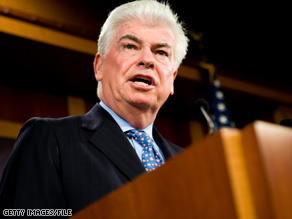
Sen. Chris Dodd's amendment will affect more executives than previously anticipated, financial analysts say.
An amendment in the $787 billion economic stimulus package passed by Congress Friday would severely restrict bonuses and other forms of compensation for top executives at companies receiving federal bailout money.

The amendment by Sen. Chris Dodd, chairman of the Senate Committee on Banking, Housing and Urban Affairs, would impose wide-ranging restrictions on how — and by how much — top executives at companies receiving federal bailout money can be compensated. The measure would cap bonuses — already often far more lucrative than base salaries for top executives — and could require executives at companies that have already received bailout money to pay back some of their compensation if it exceeded certain limits. Dodd, a Democrat from Connecticut, said the amendment was aimed at imposing “tough new limits on huge bonuses” for executives at firms receiving money from the government’s Troubled Asset Relief Program, or TARP. “The decisions of certain Wall Street executives to enrich themselves at the expense of taxpayers have seriously undermined public confidence in efforts to stabilize the economy. American taxpayers deserve better,” Dodd said. But some financial industry advisers and analysts said Saturday that the amendment was far tougher than what even President Barack Obama and Treasury Secretary Timothy Geithner proposed recently, particularly in the number of high-paid executives and employees it would affect.

Don’t Miss
Stimulus package en route to Obama’s desk

CNN/Money: How stimulus may affect your wallet

Stimulus bill: Part one

Stimulus bill: Part two

It will be up to the Treasury Department to implement the restrictions in Dodd’s amendment if the stimulus package, which is awaiting Obama’s approval, becomes law. Among the many provisions of Dodd’s measure: • Firms taking more than $500 million from TARP would be required to restrict compensation paid to the 20 top-earning employees and other key executives. For companies getting $250 million to $500 million from TARP, that includes senior executives and the top 10 earning employees. The number of affected employees would go down from there for companies taking less than $250 million from TARP. • Severance payments known as “golden parachutes” for senior executive officers or the next five most highly compensated employees would be banned at companies receiving TARP funds, ending those often sizeable severance payments for departing executives. • Top executives at TARP-funded firms would be barred from receiving bonuses exceeding one-third of their annual salary. For many top executives, that would mean a dramatic reduction. The Wall Street Journal cited as an example the 2007 compensation of Bank of America Corp. CEO Kenneth D. Lewis, who was paid a salary of $1.5 million that year, but actually earned a total of $16.4 million including a bonus, stock-option awards and restricted stock. At the same salary level, Lewis’ 2009 compensation would be restricted to about $2.25 million under the Dodd provisions, the Journal said. • The secretary of the Treasury must review past compensation paid to the top 25 employees of TARP recipients and seek reimbursements “if those payments were contrary to the public interest or inconsistent with the purposes of the [stimulus package] or the TARP,” according to Dodd’s statement. The restrictions could have unintended consequences, some financial industry insiders said Saturday. “Basically, this is encouraging the sales force — the lifeblood of any company — to look for work elsewhere, to leave [TARP-backed companies] for healthier companies where they can make more money,” said Scott Talbott, senior vice president of government affairs for the Washington-based Financial Services Roundtable, a trade association representing 100 of the largest financial firms in the country. “If the goal of TARP is to make companies stronger, to get them back on their feet so they can stand on their own, and this drives away key executives, this is a problem,” he told CNN in a telephone interview. Talbott also posed the question of what would happen on the Dodd amendment’s sliding scale of restricted compensation at large firms when the top 20 earning employees are restricted and move down in income as a result. “They are no longer that company’s top 20 earners, others in the company now become the top 20. Are those 20 (then) under the compensation restrictions” he asked. Jim Reda, a New York-based compensation and corporate governance consultant, said TARP-funded firms could face a dilemma if the Dodd restrictions are imposed: either lose key executives to other companies or pay back the TARP money immediately and possibly jeopardize the company’s capital position. “It’s not good for taxpayers to have [TARP] money in organizations where the executives are leaving or the company is weakened,” Reda told CNN. “My suspicion is that there are a lot of loopholes in this, ” Reda said. “What it accomplishes is that it really confuses everybody.” There are questions about how the restrictions would apply retroactively to companies that already have received TARP money, Reda said, and questions about how Dodd’s restrictions fit with looser restrictions on executive compensation proposed by Obama and Geithner. Presumably, Dodd’s amendment “overrides” Obama and Geithner, Reda said. “That’s extremely confusing.”

Recovering bodies from plane crash may take days, NTSB says

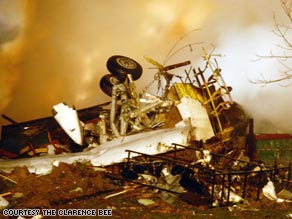
Only a few pieces of the Continental Connection Dash 8 turboprop were recognizable after the crash.
Recovering all the bodies from Thursday’s deadly passenger plane crash may take four days as investigators work through freezing temperatures and piles of wreckage, a federal transportation official said Saturday.

“The medical examiner believes that three to four days are going to be required to recover the victims of this crash, and they’re in the process of doing that,” Steve Chealander of the National Transportation Safety Board said. “They’ve already pulled some of the folks out of there, but they’ve got a long way to go.” All 49 passengers aboard Continental Connection Flight 3407 died when the 74-seat Bombardier Dash 8 Q400 turboprop crashed into a home in Clarence Center, New York, on Thursday night. A 61-year-old man in the house died also, but his wife and daughter survived. Despite reports from local authorities who said the plane hurtled toward the house from a sharp nosedive, Chealander said the current orientation of the plane indicates that it fell flat on its belly. The Continental flight from Newark, New Jersey, operated by Colgan Air, crashed about 10:17 p.m. Thursday northeast of Buffalo Niagara International Airport. Follow the plane’s path » Chealander said the recovery effort and the investigation have been hampered by freezing temperatures as authorities try to sift through the wreckage of the flight and the home it struck. Some parts of the plane have fallen as deep as the basement, he said. “Keep in mind, there’s an airplane that fell on top of a house,” he told reporters. “The house and the airplane are together.” Authorities said it would probably take weeks to identify remains of the victims, with DNA testing required in many cases because of the intensity of the crash and subsequent fire. A 2-square-mile area around the crash site, about 6 miles from the Buffalo airport where the plane was headed, remained sealed off Saturday as investigators sought to determine the cause of the crash. But the extent of the restricted area belied the concentrated force of the impact into the one house. Watch what investigators are saying »

Airline information
Continental Airlines’ statements

Relatives helpline: 800-621-3263 

Karen Wielinski was watching television inside the house when she heard a plane making an unusually loud noise. “I thought to myself, ‘If that’s a plane, it’s going to hit something,’ ” she told Buffalo radio station WBEN. “And next thing I knew, the ceiling was on me,” she said. Wielinski and her daughter Jill, 22, were in the front of the home, and they escaped the house with minor injuries. Wielinski’s husband, Doug, who was in the dining room, was killed. On Friday, federal investigators released information from the plane’s cockpit voice and flight data recorders, indicating that icing may have been a major factor in the crash.

Don’t Miss
Witnesses saw, heard plane go down

Crash victims include rights campaigner, beloved cantor

Would-be passengers feel relief, sadness

Mom, daughter escape after plane crashes into home

The plane’s pilot and co-pilot discussed “significant ice buildup” on the plane’s windshield and wings as it descended toward the Buffalo airport. The plane underwent “severe” pitching and rolling motions after the landing gear was lowered and wing flaps were set for the approach, Chealander said. There was a mix of sleet and snow in the area, but other planes landed safely at the airport about the time the flight went down. Chealander said the flight crew reported that visibility was about 3 miles and there was snow and mist as they descended. The voice and data recorders indicated that the plane’s internal de-icing was on during the landing approach, he said. “A significant ice buildup is an aerodynamic impediment,” he added. Find out why » Keith Burtis was driving about a mile from the crash site when he heard the impact. “It was a high-pitched sound,” Burtis said. “It felt like a mini-earthquake.” A ball of fire filled the night sky as the jet fuel erupted, Burtis said, and he saw a steady stream of firetrucks rush by as smoke billowed. At least nine volunteer fire departments responded. Watch iReporters’ close-up accounts » Among the passengers killed was Beverly Eckert, widow of a September 11 attack victim. Also aboard was Alison Des Forges, senior Africa adviser for Human Rights Watch, one of her colleagues said. Des Forges spent four years in Rwanda documenting the 1994 genocide and had testified about the atrocity and the situation in central Africa to Congress and the United Nations, according to the organization. Read more about the victims Also on the flight was Susan Wehle, a cantor at Temple Beth Am in Williamsville, outside Buffalo, a synagogue official said. Colgan Air identified the crew as Capt. Marvin Renslow, the pilot; First Officer Rebecca Shaw, who was co-pilot; and flight attendants Matilda Quintero and Donna Prisco. In addition, an off-duty crew member, Capt. Joseph Zuffoletto, was onboard. “This is easily the saddest day in the history of our airline,” said Philip Trenary, the company’s CEO.

Burris: Blagojevich’s brother asked me to help raise funds

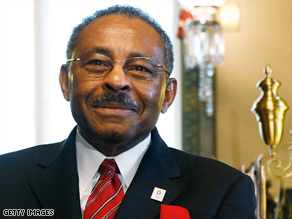
Roland Burris told reporters in January that his appointment has nothing to do with money.
Democratic former Illinois Gov. Rod Blagojevich’s brother asked Roland Burris to contribute or help raise up to $10,000 in campaign cash before Burris was named a U.S. senator on December 30, according to a Burris spokesman.

Also, in an affidavit written by Burris and obtained by CNN, Burris said Blagojevich’s brother Rob called him after the November elections to ask him to raise funds. The affidavit did not specify a dollar amount. Burris said he refused to contribute to Blagojevich or to assist in fundraising for him. Blagojevich’s appointment of Burris was hotly disputed, as Blagojevich is facing corruption charges. Prosecutors accuse him of attempting to sell the Senate seat, vacated by President Obama upon his election, to the highest bidder. He was ousted from office last month by Illinois lawmakers. Attempts by CNN to contact Rob Blagojveich and representatives of the former governor regarding the allegation, first reported by the Chicago Sun-Times, were not immediately successful Saturday. A woman answering the telephone at Rob Blagojevich’s home told CNN he was not available and hung up. Rob Blagojevich’s attorney, Michael Ettinger, told the Sun-Times that Blagojevich had spoken with Burris about a fundraiser but “didn’t know [Burris] was in the running for the U.S. Senate seat.” In his January 8 testimony before an Illinois House impeachment panel, Burris, the former Illinois attorney general, said he had no conversations with Blagojevich before the then-governor’s arrest about his desire to be appointed to the seat. Learn more about the Blagojevich investigation » Burris said in a written affidavit given to the panel that he had only one limited exchange with the governor regarding the seat, at the initiation of a Blagojevich attorney.

Don’t Miss
Burris denies any quid pro quo for Senate appointment

Burris says he’s honored to be seated in the Senate

Burris also said that he was not aware of any “quid pro quo” with the former governor. “I can for this committee state that there was no legal, personal or political exchange for my seat,” he said. But in a statement released Friday to the Sun-Times along with the affidavit filed February 5, Burris said, “There were several facts that I was not given the opportunity to make during my testimony to the impeachment committee, so, upon receiving the transcripts, I voluntarily submitted an affidavit so everything was transparent.” In the affidavit, Burris said he recalled that Rob Blagojevich called him three times — in October and then twice shortly after the November elections — to “seek my assistance in fundraising for Gov. Blagojevich.” Burris said that in one of the conversations, he believes the last one, “I mentioned the Senate seat in the context of saying that I could not contribute to Gov. Blagojevich because it could be viewed as an attempt to curry favor with him regarding his decision to appoint a successor to President Obama.” The affidavit does not directly state that Rob Blagojevich solicited funds or give a dollar amount. However, Burris spokesman Jason Erkes sasid Saturday that the governor’s brother asked Burris to contribute or help raise up to $10,000 for Blagojevich. “I was asked to raise money by the governor’s brother and made it unequivocally clear to him that it would be inappropriate and pose a major conflict because I was interested in the Senate vacancy,” the statement said. “I did not donate or help raise a single dollar for the governor from those conversations and would never consider making a donation through a third party.” Burris said in the affidavit that he did not raise or donate any funds for the governor after a June fundraiser. Asked by the impeachment panel whom he had talked to about the Senate seat, Burris said he had spoken with Blagojevich’s former chief of staff, Lon Monk, but did not get a chance to mention anyone else. “I wish to supplement my answer with other events that I have been able to recall to make certain the record is complete,” he said in the affidavit He mentions conversations with three other people regarding the seat: John Harris, Doug Scofield and John Wyma. The three are identified as “Blagojevich insiders” by the Sun-Times. Burris said, however, that his conversations with Rob Blagojevich came after talks with those people. Burris told the Sun-Times that he sent the new statement to Illinois House Majority Leader Barbara Flynn Currie. Currie initially told the newspaper that she was unfamiliar with the contents of Burris’ letter. After being read his account of the Rob Blagojevich phone calls, Currie, a Democrat, told the Sun-Times, “Very odd. I don’t know there is anything actionable here, but I would like to check the record.” Illinois Senate Minority Leader Christine Radogno, however, told the newspaper that Burris’ new account contains detail that he should have disclosed to the impeachment panel, as well as to U.S. Senate Majority Leader Harry Reid, D-Nevada, before he was seated. “If it turns out this was some sort of attempt to avoid this coming out as part of the appointment process, then he doesn’t deserve to be senator,” Radogno, a Republican, told the Sun-Times. “I think the whole thing stinks to high heaven.” Burris was sworn in January 15 after an extended political battle regarding his seat.

The Senate initially refused to seat him, citing a 125-year-old Senate rule requiring the secretary of state’s signature to certify an appointment. Illinois Secretary of State Jessie White had refused to sign the appointment certificate because of the controversy surrounding Blagojevich. But the Illinois Supreme Court ruled that White’s signature was not necessary for the appointment to be valid.

Queen Elizabeth’s New Web Page

Queen Elizabeths New Web Page

And it came to pass that Her Majesty the Queen of England decided her website needed a little juice-up. Thus, on the 13th day of February in the Year of our Lord 2009, she stood before her subjects and held aloft the royal remote control and behold, there appeared on a screen behind her what nobles and seers would come to call QE2.0, the new and improved official website of the British Monarchy.

No bottles of champagne were broken over laptops, but the man many credit with founding the internet, Tim Berners Lee, was present at the launch, which is not bad considering it’s mostly a glorified Facebook page. Why does Her Maj even need a website She doesn’t. As she explains on one of the crackling vintage radio addresses available on the royal YouTube channel, the point of being queen is to serve. It’s we regular folk who need the website. In her munificence, she provides it.

The new site has some pretty useful updates, including a calendar-map feature that shows what parts of England the queen and other members of the Royal family are scheduled to visit. There’s an interactive menu: if you live in Merseyside and would like to see Prince William in the next couple of months, you can find out if he’ll be in the neighborhood.

There are individual pages for all of Queen Liz’s children and grandchildren and several of her more distant rellies, yes, including Diana. The 10th most frequently asked question on the site is about the names of the Queen’s corgis . Less asked about are the Dorgis, a cross-breed of Dachshunds and Corgis . There’s a 700-word answer to the question about what the royal family’s surname is

As well as your regular down-home royals news, the site contains of lots of handy advice, such as what you might say to a member of the Worshipful Company of Vintners if you’re invited to watch the annual Swan Upping. And if you’re looking for decorating tips for a larger than average residence, you can take an interactive tour of several ceremonial rooms to see what might be whipped up with a lot of gilt, royal portraits and semi-naked statues. Or you can find out how to contact the queen: Snail, er Royal, Mail only, it turns out. HRH emails her grandchildren, but her email address is not public. And she’s not exactly a Twitterer.

Mostly the site gives you an idea of what the royals do day to day, which appears to be meeting a lot of people with whom they have nothing in common and trying to find something to talk about, sometimes with excruciating results. Perhaps that’s its true purpose. If it can puncture even one little girl’s dream of being a princess, it’s done us all a service.

Watch a TIME video on the annual Swan Upping.