Murray defeats injury-hit Nadal in final

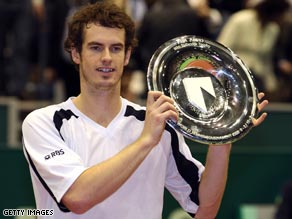
Murray took advantage of Rafael Nadal's injury to collect his 10th career title in Rotterdam.
Second seed Andy Murray collected his 10th career title after defeating world number one Rafael Nadal, who was hampered by a knee injury, 6-3 4-6 6-0 in the final of the ABN AMRO tournament in Rotterdam on Sunday.

World number four Murray was himself carrying an ankle injury he picked up during his quarterfinal win over Marc Gicquel, but showed little signs of early discomfort as he raced around the court before burying two forehands to take his first service game. Nadal held before spurning his first break point to allow Murray to take a 2-1 lead and the match stayed with serve as Murray let a 0-30 lead slip to lose the fourth before he thundered an ace down on the way to take a 3-2 lead despite his second double fault of the game. A series of unforced errors from the Spaniard gave the Scot two break points and he seized the opportunity at the second attempt when Nadal sent a forehand long to give Murray a 4-2 lead. Murray held before Nadal found top gear to win the eighth to love but a composed Murray showed no nerves as he clinched the first set by holding his service game to love. The 21-year-old Murray carried his momentum into the second set by keeping Nadal pinned to the baseline but the Spaniard was equal to Murray’s efforts and held his first service game. Pinpoint-serving allowed Murray to level before the Briton took the third game to deuce thanks to an incredible pass after a powerful Nadal smash at the net.

Don’t Miss
Nadal faces Murray in final

However, the Spaniard responded in clinical fashion to take a 2-1 lead before receiving treatment to his right thigh. The interval seemed to affect Murray’s concentration as he ploughed a simple forehand into the net to allow Nadal to break. Both players then failed to hold serve for the remaining six games of the set before Nadal clinched the second set 6-4 when Murray hit a backhand long. Murray broke Nadal’s first game in the third to love before holding to take a 2-0 lead. Nadal’s right knee seemed to be causing him problems and he double-faulted on the way to allowing Murray to break again to give the Scot a commanding lead. He won the next two games with ease before breezing past the despondent Nadal with an ace in the sixth to pick up his second title of the year. Murray was happy to have defeated the world number one for the second time this year, but admitted he would have liked to have beaten a fully-fit Nadal. “It is a shame for him after he injured his knee at the start of the second set. The play was up to a good standard in the first set,” Murray told Sky Sports. “I’m happy to win but I would have preferred it if he wasn’t hurt. I have started well this year. I would have liked to have done better in the Australian Open but I got better here as the week went on and I’ll try and keep it going now.” Meanwhile, fourth seed Radek Stepanek rallied to beat top seed and defending champion Andy Roddick 3-6 7-6 6-4 in the San Jose semifinals. The Czech will now face fifth seed Mardy Fish, who beat James Blake 6-3 6-2 after his fellow-American was hampered by an ankle injury.

The best way to measure body fat

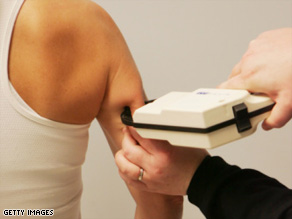
Skin-fold tests, which measure skin thickness with calipers, can be inaccurate.
If your pants feel tighter than usual, you might begin to suspect that you’ve gained a couple of pounds. But at what point should you begin to worry that the weight gain is serious? Could you be one of the approximately two-thirds of American adults who are either overweight or obese, with an increased risk for conditions like diabetes and heart disease? While no single measurement is perfect, here are a few ways to size yourself up.

Step on the scale Upside: Easy and handy. In a 2007 study published in the journal Obesity, researchers found that dieters who regularly and frequently weighed themselves appeared more likely to keep the weight off over time. Buying a scale for your bathroom to keep track of weight won’t break the bank, and your gym probably has one in the locker room. Downside: You know how you can be skinny but out of shape Or heavy and fit Body weight doesn’t take into account the proportion of fat in the body, or where that fat is deposited — factors that can point to health trouble. Also, experts say dieters often make the mistake of fixating on the number between their toes instead of focusing on changing the behavior that can improve it. iReport.com: Have you made a health-changing resolution Tell us Body mass index (BMI) Upside: Your BMI provides a lot more information than your bathroom scale, specifically a measure of body fat. “Fat is more important than weight,” says Peter Katzmarzyk, associate executive director for population science at the Pennington Biomedical Research Center in Baton Rouge, Louisiana. “Excessive fatness is the definition of obesity, not excessive weight — and having too much fat can cause serious health problems.” This calculation uses a ratio of weight to height to estimate body fat and obesity. Find your BMI » A BMI of less than 18.5 is underweight. A BMI of 18.5–24.9 is normal. A BMI of 25–29.9 is overweight. A BMI of 30 or higher is obese. Downside: Since the BMI tool cannot distinguish between lean muscle mass and body fat, it has a tendency to overestimate the level of body fat in people who have a lot of muscle — say, Arnold Schwarzenegger — and underestimate the amount of body fat in people who have lost muscle mass, such as the elderly.

Don’t Miss
Five small changes to help you lose weight

Necessity vs. luxury: What makes resolutions stick

“If you are an Olympic body builder, it doesn’t hold up so well,” says Miriam Nelson, Ph.D., director of the John Hancock Center for Physical Activity and Nutrition at Tufts University’s Friedman School of Nutrition Science and Policy, in Boston, Massachusetts. Nelson notes that BMI still works well for the general population and estimates that it gives an inaccurate assessment in only one to three percent of people, despite its limitations. And if you’re looking to compare your BMI with other dieters, think again. Pretty much anyone can rattle off his weight, but only 20 percent of the population knows their BMI, suggests a National Consumers League survey conducted by Harris Interactive last year. Health.com: Six diet trend you should never try Waist circumference Upside: Simple and predictive. This measure — an indicator of abdominal obesity, which is an important predictor of risk for developing obesity-associated cardiovascular disease — can be conducted at home by wrapping a tape measure snugly around the abdomen slightly above the hipbone, level with the navel. “It helps reduce even the small number of mistakes that might be made with BMI,” says Steven R. Smith, M.D., assistant executive director of clinical research at the Pennington Center. In fact, waist circumference may be even more important than BMI. There is a greater risk of developing conditions like type 2 diabetes and heart disease if a person carries excess fat — also known as visceral fat — around his abdomen. Fat located deep in the abdomen around the internal organs may be more dangerous than subcutaneous fat, which is located just under the skin, and peripheral fat found in places like the hips and thighs. Health.com: Lost weight Here’s how to keep it off Therefore, regardless of height, a person is considered to be at an increased risk of developing an obesity-related disease if his waist circumference is greater than 40 inches or 35 inches, in men and women, respectively. Downside: Unless you’re a supermodel, you’re probably not in the habit of measuring your waist. In a 2008 study published in the Journal of Women’s Health, one in 10 women who underwent various cardiovascular health screenings didn’t have their waists measured. Some of the women simply may have refused, suggests senior author Erin D. Michos, M.D., an assistant professor of medicine in the division of cardiology at Johns Hopkins University School of Medicine in Baltimore, Maryland. And busy doctors may resort to the scale rather than take the time to use a tape measure correctly, Michos says. She urges dieters to do the measurement themselves at home. Health.com: Weight-loss success story: Together we lost over 200 pounds Additionally, Dr. Michos points out, measuring waist circumference may provide a more vivid indication of weight-loss progress. “When someone starts to exercise, they might increase muscle mass as well, and therefore might be frustrated not to see too much change on the scale in terms of total weight,” she says. Conversely, if a tape measure reveals a decrease in waist circumference, you can see the benefit and know you’re improving your health, which can also motivate you to continue an exercise and diet plan. DEXA scans Upside: Superaccurate. This low-radiation, full-body X-ray, typically used to screen for osteoporosis, computes body composition and the percentage of fat in the body by measuring fat mass, lean mass, and bone mass. “They are the gold standard,” says David Freedman, Ph.D., an epidemiologist in the Division of Nutrition, Physical Activity, and Obesity at the Centers for Disease Control and Prevention in Atlanta, Georgia. Downside: Cost. Unfortunately, if not covered by insurance, a DEXA scan could end up costing you a couple hundred dollars, an expense that isn’t necessary, according to Nelson.

Health Library
MayoClinic.com: Weight loss — 6 strategies for success

MayoClinic.com: Weightloss (Obesity)

Other body fat measurements Upside: Your wallet won’t take such a hit from other more economical approaches. Bioelectrical impedance analysis (BIA), which can sometimes be found at health clubs and involves attaching electrodes to the hands and feet or standing on electrode pads, sends a small electric signal through the body to compute the composition of body fat and muscle mass. Some physicians and health clubs also use so-called skin-fold tests, which use calipers or pinchers to measure the thickness of folds of skins at different parts of the body. Downside: These measurements are cheaper, yes, but they are also less reliable than a DEXA scan. The BIA is heavily influenced by hydration levels and thus, can be imprecise; depending on the technician, a skin-fold test can be inaccurate too. Health.com: How foods rich in water can help you lose weight Bottom line BMI and waist circumference, along with an evaluation of your personal risk factors such as high blood pressure, cholesterol levels, and family history for heart disease, should give you a good idea about whether you need to lose weight. If you find that you have a BMI greater than 25 and a high-risk waist circumference, you should discuss your risks and options with a physician.

Are top female tennis players overpaid?

Australian Open champion Serena Williams pocketed $1.3 million for the tournament, the same as male winner Rafael Nadal.
The polite hush that descends on the crowd seconds before service is nowhere to be heard when it comes to the issue of equal prize money in women’s tennis.

It may be two years since Wimbledon and the French Open joined the other major tournaments in offering women the same cash prize as men, but for some tennis fans the issue is far from resolved. “Admit it sisters,” screamed one recent headline on Australian Web site AdelaideNow, “this is not equal.” The author went on: “Political correctness, sexual equality and feminism all prevent many commentators from stating the bleeding obvious … no sports watcher in their right minds could honestly say female tennis players, or golfers for that matter, deserve as much money as their male counterparts.” The writer — a woman — went on to lambaste the world’s best female tennis players, describing world number one Serena Williams’ defeat of Dinara Safina in the Australian Open final as “embarrassing, pitiful and pathetic.” “Her humiliation of Dinara Safina was a terrible advertisement for a sport that has apparently disappeared up its own backside.” Rather than provoking a tirade of abuse, many readers agreed with the author, outspoken Australian journalist and sports commentator, Rebecca Wilson. “Right on the money. Women’s tennis is boring. Typical game. “Ugh. Grunt. Ugh. Grunt. Ugh. Grunt. Out. Love-Fifteen,” one said. Another added: “It’s about time someone said what everyone was thinking.” More chimed in: “Everyone agrees, few will say it” and “totally agree. Women’s tennis is pathetic.” A couple of dissenters in the crowd urged Wilson to turn her attentions elsewhere: “The usual tripe that Wilson dishes up week after week,” and “please go away and let someone with something important to say use your space.” What do you think Do women deserve equal prize money in tennis Sound Off below.

Don’t Miss
Serena thrashes Safina to claim Aussie crown

Nadal beats Federer to win Australian Open

News: Sport

Billie Jean King has heard it all before. The former world number one has spent a good part of the last forty years campaigning for equal prize money, and equal status, for women. The decision by the All England Tennis and Croquet Club in February 2007, and then the French Open one day later, to award equal prize money to women marked the end of a fight that started in 1968, the first year of Open tennis. “When Rod Laver won Wimbledon, he got £2,000. And when I won Wimbledon in the same year, 1968, I got £750,” she told CNN in an interview filmed for this month’s edition of “Revealed.” “I knew then that was going to be one of our next battles that we would have to fight over the years,” she added. King hoped to put the matter to rest in 1973 when she took on self-proclaimed male chauvinist Bobby Riggs in now famous match known as “The Battle of the Sexes.” Riggs, a former men’s number one, claimed the women’s game was so poor that even he, as a 55-year-old retiree from the sport, could beat the top female players. King accepted the challenge and thrashed Riggs 6-4, 6-3, 6-3 in front of a television audience of millions. Those who argue for lower pay for women’s tennis say they play fewer sets and attract a smaller television audience so they should receive less money. Campaigners for equal pay say that it’s not an issue of time on the court, but an matter of fair and equal treatment As current world number six Venus Williams once argued in an open letter published in The Times, “we enjoy huge and equal celebrity and are paid for the value we deliver to broadcasters and spectators, not the amount of time we spend on the stage.” What do you think Should the top female tennis players be taking home the same prize money as men Sound Off below. Revealed: Venus Williams airs on CNNI at on the dates and times below: ALL TIMES GMT Wednesday, February 18: 0930, 1830 Saturday, February 21: 0830, 1900 Sunday, February 22: 0530, 1830 Monday, February 23: 0400

Taliban announce ‘cease-fire’ in Pakistani valley

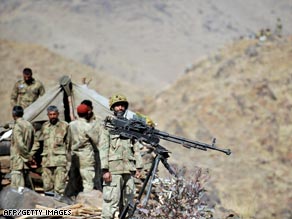
The Taliban says it has agreed a 10-day cease-fire with Pakistani forces in the Swat Valley.
Taliban spokesman Muslim Khan announced a 10-day cease-fire on Sunday in Pakistan’s Swat Valley, a volatile region in North West Frontier Province that is largely controlled by the Taliban.

The Taliban are holding talks with the North West Frontier Province’s government in the town of Timagera in the province’s Lower Dir district, he said. Taliban leader Sufi Mohammad is heading negotiations for the militants. There was no immediate confirmation of the cease-fire from the Pakistani government. Swat Valley was once Pakistan’s biggest tourist destination until it was overrun by militants led by radical cleric Maulana Fazlullah. The valley boasted the country’s only ski resort and was once a draw for trout-fishing enthusiasts. It is believed to be the deepest advance by militants into Pakistan’s settled areas — meaning areas outside its tribal region along the border with Afghanistan. The negotiations are the latest attempt by Pakistan’s civilian government — which took power last year — to achieve peace through diplomacy in areas where Taliban and al Qaeda leaders are believed to have free rein.

Don’t Miss
Children killed in Afghan firefight

Last May, Pakistan’s government announced it reached a peace deal with militants in Swat Valley, but that did little to quell the bloody fighting between Pakistani forces and militants there. Swat has been overrun by forces loyal to Maulana Fazlullah’s banned hardline Islamic group, Tehreek Nifaz-e-Shariat Mohammadi (TNSM) which has allied itself with Taliban fighters. TNSM was once led by Sufi Mohammed, Fazlullah’s father-in-law who is leading the latest negotiations. Sufi Mohammed was released from jail last year by Pakistani authorities after he agreed to cooperate with the government. He had been jailed in 2002 after recruiting thousands of fighters to battle U.S. forces in Afghanistan. Fazlullah took over TNSM during Sufi Mohammed’s jail stint and vowed to continue his fight to impose fundamentalist Islamic law in the region.

The Ever Evolving Theories of Darwin

The Ever Evolving Theories of Darwin

What do Harry Potter, Sherlock Holmes, G.I. Joe and Charles Darwin have in common? They will all be coming to movie theaters this year. The only real person on that list will be played by Paul Bettany in the biopic Creation. And in true celebrity fashion, Darwin will be everywhere this year. In a convergence of anniversaries, Darwin would have turned 200 years old on Feb. 12, and his landmark book, On the Origin of Species, turns 150 on Nov. 24. There will be documentaries, lectures, conferences and museum exhibits. Darwin-themed blogs are being launched, and a cartload of Darwin-related books are being published. A replica of H.M.S. Beagle, the ship that carried Darwin around the world, will retrace his path. This January, Stanford University let a group of 90 people do likewise–albeit more comfortably, on a private Boeing 757.

It’s only fitting to recognize the accomplishments of a great biologist. But there’s a risk to all this Darwinmania: some people may come away with a fundamental misunderstanding about the science of evolution. Once Darwin mailed his manuscript of On the Origin of Species by Means of Natural Selection, or the Preservation of Favoured Races in the Struggle for Life to his publisher, the science of evolution did not grind to a halt. That would be a bit like saying medicine peaked when Louis Pasteur demonstrated that germs cause diseases. Today biologists are exploring evolution at a level of detail far beyond what Darwin could, and they’re discovering that evolution sometimes works in ways the celebrated naturalist never imagined. “The biological problems we’re dealing with are much more complex,” says Massimo Pigliucci, an evolutionary biologist at Stony Brook University in New York. “That said, it’s a lot of fun. I’m not complaining.” Darwin developed his theory by gathering as much information as he could about life. He collected it while voyaging on the Beagle, by sitting in front of a microscope back in England and by writing to a global network of correspondents. Today, however, biologists can feast on a far bigger banquet of data. The fossil record was scanty in Darwin’s day, but now it has pushed the evidence of life on Earth back to at least 3.4 billion years ago. And while Darwin recognized that variation and heredity were the twin engines that made evolution possible, he didn’t know what made them possible. It would take almost a century after the publication of On the Origin of Species for biologists to determine that the answer was DNA. DNA is like a genetic cookbook, using four molecular “letters” to spell out recipes for everything from hormones to heart valves. Biologists today are reading the 3.5 billion letters in the human genome as well as the DNA from thousands of other species, and they’ve amassed vast databases of genetic information that they can rummage through to learn about how life evolved. Time and again, biologists are finding that Darwin had it right: evolution is the best way to explain the patterns of nature. “You just can’t even start to make sense of all this data without a framework of evolution,” says Günter Wagner, an evolutionary biologist at Yale University.

Four dead in shooting spree in upstate New York counties

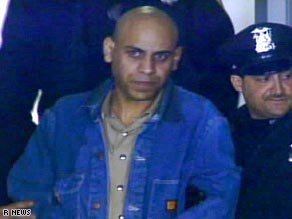
Former hospital worker Frank Garcia, 34, has been accused in the shooting rampage.
A former hospital worker systematically shot and killed four people in upstate New York on Saturday, authorities in two counties said.

Frank Garcia, 34, was arrested Saturday afternoon. Garcia knew all four victims, police said, but they didn’t reveal details about the relationships. “The individuals who were shot were known to the suspect. It was not necessarily a random act,” Monroe County Sheriff Patrick O’Flynn said. The first two victims — Mary Sillman, 23, and Randall Norman, 41 — were fatally shot before 5 a.m. at Lakeside Memorial Hospital in Brockport, where Garcia was once employed, O’Flynn said. Another woman was wounded and is undergoing treatment at a nearby hospital, he said. The second shooting happened at a house in nearby Ontario County on Saturday afternoon. Christopher Glatz, 45, and his wife, Kim, 38, were killed “execution-style” while their two teenagers were in the suburban Rochester home, Ontario County Sheriff Philip Povero said. The teens were not wounded, but it is unclear whether they witnessed the event.

Don’t Miss
R News: Four killed in rampage

Povero said neighbors reported Garcia went door-to-door looking for the Glatzes’ home. “He was in fact looking for the residence,” Povero said. “He was saying different things to different people, but he was clearly looking for that home.” Ballistic evidence has connected the two crime scenes, Povero said. Investigators found the matching brass cartridges from a pistol found on Garcia when he was arrested, he said. Garcia was arrested at a restaurant Saturday afternoon, CNN affiliate R-News in Rochester reported. Garcia was to be arraigned Saturday night in Monroe County, where the first shootings occurred, on two counts of first-degree murder and one count of attempted murder in the second degree, O’Flynn said. Sillman was a certified nursing assistant at Lakeside’s long-term care center, hospital officials said. “During Mary’s brief time within the system, those who worked closest with Mary described her as warm, kind and compassionate toward the residents of Lakeside Beikirch Care Center,” Lakeside interim CEO Michael Stapleton said in a statement. Garcia likely will face similar charges in Ontario County, Povero said. “This certainly speaks to a tragedy that is enormous, not only the taking of the lives that were taken, but the people that were left behind, the person in Brockport and the two teenage children who were present when their mother was systematically murdered,” Povero said.

Zimbabwe accuses new minister of terrorism

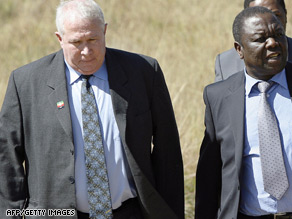
Roy Bennett, left, pictured with MDC leader Morgan Tzvangirai, is also the party's treasurer.
Roy Bennett, the former Zimbabwean opposition activist who was arrested Friday shortly before he was due to become a Cabinet minister, has been charged with conspiracy to commit banditry, sabotage and terrorism, his lawyer told CNN.

The Movement for Democratic Change nominated Bennett to be deputy minister of agriculture in a national unity government with President Robert Mugabe’s ZANU-PF party, which has ruled the country since independence in 1980. Bennett was arrested on Friday while on his way to South Africa, where he has been living for three years. Bennett, who is also the party’s treasurer, was pulled from an aircraft at the airport in Zimbabwe’s capital, Harare, the MDC said. Police accuse him of funding the acquisition of weapons to commit the crimes he is charged with. Bennett will appear in the Mutare magistrate’s court on Monday, his lawyer Trust Maanda told CNN. Bennett, a white coffee grower, is an old foe of Mugabe’s government. His farms were seized during the country’s controversial land reform program. He has previously being jailed for assaulting Justice Minister Patrick Chinamasa in parliament. Hundreds of party members and supporters Friday surrounded the Mutare police station where Bennett was being held, the party said. The incident happened the same day that other MDC ministers in the new unity government took their oaths of office. The swearing-in eventually took place but was delayed, the MDC said, because Mugabe and his ZANU-PF party wanted to appoint more ministers than they were allowed in the new government. Under the power-sharing deal signed in September, the ruling ZANU-PF party gets 17 cabinet posts and the MDC gets 13.

Mugabe brought a “bloated” list of 22 Cabinet ministers to the swearing-in ceremony, but the MDC leadership insisted Mugabe stick to the 17 agreed Cabinet posts. The stalemate lasted for more than an hour, until Mugabe’s party agreed that only 17 of their proposed ministers take office.

Air Force One is one ‘spiffy ride,’ Obama says

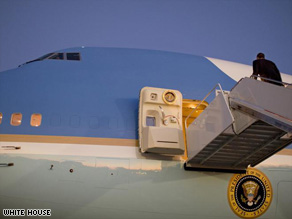
President Barack Obama walks onto Air Force One for his first flight as commander in chief last week.
During the first couple of weeks of his presidency, Barack Obama has made good use of his "spiffy" new ride.

The president, who has made several trips around the country in Air Force One, was particularly excited during his first trip on the plane as commander in chief, when he flew to the House Democrats’ annual retreat in Williamsburg, Virginia, last week. “Thanks for giving me a reason to fly Air Force One,” he told the House Democrats after his flight, which took him away from a week of fighting for the economic stimulus bill. Donning a blue jacket with the presidential seal on the right and his name embroidered on the left, Obama came back to the press section of the plane shortly before taking off for Williamsburg. WhiteHouse.gov: Obama’s first flights slide show “Hey guys, what do you think of my — this spiffy ride here” the president asked the group of reporters traveling with him on the presidential plane. Watch Obama talk about his first flight » Riding aboard Air Force One is a treat for the president, but also for the reporters covering the White House, said CNN’s Ed Henry. “I’m always amazed that every time someone finds out what my job is, without fail, their first question is: ‘Do you get to fly on Air Force One’ ” Henry said. “There is a wonder and mystery about this plane that is just remarkable.” As president, Obama’s first ride on the helicopter Marine One to Andrews Air Force Base, where Air Force One is kept, also seemed to leave him impressed. “It’s spectacular,” Obama said. “You go right over the Washington Monument, and then you kind of curve in by the Capitol. It was spectacular.” Obama also flew on the plane from Chicago, Illinois, to Washington for his inauguration, but it wasn’t called Air Force One, because Obama was not yet the president. He also had previously been a guest on Air Force One when his predecessor, former President Bush, was in office. Each president gets his own pilot and Obama met his on that first trip to Washington. “You’re out of central casting, you’re exactly what I want the pilot of Air Force One to look like,” Obama joked. The aircraft is maintained and operated by the Presidential Airlift Group, which falls under the White House Military Office. It was founded at the request of President Franklin D. Roosevelt in 1944 and originally called the Presidential Pilot Office, according to the White House Web site. During the next two decades, different propeller planes served as the main transportation for the president. That was until President John F. Kennedy became the first to travel in his own jet aircraft, which was a modified Boeing 707, according to the site. The current plane was first used in 1990 during the administration of President George H. W. Bush. The aircraft, which is longer than the length of a hockey rink, has 4,000 square feet of floor space stretched across three levels. The plane includes a large suite for the president that includes an office, bathroom and conference room. It also provides sleeping quarters for the president. The plane has two food preparation galleys that can feed 100 people at a time and a medical suite that can be used as an operating room, according to the site. While the plane does have its luxuries, plenty of the extras are devoted to security. Air Force One can refuel in midair, has unlimited range and has electronics “hardened to protect against an electromagnetic pulse,” according to the White House site. In the event of an attack on the country, the plane, equipped with advanced and secure electronic communications equipment, can become the president’s mobile command center. “[The president] has the ability to run the country from Air Force One,” said Col. Mark Tillman, who flew the plane for former President Bush during the last eight years, including after September 11, 2001, and into Baghdad, Iraq. “So he has everything that’s available to him at the White House available to him at 45,000 feet.” On occasion, press briefings take place aboard the aircraft. Henry recalled an instance when he was taking off from Egypt and Secretary of State Condoleezza Rice briefed reporters on the trip. “I’m struck by the history of standing in the aisle just two feet away from the secretary of state,” Henry said. “Until we hit some turbulence and I’m suddenly hanging onto the edge of a seat praying, ‘Please God don’t let me slam into the secretary of state in the aisle of Air Force One — my mom will never forgive me.’ I held on for dear life and the secretary kept her balance and the mini press conference went on without a hitch 30,000 feet in the air.” Henry said so far, Obama has made more of an effort to visit the back of the plane and talk with reporters than President Bush did. “So far, President Obama has come to the back of the plane to chat with reporters on each one of his early trips aboard Air Force One, and he’s even taken some questions on the stimulus bill,” he said. “But it’s relatively easy to do that in the early days when you have legislation to sell. Will he still visit the media two years from now when the newness has worn off and maybe he’s a little tired of the media” Some reporters along for the ride on Air Force One have started to Twitter their experiences and solicit questions from the public to ask Obama during the flight .Time.com: Swampland blog: More from the dept. of not Bush: Aboard Air Force One Air Force One and its staff are known for their food preparation. In the galley, the staff often keeps a list of the way many of the regular passengers take their coffee, so they can get it right without having to ask. “One of the best parts of Air Force One is the staff. All of the Air Force stewards treat everyone with respect, and they are the consummate professionals,” Henry said. “They go out and shop for all the food they bring on Air Force One so they can prepare special meals not just for the president, but for all the passengers. Whether it’s Texas chili or chicken parmagiana, they always take good care of their passengers.” Obama tried the food during the flight to his inauguration. “Let’s see how you do a burger,” Obama joked aboard the plane.

The president asked for a healthy side of salad and vegetables as well, prompting the waiter to ask if that meant he would skip the french fries. “Oh, I’ll still take the fries,” Obama quipped.

Why the 2010 Census Stirs Up Partisan Politics

Why the 2010 Census Stirs Up Partisan Politics

When Republican Senator Judd Gregg announced on Thursday that he no longer wished to be the Commerce Secretary nominee, he said that the decision was based in part on serious disagreements with the Obama White House over the 2010 census. That night on Fox News, Sean Hannity called Obama’s plans for the census process “the biggest White House power grab ever,” as his guest Karl Rove voiced agreement. The same day, House Republicans declared that the White House had “an unprecedented plan” for the census that “will taint results and open doors to massive waste of taxpayer funds.”

It may sound surprising to those who don’t consider the decennial headcount a red-hot political matter, but the census has become the controversial subject of an ongoing power struggle between Democrats and Republicans. And since the 2010 census will be the first in 30 years to be taken under a Democratic administration, the stakes are particularly high this time around.

The latest problem arose when Obama nominated Gregg to head the Commerce Department, which oversees the Census Bureau. Local Democratic officials and advocates for minority groups protested the nomination because they feared Gregg would not support efforts such as sampling that they think will result in a more accurate census count. The White House responded by publicly promising that the census director would “work closely with White House senior management.”

It was a simple restatement of existing practice. But it was heralded by some liberals as a change in policy. The Huffington Post ran an article headlined: “Democrats, Minority Groups Relieved That Gregg Won’t Oversee Census.” Those reports, in turn, disturbed conservative activists who immediately condemned the White House “power grab.” By Thursday, when Gregg bowed out, the GOP had launched a coordinated assault on the “politicization of the census.” The White House was forced to issue a written clarification, noting that “this administration has not proposed removing the Census from the Department of Commerce.”

Why does it matter who oversees the census In very general terms, Republicans would prefer to err on the side of under-counting and Democrats would prefer to err on the side of over-counting. The options can yield very different numbers for demographic groups and localities — and they have significant political and policy implications. This most recent skirmish is more manufactured than real, the result of willful misunderstandings. But it has its roots in an ongoing battle over whom the census counts — and how.

As mandated by the Constitution, a census has been taken by the government every ten years since 1790 in an effort to count every person living in the United States, both citizens and non-citizens. In recent times, the Census Bureau has arrived at a final count by relying on people to mail back surveys and then sending out census takers to go door-to-door in an attempt to fill in the gaps. Those census takers not only visit homes that have not returned the survey, but also seek to count those with no fixed address and those who live in nursing homes, prisons, shelters, and other non-standard housing.

The problem is that it is not easy to count every person in the United States, and some communities are disproportionately left out of the total. The 1990 Census missed an estimated 8 million people — mostly immigrants and urban minorities — and it managed to double-count 4 million white Americans. Recent or illegal immigrants are often reluctant to answer questions in a government survey, and many experts fear that concerns about government misuse of personal data post-9/11 could hamper participation in the 2010 census as well. Children have also traditionally been under-included in census totals.

It’s possible to use statistical modeling and sampling methods to supplement the Census in order to arrive at estimated counts of various demographic groups. But there is fierce debate about whether these methods correct or distort the Census count. In 1999, the Supreme Court ruled that sampling could not be used for the purposes of reapportioning congressional seats, and the Bush Administration chose not to use sampling to fill in the gaps of the 2000 Census.

The battle over how to count people only makes sense when you look at what is at stake. The redistricting of local districts and reapportionment of congressional seats is based on census counts — a state could gain or lose seats based on its population, and shifts within a state determine plans for redrawing political boundaries. The redistricting that took place in Texas at Tom DeLay’s urging following the 2000 census — which swung six congressional seats to the GOP — is just one example of how dramatically political fortunes can shift based on the use of those crucial numbers.

Census counts are also used to determine how many federal dollars may flow to a city or state based on grants and other outlays. Democrats have long charged that the undercounting of minorities and poor Americans prevents federal funding from reaching strapped communities. Meanwhile, Republicans argue that Democrats seek to boost numbers in order to create extra congressional districts in urban areas and to bring in more federal money for their constituencies. They charge that sampling — which Democrats support because it provides estimates for communities that can be hard to track accurately — is unconstitutional because the Constitution calls for an “actual enumeration” of the population.

It seems fairly certain that the White House did not anticipate census politics to play into its nomination of Gregg to the Commerce post. And Gregg himself backed off the issue in a news conference after he announced his withdrawal, insisting that his concerns over the census were “slight” and refusing to address it further. Nonetheless, the experience has reminded partisans on the left and the right of their investment in the census. The fight to determine how it happens and what the consequences will be has only just begun.

See TIME’s Pictures of the Week.

Israel denies reports of Hamas negotiations

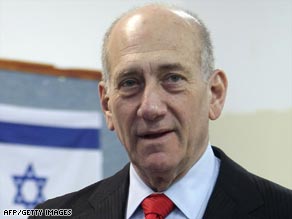
Israeli Prime Minister Ehud Olmert is staying mum about a possible cease-fire deal with Hamas.
Israel’s prime minister denied media reports that it is negotiating with the militant group Hamas, which controls Gaza, but said there will be Israeli "consultations" Sunday "regarding the situation in the south."

“Should a decision of any kind be required, it will be made only via a meeting of the Security Cabinet and after taking into account all of the new political circumstances that have been created in the wake of the recent Israeli elections,” Yanki Galanti, the media adviser for Ehud Olmert, said Saturday night in a statement. The consultations are to take place among Olmert, Defense Minister Ehud Barak and Foreign Minister Tzipi Livni. Israel held elections Tuesday which resulted in a near-tie between Livni’s centrist Kadima party and the right-wing Likud party, led by Benjamin Netanyahu. It is not yet clear who will emerge as prime minister. Israel agreed January 21 to temporarily halt its three-week military operation in Gaza, which it began in response to repeated rocket attacks into southern Israel. Since then, Egypt has been trying to broker an agreement between the two sides. On Friday, a spokesman for Hamas told CNN that Israeli and Hamas negotiators have “almost reached agreement” on a long-term truce. Tahir Annono, who is in Cairo for the truce meetings, said there would be meetings Friday and Saturday, and on Sunday an announcement would be made.

Don’t Miss
War of words between Israel and Turkey sparks formal complaint

Israel centrists just keeping lead

Hamas: Gaza truce agreement near

Hamas’ deputy leader, Moussa Abu Marzouk, said that the truce would last for 18 months and all commercial border crossings between Gaza and Israel would be opened. The security of Israelis who have been targets of the rocket attacks from Gaza and the release of Israeli soldier Gilad Shalit are priorities as Israel considers the next steps in its conflict with Hamas, Olmert said Saturday through his media adviser. Olmert has been under pressure to secure Shalit’s release as part of a broader cease-fire deal. However, the cease-fire in January did not include Shalit’s release as a condition. Shalit was 19 when he was captured on June 25, 2006, by Palestinian militants in Gaza. They tunneled into Israel and attacked an Israeli army outpost near the Gaza-Israel-Egypt border, killing two other soldiers in the assault. Israel immediately launched a military incursion into Gaza to rescue him, but failed. “We should like to emphasize that the security of residents of the south and the release of Gilad Shalit are currently at the top (of) Israel’s priorities,” the statement said.