Volunteers, scientists guard endangered whales

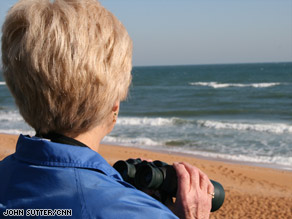
Glenn Wood, 68, has been searching for right whales for five years as a volunteer.
Glenn Wood and several other retirees lean on a wood rail on the second story balcony of the Golden Lion Café — a beachside pub and restaurant in northern Florida.

It’s 8 a.m., so no one’s here for French fries or beer-battered fish. As the group gazes out into the ocean sunrise, they’re scanning for North Atlantic right whales. Wearing whale earrings, a flipper necklace and a blue windbreaker that says “Whale Watch Survey Team” on the back, Wood says she’s been coming to this spot — the highest lookout point in the area — to search for whales once a week for at least five years. Each new calf the group spots gives her hope that the right whale — a highly endangered and often-overlooked species — will recover. “Slowly, slowly they must be growing” in numbers, said Wood, 68. “I do feel like we’re helping this. We’re hopeful.” And for once, scientists say they share Wood’s optimism. At least 32 new right whale calves — more than ever recorded — have been observed this season off the coasts of Georgia and Florida, where the whales migrate to give birth between late November and March. Only about 400 members of the species exist, and the massive mammal is thought to be the most endangered of all the large whales.

Don’t Miss
Spotting endangered whales from the skies

Each birth is seen as a miracle of sorts — a potential key to the survival of a species that has been through many tough years. Right whales were named by their hunters who once said they were the “right whale” to kill. When they were harpooned, the chubby whales floated to the surface of the water. That made them both profitable and easy to hunt. The whales — which can grow to 70 tons, or the weight of more than a dozen elephants — are difficult to spot in the water because of their jet-black appearance and lack of dorsal fins. That has made them susceptible to humans in another way: They’re often hit by ships. Usually, one or two right whales are killed each year by collisions with ships. No deaths from ship collisions have been recorded so far this calving season. The whale’s followers say a new rule that requires large ships to slow down to 10 knots as they cruise through the whales’ habitat seems to be helping. So does a large network of eyes — like Wood’s — that scan for the school-bus size whales and alert ship captains, cruise lines, airplanes, Navy submarines and others to the whales’ whereabouts. Every morning during calving season, volunteers armed with binoculars and whale-related handouts troll up and down the Florida coast — climbing to balconies and zipping up elevators to the top floors of high-rise condos and retirement communities — to look for whales. Above them and to the north, small planes filled with scientists mow neat grid lines over the Atlantic. When they spot a whale, they circle at 1,000 feet and hang out an open window to shoot photos with a long-range zoom lens. Researchers in rubber boats use crossbows to dart the newborn whales and take tissue samples for clues about the species’ genetic makeup and individual family trees. Meet the scientists and volunteers who protect the whales » Since 1980, the New England Aquarium has used photos of the distinctive patterns on the whales’ heads — along with their scars from collisions with ships — to identify the whales and assemble their family trees. Each whale is assigned a four-digit number in a catalogue, and many have names. Drawings of all this season’s new moms are tacked to an upstairs wall in the New England Aquarium’s ocean-side research house in Fernandina Beach, Florida, up the coast from Jacksonville. Workers know the moms and their stories the same way FBI agents memorize the faces of their most-wanted suspects. Meet five of the scientists’ favorite right whales » Off the top of her head, assistant scientist Monica Zani can tell you that a whale named Baldy, her calf, No. 1503, and 1503’s calf, Boomerang, all gave birth this season. “Yeah … they’re busy,” she said. From a computer in front of the wall of whales, Zani collects sighting locations and sends out e-mails, text messages and pager alerts with the subject line “WHALE ALERT.” The messages give out the exact coordinates of the whales so ships won’t hit them. Another threat is on the horizon, though. Further north, some whales have become entangled in fishing ropes and lobster traps. Such entanglements are frequently fatal. The ropes restrict the whales’ movements and dig into their skin, causing deep wounds and infections. There have been efforts to change some fishing equipment to protect the whales, but researchers say they’ve already seen five entangled whales in the Southeast this year — more than ever. Usually only one or two whales are found entangled each winter, they said. The entanglements make some scientists temper their hopes for the future of the species. “Four hundred animals is not a vibrant, thriving population — it’s one that’s very close to the edge,” said Amy Knowlton, a research scientist at the New England Aquarium. “And so I think we need to keep monitoring what’s happening from year to year, understand how they die, and really stay focused on the fact that this is a population that’s not out of the woods by any means.” Barb Zoodsma, a right whale biologist with the National Oceanic and Atmospheric Administration, said the high number of births this year can be “nothing but good news.” Still, she said, the entanglement trend is troubling. “The fate of this species can turn on a dime, so we need to ride the wave of good news right now, but we also need to remain vigilant for threats that are on the horizon,” Zoodsma said. Katie Jackson, a marine mammal biologist with the Florida Fish and Wildlife Conservation Commission, is part of a team that tries to disentangle these whales before their wounds become fatal. Riding in a small, inflatable boat, the scientists toss grappling hooks at the fishing ropes that ensnare the whales. Once they grab hold, they throw jackknives at the ropes to try to cut the whales loose. It’s dangerous work and the whales often swim away as fast as they can. Of the five entangled whales spotted this season, scientists have only been able to free three, Jackson said. One of the failed attempts was directed at whale No. 3311, named Bridle because it has a rope stuck through its mouth like a bridled horse. If Bridle isn’t disentangled, he likely will die, Jackson said. But for the moment, right whale enthusiasts seem focused on the species’ apparent rebound. Wood, the whale watcher, said many Florida residents are unaware of the school-bus sized creatures just off the shore. “In this area people are always amazed that Florida has whales at all, so we try to educate the populace,” she said. “When people drive by and see people with binoculars looking at the ocean they do wonder what we’re doing.” The more people know about the whales, the more they’ll be inclined to protect them, she said. She says the right whale is a bit of a hard sell because of its awkward appearance. Researchers say the right whale is overshadowed by more glamorous whales, like the humpback. But Wood loves the whales and their stories even if, as she says, they’re “not cute.”

She thrives on the excitement of helping an underdog species recover. “Since I started working on this we went from 350 to now closer to 400 whales,” she said.

Black actors still face Oscar challenges

Will Smith has overcome racial boundaries but can do more, says an expert in race-based casting.
On a winter evening in early 1940, Hattie McDaniel became the first black performer to win an Oscar, a best supporting actress honor for her performance as Mammy, the servant in "Gone With the Wind."

She accepted her award at the Academy Awards ceremony at the Coconut Grove, a nightclub in Los Angeles’ Ambassador Hotel, where she was seated in the segregated section at the rear of the room. Though her win was played as a sign of progress for black actors in America — “Not only was she the first of her race to receive an Award, but she was also the first Negro ever to sit at an Academy banquet,” said Daily Variety, according to Mason Wiley and Damien Bona’s indispensable “Inside Oscar” — her role was poorly received by much of the black community. The National Association for the Advancement of Colored People claimed that the part was stereotypical and degrading. “I think [the NAACP] were correct,” said Jill Watts, author of “Hattie McDaniel: Black Ambition, White Hollywood.” But, Watts added, “McDaniel knew that ‘If I reject these maid roles, [black people] won’t be on the screen.’ And her point was, ‘we need a presence within the industry.’ ” Nearly 70 years after McDaniel’s win, black performers have certainly come far. Actors like Sidney Poitier, Denzel Washington and Halle Berry have broken boundaries in making their mark on the film industry.

But black actors have been few and far between at the Oscars. In its 80-year history, the Academy has awarded 11 black actors with trophies, six of whom won in this decade. This year, two black actors are nominated for Academy Awards: Viola Davis for her role in “Doubt” and Taraji P. Henson for her part in “The Curious Case of Benjamin Button.” Watch Viola Davis talk about the Oscars » Tom O’Neil, entertainment reporter for the Los Angeles Times’ TheEnvelope.com and founder of GoldDerby.com, a Web site dedicated to predicting and analyzing award show wins, said the Academy finally began making an effort to recognize black actors after Halle Berry and Denzel Washington won Oscars in 2002. “The Oscars were notoriously stingy to black actors,” O’Neil said. “It was that year that it became such a huge issue in the media and Hollywood really woke up to this issue.” O’Neil claims that Hollywood has improved in its recognition of black actors, but the Academy’s failure to nominate 2006’s “Dreamgirls” for best picture, for example, is a sign that Oscar voters simply don’t understand such films culturally. “I don’t believe that there’s an element of racism. It’s an inability to relate to the drama being portrayed,” O’Neil said. “The largely white Academy just didn’t get [‘Dreamgirls’]. They weren’t emotionally engaged in the story.” Although awarding Oscars to 11 black actors is “stingy,” O’Neil said, “you have to compare that to the number of quality films that gave good roles to actors.”

Don’t Miss
Will ‘Slumdog’ have its day at the Oscars

What it takes to make it in Hollywood

Stars: Oscar nomination a ‘surreal’ experience

Complete list of Academy Award nominations

Special Report:  2009 Academy Awards

That’s the problem, said Russell Robinson, a professor of law at the University of California – Los Angeles, who wrote a 2006 report about unfair race-based casting in Hollywood. “It’s an industry norm that the assumption is that roles go to white actors,” Robinson said. “They use people of color to flesh out the film and exemplify racial stereotypes.” Robinson’s report, “Hollywood’s Race/Ethnicity And Gender-Based Casting: Prospects For A Title VII Lawsuit,” found that the majority of roles that do not specify a race or ethnicity are played by white actors, which tends to limit black actors to stereotypical roles. “I think what bothers a lot of African-Americans is that we see the same images time and time again. … We’d like to see the full range of complexities that we see in our communities,” Robinson said. In the past, black actors didn’t have much of choice when it came to playing stereotypical parts, said John Forbes, executive director of the Black Hollywood Education and Resource Center, a nonprofit organization dedicated to promoting films featuring black actors. “People had to do what they had to do in those days on and off the screen to survive,” he said. In the early 1900s, that often meant playing caricature roles like that of Stepin Fetchit, a foolish and weak character created and played by Lincoln Perry, who eventually became the first black millionaire actor. With the arrival of Poitier to the film industry in the 1950s, Hollywood seemed to change its perspective of black actors. iReport.com: Who will win at the Oscars “Poitier was able to create a character that was always strong. The black male image that he portrayed on the screen was something that everyone was proud of,” Forbes said. More recently, actors like Will Smith have been successful in overcoming racial boundaries because they’re profitable, Robinson said. But with their success also comes responsibility. As the biggest box office star in the world, Smith, Robinson believes, is obligated to push Hollywood to make changes.

With Smith’s 2005 film “Hitch,” “the studio would not cast a black woman as Will Smith’s love interest in the film because they didn’t want the film to be a ‘black film,’ ” Robinson said. “I would hope that Will challenged that decision. … I would hope that Will would try to get black actors hired.” Robinson added, “the question is, ‘How can you use that power to help other people’ ”

Dentists: Smiling in the Face of Recession

Dentists: Smiling in the Face of Recession

The one guy is 63-years old, just lost his job at a health insurer, and is afraid he’ll never find another one again. The other has three kids, one in college, and lost his construction job. The stress caused them to both grind their canines and molars. So they both wound up in the office of Dr. Woody Oakes, a dentist from New Albany, Indiana, with a fractured tooth. “You do see that — someone lost their job, and they come in with their jaws clenched,” says Oakes, who is also the editor of The Profitable Dentist magazine. “You can fracture your teeth when you do that.”

There’s at least one profession for which the recession might not bite: dentistry. According to Sageworks, a firm that tracks private company financial performance, dentist’s offices had higher profit margins than any other industry in 2008. With average profit margins at 17%, dentistry outpaced accounting, tax preparation, bookkeeping and payroll services, legal services, and mining support services among the top five performing professions in ’08. Dental margins rose about 1.5% from 2007, according to Sageworks.

What could be keeping dentistry strong during this recession Sure, tooth grinding and nervous eating habits — I’m going to chomp on chocolate as an escape — may be driving traffic to the drill. But economic forces are more likely responsible. Dentists note that patients who receive no or limited insurance tend to skip cleanings and other dental maintenance during tough times as they look to save a few bucks. But dentists pick up even more revenue later on. Patients who’ve skipped check-ups now have achy teeth, and have no choice but to undergo a more expensive procedure. “It’s human nature to say, “I can’t afford that right now,” says Dr. Lawrence Spindel, a dentist in New York City. “And if it doesn’t hurt, I don’t have a problem. Then all of a sudden you need a root canal.”

At the same time, insured patients want to hit the chair while they’re still lucky enough to have the insurance. “We’re seeing that a lot of folks are fearful of losing their jobs,” says Rick Willeford, founder and president of the Academy of Dental CPAs, whose members provide accounting and tax prep work for some 7,000 dentists across the country. “So they want to use their benefits. That has helped keep revenues strong.” Last spring Spindel, who had his best year ever in 2008, said he saw a “mini-boomlet” in these types of cases. “People know that if they’re going to lose their job, they damn well better use their dental insurance,” Spindel says. “They say, ‘do as much as you can do, and you need to do it within 30 days!'”
Read “How to Know When the Economy is Turning Up.”
Read “The Year in Medicine 2008: From A to Z.”

Three cleared over murder of Russian journalist

Kremlin-critic Anna Politkovskaya was killed outside her Moscow home in 2006.
A jury in Moscow on Thursday acquitted three men charged with involvement on the murder of independent journalist Anna Politkovskaya.

The not guilty verdicts followed a two month trial that was hampered from the start by the man accused of masterminding the shooting, Rustam Makhmudov. Sergei Khadzhikurbanov — a former Moscow police officer — and Makhmudov’s brothers, Ibragim and Dzhabrail were found not guilty of shooting dead Politkovskaya, a Kremlin critic, outside her Moscow home in October, 2006. An award-winning investigative reporter, she earned a worldwide reputation for exposing Russian military brutality forces and human rights abuses in Chechnya. Her reports were considered extremely embarrassing for former president, and now prime minister, Vladimir Putin. Politkovskaya’s death was described by media reports in Russia at the time as a contract-style killing. A security camera captured a man in a white baseball cap entering the building a few moments before she was shot three times in the chest and once in the head.

U.S. lawmakers visit Gaza for first time in 8 years

Sen. John Kerry, center, visits the American International School, destroyed by the Israeli attacks on Gaza.
A U.S. congressional delegation visited Gaza Thursday, marking the first time that American lawmakers have entered the Hamas-controlled Palestinian territory in eight years, according to the U.S. consulate in Jerusalem.

The delegation included Reps. Brian Baird, D-Washington, and Keith Ellison, D-Minnesota, who is the first Muslim to serve in the U.S. Congress. Sen. John Kerry, D-Massachusetts, also visited Gaza separately from the two congressmen, according to an official who was traveling with the senator. None of the U.S. lawmakers visited representatives of Gaza’s Hamas leadership. Hamas is considered a terrorist organization by the United States. Baird said that the visit represents a change in the United States’ attitude and approach to Gaza, under newly elected President Barack Obama. The destruction from Israel’s recent military operation in Gaza was beyond description, Ellison said. The two men visited the United Nations headquarters in Gaza City, and toured homes that had been destroyed in Israel’s three-week military campaign.

Don’t Miss
Hamas says it may consider Israeli soldier’s release

Israel denies reports of hamas talks

Kerry visited the site of the American school in northern Gaza, which was destroyed in the recent conflict, his representative said. He is later scheduled to visit U.N. headquarters in Gaza City. He also visited the southern Israeli town of Sderot, a frequent target of rocket attacks launched by militants in Gaza. Israel launched its military operation in Gaza on December 27 to halt those rocket attacks. Baird and Ellison say they plan to visit Sderot on Friday. Americans have been prohibited from traveling to Gaza since 2003, when a U.S. diplomatic convoy was hit by a roadside bomb. There were two exceptions to that ban, when State Department personnel visited the Palestinian territory twice in 2005. No U.S. officials have visited Gaza since Hamas seized control of the territory in 2007, effectively splitting the Palestinian government. A day before heading to Gaza, the U.S. delegation visited Palestinian leaders in Ramallah, West Bank. On the same day of the delegation’s visit, Israeli aircraft bombed six tunnels along the Egypt-Gaza border in response to several rocket and mortar strikes on southern Israel, the Israeli military said. The airstrikes caused explosions in some of the tunnels along the Rafah border crossing, the Israel Defense Forces said. Palestinian security sources confirmed the Israeli airstrike in Rafah. There were no initial reports of casualties. Israel accuses Gaza’s Hamas leadership of using the tunnels to smuggle weapons into the Palestinian territory. But Palestinians say the tunnels are necessary to get basic food supplies that are not available in Gaza because of Israel’s closure of its border crossings and seaports.

Venezuela seizes Stanford-owned bank

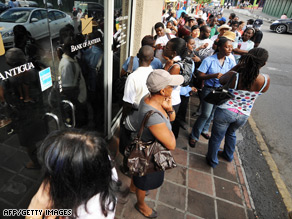
Customers queue outside the Stanford Group-owned Bank of Antigua in St. John's.
Venezuela’s government seized a local bank owned by Allen Stanford Thursday as politicans and banking regulators in the region attempted to quell panic after the flamboyant Texan financier was charged over an alleged multibillion dollar fraud scheme.

Customers in Latin America and the Caribbean have been queuing up or logging onto online banking services to withdraw money from institutions owned by the Stanford Group. The whereabouts of Stanford, who used his vast wealth to fund high stakes cricket matches in the Caribbean, remains unknown two days since he was charged by the U.S. Securities and Exchange Commission over the alleged $9.2 billion fraud. In a press conference Thursday, Venezuelan Finance Minister Ali Rodriguez Araque said banking authorities had been forced to seize the Stanford Bank Venezuela as “extraordinary withdrawals” threatened to exceed reserves, according to the state-run ABN news agency. But he said the bank would be put up for sale as soon as possible. “The financial system of Venezuela is completely stable and I urge Venezuelans to stay calm,” Rodriguez said. Similar scenes played out in Antigua, where customers lined up outside Stanford-owned banks to pull their money. Finance Minister Errol Court said banking authorities on the Caribbean island, which had granted citizenship and given a knighthood to Stanford, had “collectively agreed on a plan of action to maintain and preserve the viability and stability of the financial system,” according to Reuters.com. In a statement issued Wednesday, the Antigua and Barbuda Bankers Association warned that further withdrawals by customers could destabilize the island’s entire financial system. Three of Stanford’s companies and several senior employees also face SEC charges. According to the SEC, Stanford used the Antigua-based Stanford International Bank and a network of Stanford Group Company financial advisers to sell approximately $8 billion of “certificates of deposit” to investors. The SEC also charged SIB chief financial officer James Davis and Laura Pendergest-Holt, chief investment officer of Stanford Financial Group. The third company named in the complaint is investment adviser Stanford Capital Management. Watch more on the case » SIB’s Web site says its network has $51 billion in deposits and assets under management or advisement, with more than 70,000 clients in 140 countries.

In September, Forbes named Stanford No. 205 in its 400 Richest Americans article, saying he was worth more than $2 billion. CNN made repeated attempts on Wednesday to reach Stanford and his attorneys. There was no response. Some media reports have put him in Antigua, where he has a home, but that couldn’t be confirmed.

Woman blinded by acid wants same fate for attacker

Ameneh Bahrami said her attacker pestered her with marriage demands.
Ameneh Bahrami is certain that one day she’ll meet someone, fall in love and get married. But when her wedding day comes, her husband won’t see her eyes, and she won’t see her husband. Bahrami is blind, the victim of an acid attack by a spurned suitor.

If she gets her way, her attacker will suffer the same fate. The 31-year-old Iranian is demanding the ancient punishment of “an eye for an eye,” and, in accordance with Islamic law, she wants to blind Majid Movahedi, the man who blinded her. “I don’t want to blind him for revenge,” Bahrami said in her parents’ Tehran apartment. “I’m doing this to prevent it from happening to someone else.” Bahrami says she first crossed paths with Movahedi in 2002, when they attended the same university. She was a 24-year-old electronics student. He was 19. She never noticed him until they shared a class. He sat next to her one day and brushed up against her. Bahrami says she knew it wasn’t an accident. “I moved away from him,” she said, “but he brushed up against me again.” Watch Bahrami return to the attack scene for the first time » When Bahrami stood up in class and screamed for him to stop, Movahedi just looked at her in stunned silence. He wouldn’t stay silent for long. Bahrami said that over the next two years, Movahedi kept harassing her and making threats, even as he asked her to marry him. “He told me he would kill me. He said, ‘You have to say yes.’ ” On a November afternoon in 2004, Movahedi’s threats turned to violence. That day at 4:30 p.m., Bahrami left the medical engineering company where she worked. As she walked to the bus stop, she remembers sensing someone behind her. She turned around and was startled to see Movahedi. A moment later came the agonizing pain. Movahedi had thrown something over her. What felt like fire on her face was acid searing through her skin. “I was just yelling, ‘I’m burning! I’m burning! For God’s sake, somebody help me!’ ” The acid seeped into Bahrami’s eyes and streamed down her face and into her mouth. When she covered her face with her hands, streaks of acid ran down her fingers and onto her forearms. Watch how the still-pungent acid destroyed Bahrami’s clothes » Two weeks after the attack, Movahedi turned himself in to police and confessed in court. He was convicted in 2005 and has been behind bars all along. Bahrami’s lawyer, Ali Sarrafi, said Movahedi had never shown any remorse. “He says he did it because he loved her,” Sarrafi said. Attack victims in Iran usually accept “blood money”: a fine in lieu of harsh punishment. With no insurance and mounting medical bills, Bahrami could’ve used the cash, but she said no. “I told the judge I want an eye for an eye,” Bahrami said. “People like him should be made to feel my suffering.” Watch how the acid destroyed Bahrami’s eyes (includes graphic content) » Bahrami’s demand has outraged some human rights activists. Criticizing acid-attack victims is almost unheard of, but some Internet bloggers have condemned Bahrami’s decision. “We cannot condone such cruel punishment,” wrote one blogger. “To willingly inflict the same treatment on a person under court order is a violation of human rights.” Late last year, an Iranian court gave Bahrami what she asked for. It sentenced Movahedi to be blinded with drops of acid in each eye. This month, the courts rejected Movahedi’s appeal. Bahrami’s lawyer, Sarrafi, said the sentencing might be carried out in a matter of weeks. He said he doesn’t think Bahrami will change her mind. Neither does Bahrami. “If I don’t do this and there is another acid attack, I will never forgive myself for as long as I live,” she said. Bahrami is largely self-sufficient despite not being able to see. She can make a salad, prepare tea and walk up the five flights of stairs that lead to her parents’ apartment. She has undergone more than a dozen surgeries on her badly scarred face, but she says there are many more to come. She can’t afford to pay for her medical care, so she’s using the Internet to raise money.

She’s lost her big brown eyes, but she likes to smile, especially when she imagines her wedding day. “I always see myself as someone who can see and sometimes see myself in a beautiful wedding gown, and why not”

Best Actress: Kate Winslet’s Moment

Best Actress: Kate Winslets Moment

It’s 11 days before the Academy Awards, and Kate Winslet is giving her third best performance of the year. The occasion is a lunch at New York City’s Oak Room at which 100 or so invited guests have gathered to honor her performance in Stephen Daldry’s The Reader. This particular publicity event, orchestrated in the 26th mile of the Oscar marathon, has multiple purposes: it’s designed to entice any wavering voters in the few days before the last postmark lands on the last ballot. It’s also intended to defuse complaints that the movie’s treatment of the Holocaust is too manicured. Thus, Elie Wiesel has been drafted to host the meal, which would have been a masterly counterstroke of damage control for distributor Harvey Weinstein had Wiesel not bailed at the last minute to attend — oh, bitter irony of the red-carpet campaign trail! — a bris.

But above all, this midday fete is engineered to give the movie’s star one final turn in the spotlight. By the time Winslet arrives, she has already participated in several hours of diligent self-exposure that day, illuminating for both Larry King and the women of The View the complexities of pretending to have sex with Leonardo DiCaprio in the bleak marital drama Revolutionary Road while the film’s director, Sam Mendes — her husband — watched.

If she is fatigued, she never betrays it. An eager, insistent clot of people pushes toward her, and somehow she manages to greet each well-wisher with a fractional recalibration of body language that suggests a wordless surge of elated surprise on her part: Oh, it’s you! You’re the one I’ve been most hoping to see, and how wonderful that we share that secret knowledge! To achieve this effect, Winslet must appear, at every minute, to be not only the most interesting person in the room but also the most interested. This is not easy, and she does it very well. People walk away feeling glowy, sated and privileged. She has made them feel that way, and not out of actressy affectation, but because right now, it’s her job.

Of course, Winslet would rather be acting onscreen, which is, she says, “the one thing that I do for myself” — and lately the thing she has been doing better than just about anyone else. In an industry that insists that most actresses remain giggly, pliable and princessy well into middle age, Winslet has somehow avoided that pigeonhole entirely. She doesn’t play girls; she never really has. She plays women. Unsentimentalized, restless, troubled, discontented, disconcerted, difficult women. And clearly, it’s working for her. Her two most recent performances — as Hanna Schmitz, the illiterate former concentration-camp guard in The Reader, and as April Wheeler, the anguished, rageful 1950s wife and mother in Revolutionary Road — have earned her two Golden Globes, a Screen Actors Guild prize, a British Academy Award and her sixth Oscar nomination, a benchmark that no actor so young has ever before reached.

At 33, Winslet has become not only the finest actress of her generation but in many ways also the perfect actress for this moment. She’s intense without being humorless. She’s international in outlook . She’s ambitious but cheerfully self-deflating, capable of glamour but also expressive of a kind of jolting common sense. She has a strong professional ethic, which she somehow balances with her domestic life . And, cementing her status as an icon of the Era of New Seriousness, she really likes hard work. Assuming she’s paid her taxes, are there still any openings in the Cabinet

See TIME’s 2009 Oscar guide.
See LIFE Magazine’s classic pictures.

Afghanistan, trade on table as Obama visits Canada

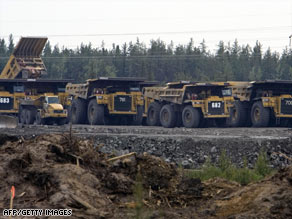
Trucks wait at an oil sands site in Alberta in 2007. Obama has environmental concerns about the sands.
President Obama takes his first foreign trip as head of state Thursday when he travels to Canada.

And though he enjoys an 81 percent approval rating north of the border, Obama is expected to tackle several explosive issues with America’s largest trading partner. • The war in Afghanistan: Canada has about 2,800 troops in Afghanistan, but Parliament has voted to pull them out by 2011. At the same time, Obama has approved a significant increase in U.S. troops in Afghanistan, bringing the total there to 55,000. View a chart of U.S. troop levels in Afghanistan » Obama said he will take up the issue of Canada’s troop withdrawal with Prime Minister Stephen Harper when the two meet in Ottawa. Watch what Obama will tackle in Canada » “My hope is that in conversations that I have with Prime Minister Harper, that he and I end up seeing the importance of a comprehensive strategy, and one that ultimately the people of Canada can support, as well as the people of the United States can support,” he told the Canadian Broadcasting Corporation on Tuesday. Watch more on the U.S. efforts in Afghanistan » • A “Buy American” clause in Washington’s economic stimulus package: Canadians worry about protectionism because of a provision in the package that requires the use of U.S.-produced iron, steel and other manufactured goods in public works projects paid for by the $787 billion package.

Don’t Miss
Extra forces could stay in Afghanistan 5 years

Obama: Troops alone cannot win in Afghanistan

Obama to walk trade tightrope

“[There is] a lot of concern in Canada that [the provision] is going to cut Canadian firms out, especially in the steel area,” said Peter Mansbridge, the anchor of CBC’s “The National.” Administration officials altered the language in the final version of the stimulus bill to ensure the provision will not trump existing trade agreements. Canadian companies will therefore still have the chance to sell products used in stimulus-funded projects. Canadian government officials, however, perceive the provision as indicative of rising protectionist sentiment in the United States that could potentially spark a trade war and, in their opinion, deepen the global economic crisis. The Canadian government says more than 7 million American jobs directly depend on trade with Canada. • The environmental effect of Canadian oil: Obama has said he is concerned about the effect on the environment of the oil sands operation in Alberta, in western Canada. “What we know is that oil sands creates a big carbon footprint. So the dilemma that Canada faces, the United States faces, and China and the entire world faces is how do we obtain the energy that we need to grow our economies in a way that is not rapidly accelerating climate change,” Obama said in his CBC interview.

Experts have said that producing a barrel of oil from sand creates three times the emissions of a conventional barrel of oil. The oil sands have made Canada the top foreign supplier of crude oil to the United States. The administration of President George W. Bush viewed Canada’s reserves as one way to end U.S. dependence on Middle East oil.

California resolves budget standoff

California Senate President Pro Tem Darrell Steinberg urges GOP help to break the budget impasse.
The California Senate finally passed the state’s budget on Thursday morning after a marathon session. The legislation received final approval from the state Assembly minutes later.

The budget package addressing a $42 billion deficit passed after lawmakers agreed to demands from a holdout Republican senator. The package includes tax increases, spending cuts and borrowing to close the deficit, reports said. “This is not really a time of celebration, when you think about the difficult decisions that we have been called upon to make,” Senate President Pro Tem Darrell Steinberg, D-Sacramento, told colleagues following the vote shortly after 6 a.m. PT. “It is, however, a time of great relief that this crisis is behind, not us, but behind the people of California.” The stalemate over the budget had caused California Gov. Arnold Schwarzenegger to declare a fiscal emergency and send layoff notices to 10,000 state workers. Sen. Abel Maldonado had been one Republican amenable to vote for the measure in exchange for various demands, and lawmakers worked to meet them to get his support. Senators voted for a measure to revise the state’s constitution to permit “open” primaries for legislative, congressional and gubernatorial elections. They also passed another, the removal of a 12-cent additional gas tax increase.

Don’t Miss
CNN/Money: Obama plan to aid 9 million homeowners

California budget crisis jeopardizes 20,000 jobs

KCRA: Schwarzenegger vows no budget talks from scratch

Even though several members didn’t like the open primary plan, they still voted for it to get the budget passed. The Senate worked through the night. All Democrats were prepared to vote for the budget hours earlier, but one more Republican was needed to reach a majority vote, Steinberg said at a news conference just after midnight. “We need one more member. One more member. We need one more,” said Steinberg, raising his voice as he pointed to a large placard with No. 1 written in red. “My door is open for any Republican that wants to put the state first.” U.S. Sen. Barbara Boxer, D-California, also was there Thursday morning and reminded lawmakers that Democrats in the U.S. Senate were able to get just enough Republican votes to pass President Obama’s $787 billion stimulus plan. Interactive: See where the stimulus money is going » “We have to put aside all this ego and put the people of California first,” Boxer said. “The people of California do not deserve the fate they will receive if it is not passed.” Without a new budget, 276 public works projects would have been halted Thursday, an additional 10,000 state workers could have received layoff notices and California might not receive parts of the federal economic stimulus package, lawmakers said. The Republican governor had butted heads for months with the Democratic majority over easing the state’s $11.2 billion revenue shortfall this fiscal year alone. Cuts would save California $750 million for the year. Watch more on California’s budget woes » In Kansas, leaders Wednesday ended a standoff that had delayed tax refunds and state paychecks by agreeing to borrow $225 million from various state accounts, a spokeswoman for the governor’s office said. Republican lawmakers approved moving money into the state’s main account to pay the bills after Gov. Kathleen Sebelius agreed to budget cuts, spokeswoman Brittany Stiffler said. The state resumed processing income tax refunds on Wednesday — they had been suspended last week because of low funds — and state employees’ paychecks will be paid on time Friday, Department of Administration spokesman Gavin Young said. Republicans earlier this week denied the Democratic governor’s request to move the money, saying they could not approve the certificate of indebtedness, also known as internal borrowing, until they knew the state could repay the money by June 30, the end of the fiscal year. However, Republicans said they would be likely to approve the internal borrowing if Sebelius agreed to the Legislature’s proposed budget cuts for the 2009 fiscal year. On Wednesday, she approved about $300 million in budget cuts. “She blinked, and that’s helpful,” Senate Majority Leader Derek Schmidt, a Republican, said Wednesday. Sebelius said, “I’m just sorry we had to have high drama and worry a lot of Kansans about our ability to pay our obligations.” The Kansas Legislature was one of several to meet this week to address budget concerns in a time when 43 states are starting the year short on funds, according to the National Conference of State Legislatures.

“This is an equal-opportunity recession. States in virtually every part of the country are suffering. … Even the energy states are starting to report problems,” Corina Eckl of the National Conference of State Legislatures said. iReport.com: What you’d fix first “For most, it has only gone downhill. They have tried to make up the difference with expanded gambling, with delays of construction projects, with hiring freezes, with fee and tax increases. But almost all of this has failed to regain lost ground, merely serving as a firebreak against worse troubles.” Map: See estimated stimulus benefits by state »