Clinton Takes a Softer Approach to China

Clinton Takes a Softer Approach to China

Ahead of her first trip abroad as Secretary of State, Hillary Clinton said she planned to renew U.S. focus on Asia, which she suggested the Bush administration had ignored. In China, that new attitude of engagement has been cautiously welcomed. “For many years the U.S. has been accustomed to delivering its demands to China, and this situation should change,” the popular nationalist tabloid Global Times put it on the morning of Clinton’s arrival. “The U.S. can no longer control China, moreover make more demands of us.”

On Saturday in Beijing, Clinton obliged, and gave indications of a softer U.S approach. She spoke repeatedly of a “positive and cooperative relationship” between the two countries. “We spent a great deal of time on the array of global problems that China and the United States face together and that we can work together to solve,” she said
after meeting with Chinese Foreign Minister Yang Jiechi. “It’s important to the global community, which is counting on China and the United States to collaborate to security and peace and prosperity for all.” En route to Beijing she told reporters that she wouldn’t allow discussions over key issues like the global economy, security and climate change to be sidetracked by talk about China’s human rights record, a topic that has long been a source of friction between the two nations. Clinton herself gave a strident speech promoting human rights during a 1995 women’s conference in Beijing.

Now as Secretary of State, Clinton is avoiding that sort of provocation. During her three-day visit to Beijing, she plans to visit a church Sunday morning and meet with female NGO and civil society leaders at the U.S. embassy later in the day, seemingly choosing subtle example over fiery talk. The “efforts of civil society, women’s groups, NGOs, academic institutions” are at least as important as discussions between governments in promoting human rights, Clinton said. Some human rights groups expressed disappointment at Clinton’s approach to the issue in China.

After meeting with Yang, Clinton announced a tentative plan to hold regular high-level talks between the U.S. and China. During the Bush administration Treasury Secretary Henry Paulson led a Strategic Economic Dialogue with China, but under the new system, both Treasury Secretary Timothy Geithner and Clinton would lead discussions divided into two tracks: economic and strategic, which includes a broad range of “political and security and global issues,” she said.

China has already indicated that it won’t be shunted aside — or shoulder the blame — when it comes to discussions of the financial crisis. As China’s manufacturing sector reels from the global drop in demand for its wares, trade will likely dominate all near-future discussions with the U.S., China’s biggest trade partner, and could become the primary source of bilateral friction. In a January speech at Davos, Chinese Premier Wen Jiabao lectured about the “inappropriate macroeconomic policies of some economies” with low rates of savings and high consumption — an “unsustainable model of development.” In other words, the U.S. When outgoing U.S. Treasury Secretary Paulson was quoted as suggesting that China’s high rate of savings helped set off the worldwide crisis by lowering interest rates and encouraging high-risk investment, the state press launched a loud and extended attack. Paulson eventually clarified that he thought the crisis had many causes, and the majority of his criticisms were meant for the U.S. When Geithner later said China has been manipulating its currency during a Senate review of his appointment, he set off a similar outburst of criticism.

The trade deficit with China reached an all-time high of $266 billion last year, prompting U.S. complaints of unfair trade practices by Beijing. Meanwhile China has bashed what it calls efforts by the U.S. to promote protectionism. As money from China’s $586 billion stimulus program begins to flow, some economists expect that it will encourage export production faster than it stimulates domestic consumption. If that’s the case, the Sino-U.S. trade gap and the resulting economic tensions will only swell.

Yang signaled that China was willing to work with the U.S. on trade, human rights and reducing carbon emissions. And Clinton’s emphasis on discussion and consultation has thus far resonated with China. “I think in principal China wants the Obama administration to adopt a cooperative approach to dealings, rather than a confrontational approach,” says Yan Xuetong, director of the Institute of International Studies at Tsinghua University in Beijing. “They would like to begin talking about things on an equal footing.”

The grave global economic picture will mean other issues in the Sino-U.S. relationship are pushed aside in the early stages of the Obama presidency. Clinton brought along Todd Stern, the State Department’s new special envoy on climate change, and will visit a high-tech, low-emissions power plant built with GE technology outside the Chinese capital to emphasize the potential for U.S.-China cooperation on greening industry. But experts don’t expect any sort of quick agreement between the world’s two largest polluters. “This is just the initial step to start talking about the issue,” says Yan. “During the Bush administration China and the U.S. cooperated with each other pretty well: they cooperated to ignore climate change. Now they are looking to cooperate to control climate change.”

Newspapers in Asia: A Positive Story

Newspapers in Asia: A Positive Story

There’s a motorcycle-taxi stand near my home in Bangkok, and many of the drivers’ hands are dirty. Not from urban grime or motor oil, but from newsprint. Fueled by a growing literacy rate and press reforms in some parts of the continent, Asia is enjoying what may be the world’s last great newspaper boom. Eight of the world’s 10 biggest paid-for daily newspapers are printed in Asia, according to the World Association of Newspapers . The largest national newspaper markets? China, India and Japan.

Even as Europeans and North Americans abandon their paid subscriptions — newspaper circulation contracted by 1.84% and 2.14% respectively in 2006-07, according to WAN’s most recent figures — Asia’s grew by 4.74%. In India alone, 11.5 million new newspaper readers were added in 2008, and ad growth is chugging along at around 10% — less robust than over the past two years but still remarkably strong. “Many people can’t enjoy their morning cup of tea without their newspaper,” says Rahul Kansal, chief marketing officer for the Times of India, the world’s most read English-language broadsheet and a major player among a whopping 64,998 newspapers registered across India.

Asia’s media expansion has mirrored the fall of its dictators, as newspaper readers thrill at no longer getting just the day’s propaganda. In Indonesia, the number of newspapers has increased from a few dozen when strongman Suharto was deposed in 1998 to roughly 800 today. The market is so buoyant that a new English-language paper, the Jakarta Globe, revved up its printing presses last November, just as several cash-strapped American papers were readying their final editions. “The Indonesian middle class is growing, and many households subscribe to two newspapers,” says Ali Basyah Suryo, strategic adviser to the start-up Globe. “People like to hold the newspaper in their hands and even clip stories or save copies. It’s seen as a valuable product.”

Even in China, where state censorship directives are dispensed daily to newspaper editors, a press revolution is under way. Over the past decade, the central government has started weaning newspapers off state subsidies. The free-market reality has forced editors to print stories that sell. While the People’s Daily, the Chinese Communist Party’s official mouthpiece, still publishes numbing headlines like “China-Mali Ties in Continuous Development,” other newspapers are attracting readers by delving into corruption scandals and celebrity sex lives. Low Internet penetration throughout much of Asia ensures that it is newspapers — not computer or cell-phone screens — that impart information to readers. As of last September, only 12.24 million Indians were Internet subscribers, a fraction of the 180 million Indians who have newspaper subscriptions.

Online citizens may be more plentiful in East Asia, but even there paper rules. In Japan, the average household still subscribes to more than one newspaper. In fact, the Japanese are the world’s most avid newspaper readers, despite a dip in circulation over the past couple of years. “One would be hard-pressed to find another country in the world where newspaper companies are publishing several million issues a day,” says Yoichi Funabashi, editor in chief of the Asahi Shimbun, the world’s second largest daily with more than 8 million subscribers. Nonetheless, publishers know they cannot count on younger consumers. The Asahi Shimbun is helping launch a paid service for thumb-tapping readers who want to access news through their cell phones. The multimedia program is set to roll out this summer and aims to hook 10 million subscribers in a few years.

The world’s most fertile ground for newspapers is also the most dangerous for reporters. In 2008, 26 Asian journalists were killed in the line of duty, according to the International Press Institute, making Asia even deadlier than the Middle East for the fourth estate. Some 54 Asian journalists are languishing behind bars, says media watchdog Reporters Without Borders. Those disheartening statistics underline, however, the importance of Asia’s newspapers as a check on the excesses of power — something that should never go out of fashion.

With reporting by Madhur Singh / New Delhi

The Nuclear Risk: How Long Will Our Luck Hold?

The Nuclear Risk: How Long Will Our Luck Hold?

This is how a submarine-launched ballistic missile works: once airborne, the
60-ton missile travels out of the earth’s atmosphere into sub-orbit, where
it moves toward its target at a shade under 4 miles a second.
Approaching its destination, the tip of the missile splits into multiple,
independently targeted warheads, each loaded with bombs up to 24
times more powerful than the Hiroshima blast, which re-enter the atmosphere
in a spectacle that from the ground would resemble a meteor shower, before
it resembled a thousand roaring suns.

There are hundreds of these and similar land-based long-range missiles ready
to launch at a moment’s notice. Only the original nuclear club countries
have them — America, Russia, China, Britain and France. Those who justify the
continued existence of these giant arsenals argue that the stability
provided by such “deterrents” far outweigh the risk. The launch of one or
all of these missiles — whether by design or by accident — would be a highly
improbable event.

But not an impossible one. Sometime on Feb. 3 or 4, a British nuclear
submarine carrying an estimated 50 nuclear warheads crashed into a French
nuclear submarine with a similar payload in the depths of the Atlantic. When
the event was leaked to a British newspaper on Feb. 16, both governments
were quick to point out that there was no risk to the missiles on board.
French defense minister Herve Morin called the collision an “incredible
incident,” and promised better communication with the British. Some
commentators estimated the chance of two submarines intersecting in such a
vast body of water at one in 85 million.

But to marvel at the bizarre coincidence of the collision, or to breathe a
sigh of relief that nuclear safety was not breached, is to miss the point.
The seemingly impossible collision of two subs in a large ocean should
remind us of the fallacy by which we assume nuclear weapons will never be
used. Because the threat of global nuclear war is not zero, even a small
chance of war each year, multiplied over a number of years, adds up to the
likelihood that the weapons will be used. Like those two subs
stalking through the Atlantic, the odds will begin to align. Mathematically,
they are destined to.

This is not a mere logic game. If there is a single “big idea” to have emerged in the first decade of the
new millennium — from the September 11 attacks to the financial crash — it is
the notion of the “black swan,” the
danger posed by difficult to predict, high-impact events. The short history
of nuclear weapons is already scattered with unplanned and seemingly
improbable incidents that suggest we feel more secure than we should. In
1995, a communication failure with the Russian Embassy led the Russian
military to believe that a weather rocket launched off the coast of Norway
was an incoming submarine-launched ballistic missile. In the 1980s,
malfunctioning U.S. missile defense systems relayed information to U.S.
officials of a massive incoming first strike — twice. As recently as 2007, a
U.S. Air Force plane flew across the American heartland while unknowingly
carrying several live warheads on board. At the time, all of these events
were described as freak occurrences. The truth is they were freak
occurrences. But they happened.

A day after the latest nuclear accident became public, an analyst from the
Federation of American Scientists, a nonproliferation think tank, released
U.S. Naval intelligence documents obtained through the Freedom of
Information Act that showed that the Russian Navy undertook more underwater
ballistic missile submarine patrols in 2008 than it has in a decade. The
Russian subs are joined in the word’s oceans by nuclear-armed vessels from
France, Britain, and China. Under the plains of the American West, and in
similar silos in Russia, Air Force missile operators keep constant vigil,
launch keys at the ready. Nuclear missiles have no self-destruct button;
once launched, they cannot be called back. Twenty years after the end of the
cold war, humanity still lives within 30 minutes of its own destruction. The
price we pay for maintaining nuclear weapons is the gamble that the highly
improbable will not lead to the unthinkable. The question to ask after this
latest nervy episode: is it worth it

See TIME’s Pictures of the Week.

Read a TIME story about the threat of nuclear war.

Has Italy’s Left Found its Own Obama?

Has Italys Left Found its Own Obama?

Italians are normally not good at waiting in line. During the weekly trip to the bank or post office it helps to have sharp elbows and a sense of entitlement. Getting on a bus or train can be more like packing down in a rugby scrum. But when those big moments in life arrive — the next step in your career, a business idea to launch, moving out of your parent’s home — Italy is afflicted by a troubling surplus of patience.

Nowhere is that more true than in politics, where Italy’s gerontocracy and unwritten party rules co-opt the young with the false promise that they should wait for a few years and their turn will come around. By the time they do finally step up, once aspiring leaders have long since lost their mojo and forgotten the new ideas they once had.

What Italian politics desperately needs is a queue jumper, and it may have found just the man. On Feb. 16, Matteo Renzi, 34, beat out two establishment figures in the Democratic Party primary ahead of the race for mayor of Florence. This is the second time Renzi has pushed his way to the front of the line. Five years ago, at just 29, he bested experienced rivals to win the post of President of the Florentine province, a somewhat less influential role that is, nevertheless, normally occupied by gray-haired men.

Renzi’s rise comes at a difficult time for the Democratic Party, the main center-left opposition to Prime Minister Silvio Berlusconi’s right-wing coalition government. At the national level, the party is in utter disarray, mired in petty battles of personalities and unable to cast aside the remnants of bygone labels and ideologies. This week, Democratic party chief Walter Veltroni resigned after the party’s sitting member in Sardinia was walloped in regional elections by Berlusconi’s hand-picked candidate. After Veltroni’s resignation, Berlusconi quipped that he is “getting used to not having an opposition.”

Renzi is the Democratic Party’s chance at change. Florence’s mayoral election is in June and he is expected to easily win the left-leaning city. “If he becomes mayor of Florence, he becomes the hope,” says one Rome-based opposition insider. “Then people start talking about the Italian Obama; start saying ‘I’ve seen the future of Italian politics.'”

The son of a Tuscan small business owner, Renzi has focused his efforts on making the provincial government more efficient and delivering services. In particular, he’s improved Florentine school facilities, expanded recycling and seems to have a solution to flooding along the Arno river.

A practicing Catholic, Renzi says he won’t let the Vatican guide his policy. In the primary, he ran a classic grass-roots campaign using the Internet, Facebook and other tactics drawn from Obama’s successful presidential run. “I’m a politician,” he says. “I don’t perform miracles. I’ve just tried to make the administration of government work better, day in and day out.”

Sometimes boisterous and, yes, still a bit baby-faced, Renzi was first featured in TIME three years ago when I profiled Italy’s crippling generation gap ahead of the 2006 poll that pitted Romano Prodi against Berlusconi, two candidates then pushing 70. We caught up again last summer when Renzi was watching Barack Obama’s unlikely story unfold and preparing to defy the party bosses in Florence and Rome with his bid for the mayoralty. “Everyone was telling me to stay put, that the smart move was to run for another term at the province,” Renzi says. “I said ‘no thank you. I’m running for mayor.'” One regional party boss in Tuscany even told him explicitly: “Respect the line, buddy, wait your turn. I said ‘No, in fact, I’m cutting the line!'”

This weekend, in the wake of Veltroni’s departure, Democratic leaders will gather in Rome to discuss the way ahead. The party has no real strategy to take on Berlusconi, and no real new ideas to fix Italy. Perhaps it’s time to think the unthinkable and hope that Renzi cuts the line again.

See pictures of Rome’s famous and fabulous coffee bars.

Read a TIME story on Renzi.

Queen of the Shopping Aisles

Queen of the Shopping Aisles

The first clue came when I got my hair cut. The stylist offered not just the usual coffee or tea but a complimentary nail-polish change while I waited for my hair to dry. Maybe she hoped this little amenity would slow the growing inclination of women to stretch each haircut to last four months while nursing our hair back to whatever natural color we long ago forgot.

Then there was the appliance salesman who offered to carry my bags as we toured the microwave aisle. When I called my husband to ask him to check some specs online, the salesman offered a pre-emptive discount, lest the surfing turn up the same model cheaper at Best Buy. That night, for the first time, I saw the Hyundai ad promising shoppers that if they buy a car and then lose their job in the next year, they can return it. Suddenly everything’s on sale–even silver linings. The upside to the downturn is the immense incentive it gives retailers to treat you like a queen for a day. During the flush times, salespeople were surly, waiters snobby, as though their kanpachi tartare with wasabi tobiko might be too good for the likes of you. But now the customer rules, just for showing up. There’s more room to stretch out on the flight, even in coach. The malls have that serene aura of undisturbed wilderness, with scarcely a shopper in sight. Every conversation with anyone selling anything is a pantomime of pain and bluff. Finger the scarf, then start to walk away, and its price floats silkily downward. When the mechanic calls to tell you that brakes and a timing belt and other services will run close to $2,000, it’s time to break out the newly perfected art of the considered pause. You really don’t even have to say anything pitiful before he’ll offer to knock a few hundred dollars off. Some places figured out that children, those adorable cash suckers, could clear a passage into our pocketbooks, beyond the old kids-eat-free-on-Tuesday promotions. Colorado’s Aspen-Snowmass ski resort arranged for kids to fly free and threw in lift tickets for those accompanied by a paying adult. Restaurants are caught in a fit of ardent hospitality, especially around Wall Street: Trinity Place offers $3 drinks at happy hour any day the market goes down, with the slogan “Market tanked Get tanked!”–which ensures a lively crowd for the closing bell. The “21” Club has decided that men no longer need to wear ties, so long as they bring their wallets. Food itself is friendlier: you notice more comfort food, a truce between chef and patron that is easier to enjoy now that you can get a table practically anywhere. And tap water is fine, thanks. New York Times restaurant critic Frank Bruni characterizes the new restaurant demeanor as “extreme solicitousness tinged with outright desperation.” “You need to hug the customer,” one owner told him. There’s a chance that eventually we’ll return all this kindness with the profligate spending the government once decried but now would like to harness to restart the economy. But human nature is funny that way. In dangerous times, we clench and squint at the deal that looks too good to miss, suspecting that it must be too good to be true. Is the store with the supercheap flat screens going to go bust and thus not be there to honor the “free” extended warranty Is there something … wrong … with that free cheese Store owners will tell you horror stories about shoppers with attitude, who walk in demanding discounts and flaunt their new power at every turn. They wince as they sense bad habits forming: Will people expect discounts forever Will their hard-won brand luster be forever cheapened, especially for items whose allure depends on their being ridiculously priced There will surely come a day when things go back to “normal”; retail sales even inched up in January after sinking for the six months previous. But I wonder what it will take for us to see those $545 Sigerson Morrison studded toe-ring sandals as reasonable Bargain-hunting can be addictive regardless of the state of the Dow, and haggling is a low-risk, high-value contact sport. Trauma digs deep into habits, like my 85-year-old mother still calling her canned-goods cabinet “the bomb shelter.” The children of the First Depression were saving string and preaching sacrifice long after the skies cleared. They came to be called the “greatest generation.” As we learn to be decent stewards of our resources, who knows what might come of it We have lived in an age of wanton waste, and there is value in practicing conservation that goes far beyond our own bottom line. See the best business deals of 2008.
See pictures of the recession of 1958.

44 dead in China mine blast: state media

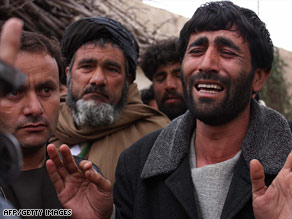
An Afghan man grieves for his brother after an attack this week by U.S.-led coalition forces.
At least 44 miners have died and several dozen others were injured by a mine blast Sunday in northern China’s Shanxi province, state-run media said.

“We expressed our deepest condolences to the survivors of the noncombatants who were killed during this operation,” said Brig. Gen. Michael Ryan, U.S. Forces-Afghanistan. Three militants also died in Tuesday’s operation in the Gozara district of Herat province, the military said. The killings further inflame Afghans’ anger and frustration over the killing of civilians in U.S.-led coalition and NATO operations. Many civilians also die in the crossfire between coalition forces and Taliban militants. Watch the challenge coalition forces face » Afghan and coalition investigators and international observers this week were in Herat this week. Weapons and ammunition were found at the site of the operation and Afghan soldiers held shuras, or consultative bodies, with village leaders.

Don’t Miss
Pelosi, Karzai discuss terrorism, reconstruction

Obama administration stays course on detainees

Taliban ‘very tough test,’ Gates says

Closure of supply base begins

Ryan discussed the attack with senior police and army officials and with the governor of Herat. “Our inquiry in Herat demonstrates how seriously we take our responsibility in conducting operations against militant targets and the occurrence of noncombatant casualties,” Ryan said. “Our concern is for the security of the Afghan people. To this end, we continually evaluate the operations we conduct during the course of our mission in Afghanistan and have agreed to coordinate our efforts jointly.”

President Hamid Karzai raised the issue of civilian casualties during a meeting he had on Saturday with visiting U.S. House Speaker Nancy Pelosi. A “recent consensus between the Afghan government and NATO, which gives more authority to the Afghan security forces during military operations, house searches and detention of suspected individuals, will help in reducing civilian casualties and bringing more effectiveness in the fight against terrorism,” Karzai said.

Protest in Ireland of government handling of economy

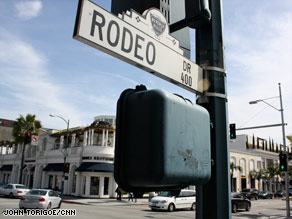
Beverly Hills officials say they expect tax revenues to drop by about $24 million over the next 16 months.
Hundreds of thousands of workers filled the streets of Dublin on Saturday to protest the government response to Ireland’s economic downturn.

But these days, visitors to California’s most famous ZIP code are more likely to take note of the empty storefronts and deep-discount signs. Call it recession, 90210 style. Fewer sales have meant fewer tax dollars even for this well-funded city. City officials say they expect tax revenues to drop by about $24 million over the next 16 months. They say, as far as they know, that’s the biggest single blow to the city budget in Beverly Hill’s 93-year history. Budget cuts being considered to cover the shortfall include reducing police overtime. Extreme wealth often cushions cities, just like it does individuals, during recessions. But Beverly Hills business owners say they’re feeling the impact this time. Jordan Tabach-Bank owns The Beverly Loan Co., which bills itself as “Pawn Shop to The Stars.” Since the 1930s, three generations of his family have offered socialites, businesspeople and celebrities confidential loans for precious jewels and artwork. He says now he’s giving more loans and they’re bigger than ever, including ones to local business owners needing money to cover payroll and keep their businesses afloat. “Doctors, lawyers, accountants,” he said. “I recently had a hedge-fund manager in here getting a large loan on his collection of diamonds.” Nearby, boutique owner Parvin Yonani said she’s slashed prices by as much as 85 percent. She says tourists are staying home and Beverly Hills residents are holding on to their money. She cut the price on a pair of shoes from $1,800 to $245. “Still I couldn’t sell it,” she said. “I paid about $800. So you’re taking a loss.” Another local business owner, Thomas Blumenthal of Geary’s Beverly Hills, said there are still signs of life in the West Coast mecca of the well-to-do. He’s had to trim some of his employees’ hours, but hasn’t made any other major changes, he said. “The wealthy still have money,” he said. “We’re still seeing people coming in, spending money on new homes, redoing their homes, buying new jewelry and statement pieces.

Don’t Miss
People.com: Oscar parties dialed back a bit.

CNNMoney.com Housing affordability improves

“It’s just not happening as much as it was last year.” Jerry Nickelsburg, an economist at University of California, Los Angeles, said that considering measures like home foreclosures, the downturn hasn’t been as bleak in Beverly Hills as other cities.

But he said that in one crucial way, this recession cuts across income lines. He said a collapse in consumer spending last September has continued until now. “That collapse in consumption was widespread and based on a fear — uncertainty — about the future,” he said. “So that really crossed all income classes.”

9021-Ouch: Recession trickling up to Beverly Hills

Beverly Hills officials say they expect tax revenues to drop by about $24 million over the next 16 months.
The Lamborghinis and Bentleys still cruise Rodeo Drive in Beverly Hills.

But these days, visitors to California’s most famous ZIP code are more likely to take note of the empty storefronts and deep-discount signs. Call it recession, 90210 style. Fewer sales have meant fewer tax dollars even for this well-funded city. City officials say they expect tax revenues to drop by about $24 million over the next 16 months. They say, as far as they know, that’s the biggest single blow to the city budget in Beverly Hill’s 93-year history. Budget cuts being considered to cover the shortfall include reducing police overtime. Extreme wealth often cushions cities, just like it does individuals, during recessions. But Beverly Hills business owners say they’re feeling the impact this time. Jordan Tabach-Bank owns The Beverly Loan Co., which bills itself as “Pawn Shop to The Stars.” Since the 1930s, three generations of his family have offered socialites, businesspeople and celebrities confidential loans for precious jewels and artwork. He says now he’s giving more loans and they’re bigger than ever, including ones to local business owners needing money to cover payroll and keep their businesses afloat. “Doctors, lawyers, accountants,” he said. “I recently had a hedge-fund manager in here getting a large loan on his collection of diamonds.” Nearby, boutique owner Parvin Yonani said she’s slashed prices by as much as 85 percent. She says tourists are staying home and Beverly Hills residents are holding on to their money. She cut the price on a pair of shoes from $1,800 to $245. “Still I couldn’t sell it,” she said. “I paid about $800. So you’re taking a loss.” Another local business owner, Thomas Blumenthal of Geary’s Beverly Hills, said there are still signs of life in the West Coast mecca of the well-to-do. He’s had to trim some of his employees’ hours, but hasn’t made any other major changes, he said. “The wealthy still have money,” he said. “We’re still seeing people coming in, spending money on new homes, redoing their homes, buying new jewelry and statement pieces.

Don’t Miss
People.com: Oscar parties dialed back a bit.

CNNMoney.com Housing affordability improves

“It’s just not happening as much as it was last year.” Jerry Nickelsburg, an economist at University of California, Los Angeles, said that considering measures like home foreclosures, the downturn hasn’t been as bleak in Beverly Hills as other cities.

But he said that in one crucial way, this recession cuts across income lines. He said a collapse in consumer spending last September has continued until now. “That collapse in consumption was widespread and based on a fear — uncertainty — about the future,” he said. “So that really crossed all income classes.”

Source: Obama seeks to halve deficit by 2013


President Obama will seek to cut the federal deficit in half by the end of his first term, according to an administration official.

LOS ANGELES, California (CNN) — One major contender’s chances at Oscar gold may be damaged due to its sensitive subject matter. “The Reader,” which is up for five Oscars — including best actress (for star Kate Winslet) and best picture — is being slammed by “Explaining Hitler” author Ron Rosenbaum, who’s asked Academy members to shun the post-World War II drama because the film “asks us to empathize with an unrepentant mass murderer.” Rosenbaum, who wrote his commentary for Slate.com, said that’s not his only reason. “It gives the impression that ordinary German people only learned the terrible things that happened in the death camps in the East after the war,” he said in an interview with CNN. “In fact, ordinary German people participated in Hitler’s final solution, the extermination of the Jews — it was no secret.” Read Rosenbaum’s essay Based on the German book with the same title, “The Reader” stars Winslet as Hanna Schmitz, a former Nazi prison guard living in postwar Germany. She meets and has a secretive affair with teenager Michael Berg (David Cross), who often reads aloud to her at her request. Unbeknownst to Michael, Hanna is illiterate. Their affair ends abruptly when she mysteriously disappears.

Eight years later, Michael is a law student. One day, while observing Nazi war criminals on trial, he’s shocked to find Hanna as a defendant in the courtroom. The court finds her guilty of killing 300 Jewish women during the war and sentences her to life in prison. While behind bars, Michael sends her books on tape, which, over time, help Hanna finally learn to read. Therein lies the problem for Rosenbaum. “What essentially it did,” said Rosenbaum, “was celebrate the enrichment of a life of a mass murderer when she learned how to read. … Imagine if there were a film about Charles Manson learning how to play chess and what a better guy it made him.” However, others in the Jewish community are applauding the film, including Ken Jacobson, deputy national director of the Anti-Defamation League. Jacobson says “The Reader” opens itself up to criticism, but is worthy of an Oscar at the same time. “I think it conveys a series of messages that actually are very powerful about the Holocaust, and it’s not in the usual way,” Jacobson told CNN.

Don’t Miss
Will ‘Slumdog’ have its day at Oscars

Full list of Academy Award nominees

Special Report:  Academy Award Spotlight

“As time goes on, as we have Holocaust deniers emerging more and more, we need people to be able to relate personally to what happened,” said Jacobson. “I think this film does this in a very powerful way.” The Weinstein Company, the studio behind “The Reader,” says it is proud of the film. “It is sad that some people misinterpreted the film’s message,” the company said in a statement. “It is not about the Holocaust,” the company added, “it is about what Germany did to itself and its future generations.” Will Rosenbaum’s piece, and the backlash he touched off, affect “The Reader’s” Oscar chances Sunday Entertainment reporter Tom O’Neil, who follows awards shows for the Los Angeles Times’ TheEnvelope.com, doesn’t think so. Given “The Reader’s” five nominations, he believes Hollywood has already embraced the film. “Oscar has taken special notice of ‘The Reader’ because it’s not just your average Holocaust movie,” said O’Neil. “It doesn’t beg for forgiveness when dealing with Nazis. It makes you think.” Still, Rosenbaum says any further accolades for the drama would be unfortunate. “I would be very disappointed in the intelligence level of Hollywood if it gave the best picture award to ‘The Reader,’ ” he said.

12 killed, 25 hurt in Slovakia bus-train collision

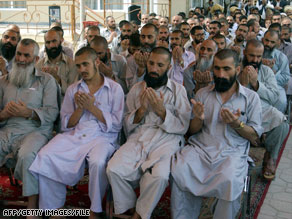
Former detainees pray near Kaubul in 2005 following their release from U.S. custody at Bagram Air Base.
At least 12 people were killed and 25 were injured Saturday when a train collided with a bus in Slovakia, government officials said.

“Having considered the matter, the government adheres to its previously articulated position,” said a Justice Department document filed in federal court in Washington. In a controversial 5-4 vote, the Supreme Court last year ruled that detainees held at the U.S. naval base at Guantanamo Bay had a right under the constitution to challenge their continued detention. However, the court did not say whether it applied to prisoners in other locations abroad, including Afghanistan. Five prisoners held at Bagram Air Base, backed by human rights groups, have gone to court to claim the same rights as the men detained in Guantanamo Bay. The new administration, which was given a month by a federal judge to declare whether the government wants to change its position, has now indicated it will continue to argue that it is against its security interests to release enemy combatants in a war zone. Barbara Olshansky, lead counsel for three of the detainee petitioners, said that the administration’s decision was “deeply disappointing.”

Don’t Miss
Read the Justice Department response

Court: Chinese at Guantanamo can’t be freed in U.S.

Teenage terrorist or confused kid — Gitmo’s youngest prisoner

“We are trying to remain hopeful that the message being conveyed is that the new administration is still working on its position regarding the applicability of the laws of war — the Geneva Conventions — and international human rights treaties that apply to everyone in detention there,” she said. The air base at Bagram, located north of the city of Kabul, houses between 600 and 650 detainees. Most were picked up for suspected ties to terrorism.