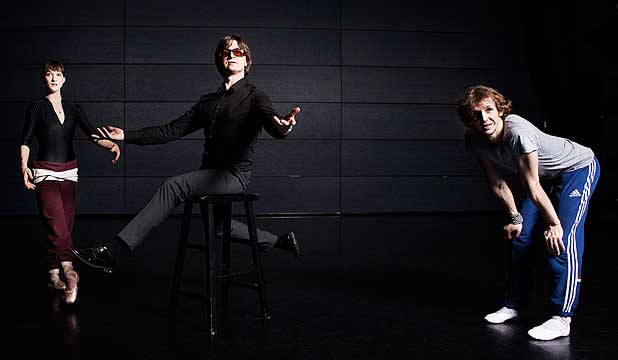
Sergei Filin, artistic director of Moscow’s Bolshoi Ballet, stands with his back to the mirror, chewing on his pinkie finger. He leans forward to get a better look at the dancers bounding in front of him, and squints as he flips his brown-tinted sunglasses up and down.
He wears them even in this darkened studio, ever since he was targeted in a Mafia-style revenge plot last year, when a thug hired by an embittered Bolshoi soloist threw sulfuric acid in Filin’s face.
The brutal attack made headlines around the world and scandalized the renowned ballet company, a symbol of Russian pride and perfection. The 43-year-old director emerged with third-degree burns and an uncertain future. Filin’s livelihood depends on a sharp eye for detail, but after 27 surgeries in Germany, he sees very little. Nothing out of the right eye; 50 per cent out of the left, on a good day.
But at this moment, there is no uncertainty. Filin has seen enough.
“Ach!” he cries out, squeezing his head in his hands. “Semyon, Semyon.”
“Can’t I do it this way” asks Bolshoi principal dancer Semyon Chudin in Russian, wondering what could be wrong with his jumps, which were high and sharp. But tense.
“You can,” snaps Filin, with a laugh. “But it’s bad.”
“Why”
“Because it’s not beautiful.”
Deafness didn’t stop Beethoven. Blindness won’t stop Filin. He is still in search of beauty. He is sensible to its shape, sound and visceral charge. Call it artistic vision: His dancer’s perception of the carriage and control of the body is undiminished. It is, most likely, what has saved him, and saved his job.
Filin looks sleek in a dark gray suit, black shirt and rose-coloured scarf, with his hair falling just over the collar. He resembles a younger, clean-shaven Bono. But his walk gives him away. That regal posture and buoyant, confident step mark him as a dancer. And a boss.
The former ballet star moves without hesitation. He enters the lobby of the Manhattan Movement & Arts Center unassisted, trailed by his mother, Natalia Filina, and a friend, Dilyara Timergazina, who is interpreting for him on this trip. He holds his head high, with the air of someone who is used to creating a stir.
Immediately, the stir begins. Going by his reception here, where Filin arrived last month to judge the Youth America Grand Prix, an annual ballet competition, and to rehearse some of the world’s top professional dancers for its gala, the acid attack has made him a hero. The dark glasses make him instantly recognizable.
“Ah! I love you!” cries an 18-year-old competitor from China, jumping up from the floor to stop Filin as he passes. She claps her hands in glee and mimes a photo request. With a debonair nod, Filin whips off his scarf and throws an arm around her while her mother snaps the picture. The girl bows to him, her hands clasped and eyes shining.
Filin has been told by his doctors to be careful. No jumping, no heavy lifting – and that includes ballerinas, whom he might be tempted to heave in a rehearsal. A rise in blood pressure could hurt his eyes. But how do you get a man to keep still when he has devoted his life to movement Filin is full of restless energy. In an interview, he pounds a desk with a water bottle for emphasis as he trumpets his accomplishments, such as hiring the Bolshoi’s first American principal dancer, David Hallberg, and perking up its repertory with modern, Western ballets.
Ad Feedback
In a rehearsal, he micromanages every last nuance of expression – the curve of the fingers, the gestures, musical timing – as he coaches dancers through a pas de deux. He runs from corner to corner, with Chudin following, and (Filin can’t help himself) he demonstrates how Chudin should jump. Quick and light, like a jackrabbit. Watching him, his mother covers her eyes.
Filin may have been brought low, but he is not backing down.
The Bolshoi’s performances at the Kennedy Center, May 20 through 25, mark the company’s first American engagement since the January 2013 attack on its director. It’s a long-awaited moment for Washington audiences to see how the art has fared in the turbulent aftermath. Filin insists that he is firmly in control.
The assault “hasn’t changed my heart or my soul. I am the same Sergei Filin I used to be,” he says, speaking through his interpreter during an hour-long interview interrupted twice so his mother could put drops in his eyes. She and Timergazina are his only companions on this trip; his wife and three sons, ages 17, 8 and 5, stayed in Moscow.
Filin’s skin, after state-of-the-art burn treatments, looks youthful and nearly unblemished, with a single fishhook-shaped scar on his jaw. When he takes off his glasses and tips his face up for the eyedrops, he becomes so startlingly vulnerable that one looks away, but not before noting the condition of his silver-blue eyes. The left one roves; the right, sightless one is clouded and looks shrunken, the skin tightly pulled around it.
“Nothing has changed in my style or my responsibilities,” he says with an extravagant shrug.
His style has won him praise – and enemies. If expansionism is the current theme in Moscow’s politics, so it has been in Moscow’s ballet under Filin. Since taking over in 2011, Filin has moved the Bolshoi beyond its stable of classic ballets and holdovers from the Soviet period by acquiring such varied contemporary productions as Onegin, by the late John Cranko; “Lady of the Camellias,” by the Germany-based American John Neumeier; Marco Spada, by Frenchman Pierre Lacotte, and Appartement by Sweden’s Mats Ek.
“I have helped the Bolshoi Theater to open its doors to talent,” he says, stirring his hands lightly in front of him, “to talented people, disregarding their nationality or birthplace.”
Mixing things up in the massive institution that traces its history back to Catherine the Great, with 200 dancers and layers of bureaucracy, had a history of risk. Reforms had been raising temperatures at the Bolshoi since Alexei Ratmansky, the celebrated choreographer now in residence at American Ballet Theatre, headed the company from 2004 to 2008. His untraditional productions and casting choices met with dancer protests, similar to what Filin would encounter.
Yet for Filin, frictions swiftly escalated. Shortly before he was attacked just outside his home in Moscow, his tires were slashed and he had expressed fears for his family’s safety to upper management. Bolshoi dancer Pavel Dmitrichenko confessed to organizing the attack with two non-dancers, and is serving six years in a penal colony. Police and investigators reported at his trial that the Bolshoi soloist felt he was being passed over for roles and was upset that his ballerina girlfriend, Anzhelina Vorontsova, was not being promoted.
But many feel Filin’s moves can only improve the company.
“He is so committed to bringing in world-class, contemporary repertoire to the Bolshoi Theater, and I think that’s the smartest approach that he could possibly make,” says Hallberg in a telephone interview. “He’s modernising Bolshoi Theater.”
The new acquisitions are “ballets that a dancer could only dream of,” says Olga Smirnova, a doe-eyed 22-year-old phenom who is in town to dance at the gala. She chose to join the Bolshoi over its refined St. Petersburg rival, the Mariinsky Ballet, shocking ballet-watchers. Smirnova had just graduated from the Mariinsky’s feeder school, the Vaganova Academy. Why did she throw her lot in with the Bolshoi
“This is the question that’s going to chase me until the end of my professional career,” she says softly, speaking through an interpreter. The Bolshoi “is in the forefront of a very intensive period of development,” she says, and the new repertoire “enables you to learn different styles and develop different aspects of your body that you don’t even suspect.”
Yet Washington will see none of the works that represent Filin’s vision. The Bolshoi will perform only one ballet here: Giselle, the 19th-century warhorse seen at the Kennedy Center with thudding regularity.
Asked if he would rather bring one of his new productions to Washington, Filin crosses his legs and clasps his hands. Is he girding himself against revealing too much It doesn’t work.
“If it had been only my personal choice, of course the answer is yes,” he says. “But presently the selection is determined by the Kennedy Center and the tour department of the Bolshoi Theater. They negotiate the type of performance that we bring.”
“The decision is based on ticket sales,” he added.
What would he have preferred to bring After mildly protesting the question, Filin leaned forward with a hearty laugh. “When I have the authority to bring a selection, you will see what kind of ballets I want to bring to Washington. Then we’ll definitely meet again!”
“Giselle,” a soft-textured romantic-era ballet, is worlds away from Filin’s present mind-set. It’s about a peasant girl in love with a disguised, two-timing nobleman; she drops dead when she learns the truth about him. Returning to the stage as an understanding ghost, amid mist and moonlight, she forgives her tormentor.
For Filin, the idea of letting his attackers off the hook is “kind of sick.” But it gives him a wickedly witty idea about how to update “Giselle.”
“I don’t think she had enough time to consider her moral injury. I think that if she didn’t have an instant death, but could breathe on, then she would have developed hatred for Albrecht,” he says, with a smile. “And feeding on her hatred, she would have designed a way to harm him.”
Filin laughs, and Timergazina, interpreting, laughs too, and waves a hand at him as if to shut him up.
There’s no shutting him up. “To mine the field around her village,” Filin continues, chuckling, scattering explosives in the air, “or to make a big hole so that he’d fall into it with his horse and die.”
He beams as his revenge fantasy builds: “How she brewed the poison, and then put some acid inside!” He mimes dumping chemicals into a vat and tossing the contents, heaving the weight with both hands, and laughs louder.
What is it that guides Filin
Dancers have a kind of sixth sense about where their bodies are in space and how to move through it. Perhaps this internal compass is what Filin draws on to navigate his world with relative ease. But isn’t it more difficult to tell what other dancers are doing, in a rehearsal
He says he can perceive “the style, how the body works. I can also hear whether they are musical enough and how purely they perform the movements.”
Purity. This is what he’s after as he works with Chudin and New York City Ballet principal Ashley Bouder on a scene from another romantic-era ballet, “La Sylphide.” You’re landing too heavily, he keeps telling Chudin. Be more elegant.
At one point, Bouder, the fairylike sylph of the title, chases and catches an imaginary butterfly. Chudin, her tenderhearted mortal lover, asks her to let it go.
Filin grabs Chudin by the waist. “You have to look at her!”
He spreads his arms wide. “It’s not this big enormous thing!” he tells them. “It’s little, tiny. Delicate.” This scarred, tough-minded man shows them how to convey the preciousness of insect life with a wiggle of his fingers. The three of them huddle together, fingers fluttering, as if a chorus of teeny wings was taking flight.
Ultimately, the art of ballet is about intangibles. Small, beautiful details with an emotional power that’s difficult to explain. You have to feel them. At its most poetic level, ballet turns on almost imperceptible elements that are sensed, suggested. And it is in this space that Filin operates as if by instinct, guided by all his years as a dancer, and who knows Perhaps by new sensitivities that his ordeal has unmasked.
This was Chudin and Bouder’s first rehearsal together; by the end of it the charm and poignancy of their scene was vividly clear.
What was the chief thing that Filin wanted to teach them
He replies, startlingly, in barely accented English. “I wanted to see . . .” He twirls a hand, searching for the right word.
“The breath. Air. The vibration between them.”
And did he see these unseeable things
He grins. Through his dark glasses, you see the corners of his eyes crinkle.
“Yes!”
The competition he’s judging starts in 20 minutes. Timergazina tugs the director’s arm to get him to stop talking. Swaggering, almost bounding, into the hallway, Filin is joyous.
“I love dancers!” he says, pounding his chest. “You see The dancing I see perfectly.”
– Stuff