Prizes take backseat at MTV awards


Blood, buttocks, snakes and angry rants are just some of the surprises served up by the MTV Video Music Awards over the last three decades, and at today’s ceremony, there is stiff competition to deliver the show’s next most outrageous stunt.

R&B star Beyonce and newcomer rapper Iggy Azalea lead the nominees at the Video Music Awards, or VMAs, with eight nods each, and winners will receive the “Moonman” statuettes at the newly renovated Forum arena in Inglewood, California. New Zealand teenager Lorde is up in two categories.

X Factor NZ auditions hit the road again


Greymouth might have produced the country’s first home-grown X Factor winner – but the West Coast hasn’t made the cut for this year’s pre-audition tour.

The X Factor NZ hits the road in October and November, travelling to 13 locations searching for talent to take part in the second season of the TV3 show. Host Dominic Bowden’s return has been confirmed, and producers have announced that, for the first time, bands will be able to audition.

>Share this story on Facebook

But for West Coasters looking for a repeat of last year’s win by a local (Greymouth’s Jackie Thomas took the competition from Whenua Patawai), the closest they’ll get to the pre-audition action is Christchurch or Nelson.

John McDonald, co-executive producer said, “we believe the keen ones will come to us. We’ve tried to plan the pre-audition tour such that everyone that wants to audition won’t need to travel more than 2-3 hours to our locations.”

McDonald said the decision to allow bands to enter was exciting for a country that was “littered with great bands that play week in and week out on the pub circuit, school halls and small gigs. We think they’ve got as much right as anyone else to be discovered and end up with a record deal”.

The second season won’t screen until next year. No dates have been released, but host Dominic Bowden says production will be better geared around university and high school breaks.

“You can potentially finish your exams and have an incredible life-changing experience over the summer.”

He says he can’t wait to get started. “Since the first one finished, I’ve been like ‘ok, when are we going again’ I’m a live television junkie, both as a viewer and as someone who’s up the front.”

The presenter, who has based in the United States working as an entertainment reporter, says the X Factor NZ is a great platform for local performers.

“Living in America, I felt like the greatest asset was that I was a Kiwi and I believe the same can be true for our musicians. You don’t have to look far, whether it’s Kimbra or Lorde or the Naked and Famous. I’m constantly asked what’s in the water in New Zealand, because there are so many great singers, so many great performers coming from down under.

Ad Feedback

No judges for the second season have been announced. Last year, contestants faced Melanie Blatt, Ruby Frost, Stan Walker and Daniel Bedingfield. Bowden’s on-screen relationship with Bedingfield was tense. Is there anyone he wouldn’t want to see back

“Maybe I won’t say who it is, but I’m pretty sure you wouldn’t have to out too much thought into it. If you think about my job, and think about that person – you want someone who actually doesn’t try and make it too hard for you. But in saying that, I like a challenge. How’s that for diplomatic”

This year’s auditions are open to singers, groups or bands, aged 14 years or older on October 11. Potential contestants need to download an application form from

Boyhood: Epic work of art


REVIEW:

Without question my Film of the Year So Far (and with nearly two-thirds down, that’s not a trivial declaration), Boyhood may be notable for its form rather than its content, but both aspects are exemplars of How to Make a Great Film.

Together, the process and the story combine to deliver a hugely affecting cinematic experience which is well worth the nearly three hours you’ll spend on it.

The content is simple enough: young Mason is your average boy growing up in a middle-class household in Texas. His parents have separated and occasionally mum struggles with raising him and his sister Samantha.

Sometimes there’s a new man on the scene, although Mason’s interactions with his birth father are convivial enough. He’s basically a well-adjusted kid experiencing a fairly typical childhood.

However, the form is ground-breaking: 12 years ago director Richard Linklater cast a young boy named Ellar Coltrane against well-known actors Ethan Hawke and Patricia Arquette, and started shooting a movie about the life of an ordinary family over a passage of time.

But instead of employing different ages of actors and knocking out a feature film in the six months it usually takes to shoot a movie, Linklater had grander ambitions.

Between 2002 and 2013, he and his cast and crew would meet once a year for a few days to develop and film new scenes, focusing on quotidian plot-points rather than big life events, with his primary intention being to capture the boy growing into a teenager. So we see the storyboarded parents split up and new partners introduced. The boy grows long hair; he takes up photography, learns to drive. Each of the family dramas is recognisable, familiar, resonant.

The result is a simply stunning 160-minute chronology of one’s school years, and the travails of adjusting to upheavals in family life. Hawke and Arquette are superb, their ageing more subtle than the children’s but still appropriately noticeable, but it is Coltrane upon whom the director took a punt in casting, and boy, did that punt pay off.

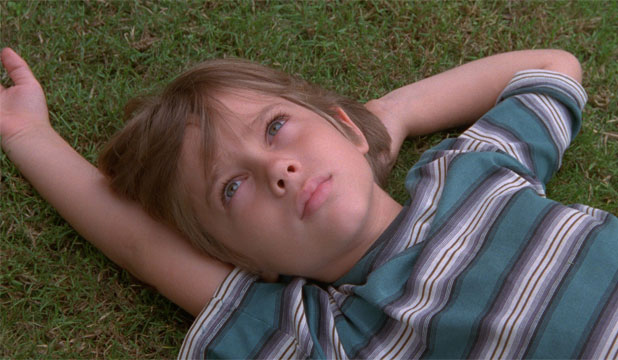
From the opening shot of him lying gazing at the sky through to a nicely bookended moment also set among natural beauty, Coltrane is effortless in front of the camera, and our disbelief at his really being “Mason” is completely suspended. There is something indescribably uncanny about watching this lad morph before our eyes – the hair gets shaggier, the chin is suddenly wispier – but the effect is somehow very moving, indeed.

Consistent with the director whose famous Before (Sunrise, Sunset, Midnight) trilogy demonstrated his fascination with the passing of time, Boyhood’s backstory is endlessly fascinating.

For starters, the fictionalised story was scripted by Linklater but he would brief his cast months before the shoot, inviting them to choose the song they would listen to on a filmed family car trip and asking Coltrane to make a note of his conversations should he happen to fall in love with a girl (Linklater wanted to capture how teens actually speak rather than write his “old person’s” take on young love).

Ad Feedback

Capitalising on this commitment to authenticity, as Coltrane developed an interest in photography in real life, Linklater wrote the hobby into his character. It totally works. What became Mason’s (and Coltrane’s) journey into manhood is one you’ll want to witness all over again.

Brain and brawn: How To Think About Exercise


Treadmills are boring. Kick-boxing hurts. Press-ups make your arms tired, and getting up early to swim lengths sucks.

No wonder gym memberships lapse and expensive running shoes end up in bottom drawers: the far-off promise of a six-pack and a healthy heart just can’t compete with the immediate allure of indolence and inertia.

But according to Australian philosopher Damon Young, the problem isn’t exactly laziness, and the solution isn’t simply to try harder.

The real reason we abandon well-intended exercise regimes is that we’re thinking too much like Descartes – and the way to fix it is to get a bit more Socratic. A rudimentary grasp of the writings of Heidegger, Aristotle, Camus, Hume and Tolkien may also help.

This is, of course, a bit daft, but in his thoroughly readable treatise How to Think About Exercise, Young skips through a couple of millennia of philosophical writings on the subject of exercise, extracts the most useful bits and then, in a style reminiscent of self-help-through-high-culture guru Alain de Botton, explains how you might use all this erudition to improve your life.

Young, whose other works include a study of the gardens of famous thinkers, a pop-philosophy history called Distraction and a children’s book called My Nanna is a Ninja, will this week appear at the Christchurch Writers and Readers Festival.

Earlier this month, on the phone from his home in Melbourne, he explained why the world needs a book about the philosophy of exercise. The book, says Young, is “a morale boost” for bookish folk who are interested in exercising more but find themselves alienated by a fitness industry “which can be anti-intellectual at times”.

Conversely, there are sporty folk “who might want to think about it a bit differently”. And then there are the people who’ll drag themselves along to the gym in the hope of becoming healthy and beautiful, then give up after six months.

“I’m suggesting that’s because they’re focussing on the wrong part of exercise,” says Young. Rather than treating your body like a car that needs to be taken to the mechanic for a tune up, why not “pay attention to what it does for your character, your intelligence or imagination” Those benefits will keep you absorbed for a lifetime.

So what has Descartes got to do with all this

Young isn’t exactly blaming your double-chin and pot belly on the 17th-century French philosopher, but Descartes was the first to convincingly articulate for the concept of dualism: the idea that the body and the mind are separate, that the real you is your mind, and your body is just an unreliable, short-lived vessel.

You don’t need to read Descartes to believe this, says Young. It’s quite reasonable to feel “like we are minds stuck in bodies that are flawed – they feel pain, they get sluggish, they can be a source of wayward impulses”.

But Descartes was wrong. Body and mind are inextricably linked; we are “inescapably fleshy”. The philosophies you should be listening to, says Young, are those such as Socrates’, who reckoned “people’s minds are so invaded by forgetfulness, despondency, irritability and insanity because of their poor physical condition that their knowledge is actually driven out of them”.

Ad Feedback

Or Aristotle, who reckoned we are a bundle of dispositions which can be strengthened with training. Young was his own guinea-pig for the book. He tried yoga to see if it would awaken a greater awareness of his own physicality (it did, but he later quit). He boxed, swam and ran in search of the salutary values of pain, fear and boredom respectively.

Young convincingly argues that brain and brawn should co-exist in one body. But there’s more: self-help tips. “One of the themes of the book is that you should try something that complements your personality rather than matches it,” says Young.

“So someone who is overly humble and is down on themselves – they may want to try exercise that will enhance their pride, such as sprinting up a hill as fast as they can.

“Someone who is full of themselves – thuggish, braggardly – may want to take something humbling like rockclimbing, where having massive upper-body strength might be handy but what you really need is caution and skill and patience.

“If there are gaps in your character you can use exercise, in some cases, to fill them up.” It’s not like taking a pill, says Young. It won’t work for everyone all the time. “But there’s good evidence it will work for some people.”

There’s one more reason Young likes to exercise: “I’m going to die one day. I’ll no longer be a body. I might as well see what it can do.”

How to Think About Exercise, by Damon Young Macmillan

For details of Damon Young’s appearances at the WORD Christchurch Writers and Readers Festival, see www.wordchristchurch.co.nz

– Sunday Star Times

Otara Millionaire’s curse


To the world, it was just another catchy tune. But for Pauly Fuemana’s family, How Bizarre was a curse.

The quick rise to fame, the Hummer, the dollar bills, the bankruptcy and eventual death from the side-effects of a rare neurological illness – the sad decline of Pauly Fuemana, lead singer of OMC, has been well-documented.

But for his family, the hit single was no blessing.

>Share this story on Facebook

How reality TV is hooking us in


How many screens does it take to watch a reality television show

“It depends what’s got the most battery,” says broadcast personality Dom Harvey.

Today’s viewer is a multi-tasker, using social media platforms to simultaneously read, write and comment about what they’re watching. It’s called second-screen engagement – and no genre has tapped into it better than reality television.

This week, New Zealand’s biggest networks – TVNZ and MediaWorks – go head-to-head in the battle to dominate social media conversations with the return of DIY competition The Block NZ and the first local production of My Kitchen Rules.

Once, their success would be measured by ratings.

Today, the bean counters will also be noting “second-screen” involvement: Twitter, Instagram, and Facebook participation via mobile phones and tablets.

“It almost gives it that feeling of being at a sports game,” says Harvey, who admits to using both his mobile phone and iPad while watching television.

“Suddenly, you’ve got thousands of people who are all joining you in this activity. The only pitfall I’d say, is it’s hard to read what other people are writing, and write your own stuff as well. I’ll be scrolling through my feed and reading other people’s tweets and suddenly realise I’ve missed about three minutes of what’s happening on television. Then you’ve got to rewind and hopefully by the time the ad breaks are over, you will have caught up again.”

Consider the inconceivability of that statement 15 years ago: Words like “feeds” and “tweets”; the concept of rewinding live television and the bliss of skipping a commercial break.

“I’m a kid of the 80s,” says Harvey.

“I was raised in the era when there were just two TV channels and the next day, at school or work, everyone was talking about exactly the same TV shows. There were such limited options.”

The “second-screen” experience, where viewers post their thoughts online as the action happens, has been dubbed the new water cooler. Participants enjoy being part of a bigger conversation.

But it’s also, says Harvey, “partially an ego thing”.

“If you write something that gets favourited 50 times and 29 retweets, it certainly gives you a little bit of a buzz. Which is tragic, I know.”

Last year, MTV’s parent company Viacom International Media Networks determined that 70 per cent of its young viewers were interacting with other fans via a second screen while watching their favourite shows.

As one American commentator wrote: “The reality television world has started to strategically use social media for some of the heavy lifting to get ratings, which in the past had been placed solely upon the shoulders of some crazy woman or a guy who would eat live rats for $1000.

Ad Feedback

“The star characters of these reality shows are now continuously using social media to be in your face daily – if not hourly – with their drama.

“A strong social media presence now comes as a job requirement when you apply for reality stardom.”

How does that experience play out here In March 2011, Greymouth woman Jackie Thomas posted her first tweet: “Why the heck do I have a Twitter #notfamousenough.” Two years later, she won the first series of X Factor NZ. Her followers hit a healthy – for New Zealand, if not spectacular for a pop star – 10,000. (Neil Finn, by contrast, has 24,000; Kimbra has 144,000 and Lorde more than two million).

According to figures provided by TV3, when the series screened, up to 70,000 Facebook fans were actively talking about the show at any one time, and every episode trended on Twitter.

There were downsides. Harvey had to apologise for his tweet that referenced a child molestation storyline from the movie Once Were Warriors. When contestant Grace Ikenasio was eliminated, he wrote “Poor Gracie! First molested in her own bed by uncle bully [sic]. And now kicked out of #xfactornz.”

The problem, said Harvey this week, “is you’re in the privacy of your own home and often you’re writing and you’re posting these things without giving it too much thought”.