Memphis: Flood-Weary Residents Go Sightseeing on the River

Memphis: Flood-Weary Residents Go Sightseeing on the River

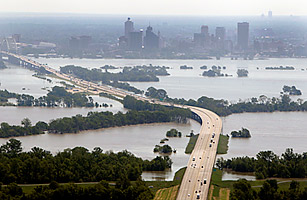
After weeks of storms and floods, Memphians awoke Tuesday morning to the highest river they’d seen in 74 years. The Mississippi had risen to 48 ft. ; 120 million cu. ft. of water rushed by every minute — enough to fill a football field 44 ft. deep every second. By May 10, the river had swelled to six times its normal girth, more than 3 miles across at Memphis.

But much of the city remained largely untouched by the creeping water, and its residents had clearly grown weary of staring suspiciously at it. Along the banks of the flood-ravaged Mud Island Tuesday morning, the pleasure boats returned to the bloated Mississippi.

This, of course, was the opposite of what the authorities were recommending. “We do not consider these waters recreational,” lectured Bob Nations, the head of the Memphis/Shelby County Emergency Management Agency, at a press conference earlier that morning. “We do not consider these waters healthy. They are dangerous.” Though mostly snow and ice melt and rain, the waters have flooded farm fields treated with dangerous pesticides and overrun sewers and industrial plants.

Still, they hadn’t banned pleasure craft from the river, so I decided to take a ride. Memphis’ waterfront looked “like a California beach walk times 10,” said Mark Bills, owner of Uptown Carriages in Memphis. Bills and two other horse-drawn carriage drivers, Lissie Mullen and Shannon Bryan, were taking the day off to sightsee in the city they were all born and raised in: their first airboat ride on a river they’d lived next to for more than century combined. Thousands of tourists — mostly locals like these three — paraded up and down the raised trolley rails over the flooded Riverside Drive. Hawkers sold water, ice and beer. A couple of enterprising salesmen peddled T-shirts reading “I Survived the Flood of 2011” and “2011: The Flood of the Century.” “I feel like a kid, this is so exciting,” Mullen said, buying souvenirs ahead of the outing at the Memphis Riverboat tourist shop. A crowd formed as Captain William Lozier piloted the Demona, named for his wife, to the pier. “Hey, can you rent those things?” asked a woman with a baby. “Yes, for $30 the half an hour,” Lozier said, before adding, “but I don’t take babies, kids or pregnant ladies.”

Demona had no seatbelts — “so we don’t drown if we flip,” quipped Bryan cheerfully. Airboats are tiny crafts that seat six and use a giant fan to propel the shallow boats across the surface of the water. Passengers must wear glasses — bugs smashing into your eyeball at high speeds can be painful — and ear plugs, the giant kind worn by workers on airport runways. “If you care about your hearing, you’ll wear them,” Lozier advised. The four of us buckled into life jackets and scrambled aboard, jockeying for the front seat. I lost, but was ultimately glad I did as Bryan and Mullen ended up soaked.

The rushing river did seem a little daunting, but the airboat seemed to flit above it — as it did the occasional grassy knoll the Lozier playfully swerved up against. “What people don’t understand is that it’s so spread out that it’s not much different from regular currents,” Lozier says. Several school groups have canceled riverboat tours because of what parents perceive as dangerously high waters. We skimmed over the submerged grounds of an amusement park on Mud Island and raced straight across the heaviest currents toward Arkansas on the far bank, where the water sprawled like a lake for miles.

The day was already warm — 85F at 11:30 a.m. I shuddered to imagine Memphis’ coming mosquito plague when all this water settled into small lakes, then ponds, then large puddles — slowly evaporating over the summer.

We paralleled Interstate 40 for more than a mile; the Mississippi usually spans just half a mile there. Drivers rubbernecked to take pictures of us, surprised to see a boat so close, as we dodged semisubmerged billboards, telephone poles and what was not long ago a weigh station for trucks. We took pictures of the drivers taking pictures of us. We passed what was left of a trailer park. The water had swept the RV’s from their homes and wedged seven of them beneath an overpass. The road was slightly elevated — built to withstand exactly this event — but that also meant that we could weave under the pylons every few hundred yards.

The water smelled dully like a sewer with a side of chemical plant, a bit like Arabi in New Orleans, where the floodwaters mixed with an oil slick after Hurricane Katrina. I was reminded more intensely of how much I’d rather not take a swim just as we hit the wake of a motorboat and flew up like kids on the back seat of a school bus on a bumpy road.

We turned south after a while and played hide-and-seek with a railroad bridge and Interstate 55 before looping northward back to Memphis. The city’s famous Pyramid arena — a massive 20,000-person venue with shiny glass sides — reflected the sun. Tourists waved at us from Tom Lee Park and an annoyed television correspondent waved us quickly out of his shot. After all, how serious could a natural disaster be if he had airboats on the water behind him? Lines of white television trucks lined the waterfront, and more river gawkers waved from the elevated trolley platform above.

As we pulled in, a crowd again formed. Lozier told onlookers where to buy tickets. A salesman was advertising the 2:30 riverboat cruise. After weeks of tornadoes, torrential rains and then the rising Mississippi, business has been bad. But as the fear of flooding wanes, judging by the crowds that were lining up for boat tours, Memphians are again embracing their mighty river.

See photos from the aftermath of the April storms.

See TIME’s Pictures of the Week.

NASA’s Mission Helps Prove Einstein’s Relativity Theory

NASAs Mission Helps Prove Einsteins Relativity Theory
“Lights All Askew in the Heavens,” proclaimed a headline in the New York Times on November 10, 1919. The reason: results had just come in from the very first test of Albert Einstein’s new general theory of relativity. “Men of Science More or Less Agog over Results of Eclipse Observations,” the headline continued, in what passed for breathless excitement back then.

The key theory that had the scientists so giddy was Einstein’s claim that space and time were elastic, and could be warped and stretched like taffy. The test that proved it involved observing stars whose position in the sky makes them appear to be close to the sun and measuring whether solar gravity warped space-time enough to distort the starlight slightly. A 1919 solar eclipse allowed scientists to see the stars clearly and make the necessary measurements — proving that the great man’s theories were correct.

You might think that when a scientific finding hasn’t been seriously challenged for 93 years the matter would be pretty much settled, but experimentalists have been poking and prodding Einstein’s premises ever since. There’s more than just stubborn skepticism at work: some of relativity’s more esoteric implications are fiendishly hard to confirm, so the physicists keep devising more and more sensitive and difficult studies — even though the theory keeps passing them all.

Which explains a recent announcement out of NASA headquarters. After no fewer than seven cancellations, followed by seven reprieves, the space agency’s orbiting Gravity Probe B mission, or GP-B for short, has at last confirmed not one, but two of relativity’s more subtle predictions — and it took only 51 years and three-quarters of a billion dollars to do it.

To understand what the probe found, you first need to know about space-time, the four-dimensional stage on which everything in the universe plays out. What we think of as gravity, Einstein said, isn’t a force that pulls two objects toward each other. Rather, it’s a warping of space-time itself that makes objects want to move. The classic real-world analogy is a bowling ball on a trampoline. The ball makes the trampoline’s surface dip. That’s something vaguely like the way a star or a planet makes space-time warp. The big difference is that space-time isn’t a flat surface, but something that fills the universe. This makes the warping pretty much impossible to visualize, even for physicists, so don’t try. In any case, if you roll a marble close to the bowling ball, it will naturally fall into the depression — just as a passing meteorite falls to Earth.

That’s part one. Part two is that since the bowling ball represents Earth, it isn’t just sitting but spinning, which makes the surface of the trampoline twist a little in the direction of the spin. The same goes for the space-time surrounding our spinning planet. What GP-B did was to measure both the dip and the twist.

The spacecraft managed that impressive feat by carrying four of the most perfect gyroscopes ever built — actually, they’re superconducting balls of niobium — into orbit around planet Earth while the ship itself pointed unerringly at the star IM Pegasi for 17 months, starting in 2004. The balls, meanwhile, floated independently inside, supported only by magnetic fields. If the gyroscopes kept the same orientation as the spacecraft that bore them, Einstein would have been refuted. But they wandered a bit, meaning the satellite was flying through gently twisted space. Relativity had come through once again.

It took years to figure that out, though, because the experiment turned out to be flawed. Patches of electric charge had built up on the surface of the balls, adding an extra force that proved extremely tricky to unravel. And even when the physicists had done so, they found they could measure the dip in space-time only to an accuracy of 1%, and the twist, formally known as “frame dragging,” to a flabby 19%. In the half-century since GP-B was first proposed, moreover, other physicists have confirmed both effects.

“I have to compliment the Gravity Probe B team for their result because Gravity Probe B is a very difficult and very beautiful experiment,” the Italian physicist Ignazio Ciufolini told the website ScienceNOW. He was clearly being polite, considering that his own LAGEOS satellite measured frame dragging with higher precision a few years ago.

LAGEOS and the other experiments that yielded similar findings weren’t necessarily cheap, but they didn’t cost $750 million either — a price that even NASA was finally unable to afford. It backed away from funding the last stages of the project, relying on a Saudi scientist to kick in the final few million.

So was Gravity Probe B worth it? To hear GP-B scientists tell it, the experiment was a resounding success. But in order to justify that judgment in the face of the high cost, slow progress and imprecise results, they knew they couldn’t simply invoke Einstein. Instead, they also felt the need to point out that people who had worked on GP-B as grad students had gone on to do important things , and that the technology developed for GP-B had widespread applications — including, believe it or not, GPS systems that now help farmers plant very straight rows of corn.

For anyone familiar with the NASA press office, this isn’t a huge vote of confidence. If you need agriculture to justify a fundamental physics experiment, you’re clearly feeling a little desperate. And with sharply declining budgets, better corn rows won’t likely convince the agency to spring for more big-ticket tests of general relativity.

But money for such studies didn’t seem to be forthcoming anyway. Just last month, NASA announced it was backing out of a proposed space mission called the Laser Interferometer Space Antenna, designed to look for gravitational waves — yet another of relativity’s strange predictions. It may be a while, in other words, before men of science — and the women who long since broke into that once exclusive club — get to be more or less agog again.

Watch “10 Questions for Stephen Hawking.”

See TIME’s Pictures of the Week.

Why the Taliban Won’t Miss bin Laden

Why the Taliban Wont Miss bin Laden

As the sun rose, the men from the raiding party chanted verses from the Qu’ran, spread their chequered scarves on the dirt, and prayed for Osama bin Laden’s swift passage to paradise. It was a ritual they’d performed a hundred times for their fallen comrades. But there were no outbursts of grief or pledges of vengeance. Bin Laden had been a good Muslim, said the small, wiry Taliban judge leading the ritual. Bin Laden had surrendered a life of luxury for one of hardship, and his “death on the battlefield” was befitting. Beyond that, as far as the Taliban are concerned, “His death had no impact,” said the judge, who goes by the nom de guerre ‘Khanjari’

Books: Anguish Artist

Books: Anguish Artist
THE BLEEDING HEART by Marilyn French Summit; 377 pages; $12.95 The bestseller is the AK-47 of the women's liberation movement. It has
proved to be a highly effective weapon: relatively cheap, easy to mass
produce, reliable and deadly even in inexperienced hands. A case in
point was Marilyn French's first novel, The Women's Room . It hit
middle-class America at the right time. Consciousness was up; stale
marriages were crumbling like mummies exposed to the air; Jacks were
breaking their crowns and Jills stopped tumbling after. The Women's
Room certainly contributed to the body count. Its views were stated
with unnerving energy and conviction; the prose was tight; the suburban
settings had the authentic odor of nylon pile, and the characters were
quivering chunks torn from the author's own life. Her soul on ice,
Marilyn French sounded like a feminist Eldridge Cleaver. The Bleeding Heart suggests a slight thaw. Its core is a seemingly
endless and inconclusive dialogue—SALT talks in the gender
wars—between a 45-year-old woman and her lover, a middle-aged
businessman. Dolores Durer is a professor of English at a Boston
college, divorced and the mother of grown children. She is in Oxford,
England, to complete research for her book, Lot's Wife: A Study of the
Identification of Women with Suffering. Victor Morrissey, 50, is in Britain to open a branch office. His wife is
in a wheelchair in Scarsdale, N.Y. She lost both legs when, enraged and
intoxicated after learning of her husband's philandering, she drove her
car into a concrete abutment. The relentless tenet of The Bleeding
Heart is that women always suffer and pay more than men. Even Dolores' name is a constant and heavyhanded reminder: the Latin
dolor, for pain; durare, to endure. Victor means victor, the confident,
satiated gladiator who pats his woman on the rump and rushes off to
compete for glory and riches. He gets ample time to give his side of
the story. The man is bright but no intellectual threat to Dr. Durer's
fevered assertions and generalizations. Still, he may be too smart to
challenge such filibusters as, “What I want, Victor, is to change the
world … To make it a place where women's way of seeing, thinking,
feeling, is as valid as men's. Where maybe even men will join the women
because they will see that women's way of thinking is more decent, more
humane, and in the long run, Victor, more likely to preserve the human
race!” Dolores never backs down; her self-respect is at stake, and it is
apparently still too new and fragile to allow concessions. One can
admire her for this, even while she uses her vulnerability to assume
the dual role of a martyred carrier of great truths and a political
radical who believes “you have to be narrow when you're at
war.” Neither is it difficult to understand Dolores' need for
Victor's warm body at the same time that she resents him. She has had
it rough, as her copious flashbacks to a miserable marriage and family
tragedies indicate. Life is messy, after all, and consistency is often
the first casualty.

Drug Nets

Drug Nets

Stepping up the attackSometimes it seems that success fathers its own problems. In its
campaign to hook smuggled drugs, the Reagan Administration has claimed
some impressive catches: since establishing a regional interdiction
center in South Florida in March 1982, it says that cocaine and
marijuana seizures there are up 54% and 23% respectively, drug arrests
have risen by 27%, and the street value of intercepted dope amounts to
around $5 billion. Smugglers, however, have risen to the challenge by
trafficking in smaller, harder-to-detect loads and by moving some
off-loading operations to other places, including California and the
Atlantic Coast as far north as Nova Scotia.To counterattack, Vice President George Bush, in a speech on Friday,
announced the creation of five new regional interdiction centers that
will be modeled on the South Florida experience. Based in New York,
Chicago, New Orleans, El Paso and Long Beach, Calif., each new office
will be assigned representatives from all the major military and
intelligence bodies and will make use of equipment from other agencies.
Explained one Bush aide: “The military has to go on training missions
anyway. If we know of a trouble spot, why not ask the Air Force to fly
a plane with radar to that spot?”All of this coordinated activity comes none too soon in the view of the
General Accounting Office . Last week it issued an 88-page report
charging that despite a tripling of federal resources to $278 million
over six years, only 16% of the marijuana and less than 10% of the
other illegal drugs entering the country were seized. It further
observed that military assistance is necessarily limited by costs,
other commitments and national security considerations. Above all,
the GAO urged the creation of a single “drug czar” post to coordinate
sometimes inefficient and even counterproductive drug-busting efforts
by the various agencies involved.Administration officials complained that the report, mostly covering the
period between 1977 and September 1982, ignored recent
developments, and pointed out that there is already an emphasis on
closer cooperation. Each of the newly established offices will have a
full-time coordinator under the overall command of the Vice President's
staff. Said Bush last Friday: “We in the Administration are not unaware
of the difficulty of our task. But our efforts are both innovative and
substantial.”

Crack Down

Crack Down
Presidents bedeviled by seemingly intractable problems tend to resort to symbolic gestures. As he wondered how to pay for the Great Society and the Viet Nam War all at once, Lyndon Johnson roamed the White House halls turning off lights to save electricity. In the depths of the energy crisis, Jimmy Carter turned down the thermostat in the Oval Office and put on a sweater. So, as the national furor over the drug crisis continues to grow, it was not altogether startling to hear Ronald Reagan offer to take a urine test to determine if he has consumed any narcotics lately — and to ask his entire Cabinet to follow suit. Declaring a “national mobilization” on narcotics abuse, the President set forth a program last week that was long on exhortation and good intentions but a bit short on specifics and cash. Indeed, about the only concrete step he announced at a briefing for White House reporters was a call for mandatory drug testing for certain key federal workers, and even then the President did not spell out which ones. Over the weekend, Reagan “led the way” by taking his test before undergoing what proved to be a routine urological examination. It was not the sort of event that provided the press corps with a photo opportunity, but it served to underscore just how serious the President is about tackling the nation’s drug epidemic. He can hardly afford to be less than serious. The National Institute on Drug Abuse estimates that up to 5 million Americans regularly use cocaine and that annual cocaine-related deaths have tripled since 1982, from 202 to more than 600 in 1985.White House polls show that the public is more worried about drugs than about such matters as the federal budget deficit and arms control. Congressmen, particularly Democrats trying to find an election issue for this fall, are tripping all over one another to introduce free-spending antidrug legislation. The President’s wife has long been in the forefront of the drug war with a “Just Say No” campaign that she has doggedly propagated to the nation’s youth. Yet for reasons philosophical and fiscal, the President is not rushing to throw federal dollars at the drug crisis. He does not want to inflate the federal deficit, which could reach a record $230 billion this year, by creating new and costly Government programs. Reagan would prefer that many of the solutions — and most of the funding — come from state and local officials and the private sector. Thus the crusade called for by the President last week was, as he admitted, less a program than a set of goals. Promising “more to come,” he offered a six-point plan: A drug-free workplace for all Americans. Reagan wants the Federal Government to serve as an example. Though he stopped short of calling for across-the- board drug screening for all federal employees, as some of his aides have urged, the President proposed mandatory urinalysis for federal workers in “sensitive” jobs. White House aides later explained that this meant workers charged with public safety, like air-traffic controllers and national- security and law-enforcement officials. The President’s Cabinet has dutifully agreed to undergo drug tests if asked, as have most White House staffers.

The Drug War Bogs Down

The Drug War Bogs Down
It is lunchtime in New York City’s Chelsea district, and Barry, a young drug dealer, is out on the streets hawking his wares. Business is good. “You want a splash?” he asks a customer, referring to a slim fold of waxed paper containing $20 worth of cocaine. Although he was arrested twice last winter, Barry was sprung both times within 24 hours. The first bust cost him a $400 fine, the second was dismissed on a technicality. “When the crack thing was in all the papers, the heat was pretty bad,” Barry recalls. “The cops were coming around, sealing the street, searching people up against walls. But that didn’t last. They only do it for so long, and then they leave you alone. Maybe they’ve given up.” Remember the drug crisis? Only a year ago everyone was obsessed with crack, the extremely addictive, smokable cocaine. A scant 18 months have passed since the shocking coke-related deaths of Athletes Len Bias and Don Rogers. In the wake of the stock-market crash and tensions in the Persian Gulf, it is hard to believe that in September 1986 some opinion polls showed drug abuse topping economic woes and the threat of war as America’s No. 1 national concern. Politicians were quick to respond to the electorate’s anxiety. Ronald and Nancy Reagan gave a national television address supporting the antidrug crusade. Congress hastily drafted the Anti-Drug Abuse Act of 1986, appropriating $1.7 billion for law enforcement, drug treatment and education. In a critical election season, both houses of Congress eagerly passed the legislation, with only 18 lawmakers opposing it. A year later, the drug war is being lost in the trenches. While arrests have surged, more cocaine is being smuggled into the U.S. than ever before, and the demand for coke has never been higher. Drug-abuse treatment centers around the nation remain overcrowded and underfinanced. Prospects are dim for renewed funding at last year’s high level for enforcement, education and treatment. Americans consumed 72 metric tons of coke in 1985, more than double the 1982 estimate. Moreover, because of depressed prices, competing dealers are selling cocaine in increasingly stronger doses. While street coke in 1983 was about 35% pure, today it has a purity of almost 65%. Tying to stanch the flow of narcotics into the U.S. has become a Sisyphean task. U.S. agencies seized a record 33.4 metric tons of coke and made an unprecedented 20,000 arrests in fiscal year 1987. With money from the 1986 drug bill, federal agencies have hired thousands of new investigators and contracted for improved interdiction hardware. The first of as many as seven radar balloons along the U.S.-Mexico border went into service this month over Fort Huachuca, Ariz. Yet the more authorities interdict cocaine, the more it seems to get smuggled into the country. “If we want to talk about slowing down the flow of cocaine into the U.S., we should think more in terms of demand reduction,” says DEA Chief John Lawn. “If the cartel in Colombia is shut down, other cartels in other source countries will merely pick up the customers.”

Striking At the Source

Striking At the Source
Word leaked out almost as soon as the giant U.S. Air Force C-5A transport plane touched down in the Bolivian city of Santa Cruz. As U.S. embassy spokesmen in the capital city of La Paz and Defense Department officials in Washington tried to downplay the matter, headlines in Bolivia and the U.S. were blaring the news: in the first use of a U.S. military operation on foreign soil to fight drugs, Army Black Hawk helicopters, armed with .30-cal. machine guns and escorted by about 160 U.S. soldiers, had been flown into the South American jungle to assist Bolivian authorities in wiping out that country’s production of cocaine. Although the mission had a ferocious code name, “Operation Blast Furnace,” it was apparently carried out under unwritten rules similar to those observed when federal revenue agents chased down Appalachian bootleggers: the etiquette dictated that no one on either side would really shoot to kill. U.S. troops, though armed with M-16 rifles, were under orders not to fire unless fired upon. Besides, the splash of unwanted publicity removed the surprise, ensuring that most of the big drug traffickers would be out of the country before the forces arrived. Said Bolivian Ambassador to the U.S. Fernando Illanes: “With all the advance advice, I think everybody is scampering.” At the outset, the mission had a comicopera quality to it. The planned arrival from the U.S. Southern Command in Panama of the C-5A transport ferrying the helicopters, to be followed by C-130 troop planes, had to be delayed three days because a wildcat gasoline strike prevented refueling at Santa Cruz airport. While the huge C-5A sat at the airport in full view of TV cameras, reporters and, presumably, drug merchants, U.S. troops needed four days to transport supplies to a base camp north of Trinidad, in Bolivia’s lush northeastern Beni region, where most of the coca leaves are processed. “This thing has turned into a bad dream,” confessed one Pentagon official. In La Paz, meanwhile, opposition parties complained that President Victor Paz Estenssoro should have consulted his Congress before calling in the U.S. military. Even some high-placed Bolivians were dismayed by the turn of events. Said Jacobo Libermann, one of Paz Estenssoro’s advisers: “We would have liked assistance of another nature, entirely run by Bolivians and carried out discreetly. Instead, we got the invasion of Normandy.” By week’s end the operation was at last under way, as U.S. pilots flew Leopards

Cocaine Habit: Drug Use Rises in U.S. Among Middle Class

Cocaine Habit: Drug Use Rises in U.S. Among Middle Class
The “all-American drug” has hit like a blizzard, with casualties rising. C17H21NO4. A derivative of Erythroxylon coca. Otherwise known as cocaine, coke, C, snow, blow, toot, leaf, flake, freeze, happy dust, nose candy, Peruvian, lady, white girl. A vegetable alkaloid derived from leaves of the coca plant. Origin: eastern slopes of the Andes mountains. Availability: Anywhere, U.S.A. Cost: $2,200 per oz., five times the price of gold. Whatever the price, by whatever name, cocaine is becoming the all-American drug. No longer is it a sinful secret of the moneyed elite, nor merely an elusive glitter of decadence in raffish society circles, as it seemed in decades past. No longer is it primarily an exotic and ballyhooed indulgence of high-gloss entrepreneurs, Hollywood types and high rollers, as it was only three or four years ago — the most conspicuous of consumptions, to be sniffed from the most chic of coffee tables through crisp, rolled-up $100 bills. Today, in part precisely because it is such an emblem of wealth and status, coke is the drug of choice for perhaps millions of solid, conventional and often upwardly mobile citizens — lawyers, businessmen, students, government bureaucrats, politicians, policemen, secretaries, bankers, mechanics, real estate brokers, waitresses. Largely unchecked by law enforcement, a veritable blizzard of the white powder is blowing through the American middle class, and it is causing significant social and economic shifts no less than a disturbing drug problem.

Denmark’s Wind of Change

Denmarks Wind of Change
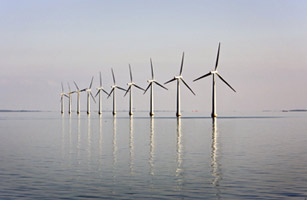
If you want to know why Denmark is the world’s leader in wind power, start with a three-hour car trip from the capital Copenhagen — mind the bicyclists — to the small town of Lem on the far west coast of Jutland. You’ll feel it as you cross the 4.2 mile-long Great Belt Bridge: Denmark’s bountiful wind, so fierce even on a calm summer’s day that it threatens to shove your car into the waves below. But wind itself is only part of the reason. In Lem, workers in factories the size of aircraft hangars build the wind turbines sold by Vestas, the Danish company that has emerged as the industry’s top manufacturer around the globe. The work is both gross and fine; employees weld together massive curved sheets of steel to make central shafts as tall as a 14-story building, and assemble engine housings that hold some 18,000 separate parts. Most impressive are the turbine’s blades, which scoop the wind with each sweeping revolution. As smooth as an Olympic swimsuit and honed to aerodynamic perfection, each blade weighs in at 15,400 lbs. , and they’re what help make Vestas’ turbines the best in the world. “The blade is where the secret is,” says Erik Therkelsen, a Vestas executive. “If we can make [a turbine], it’s sold.”

But technology, like the wind itself, is just one more part of the reason for Denmark’s dominance. In the end, it happened because Denmark had the political and public will to decide that it wanted to be a leader — and to follow through. Beginning in 1979, the government began a determined program of subsidies and loan guarantees to build up its nascent wind industry. Copenhagen covered 30% of investment costs, and guaranteed loans for large turbine exporters such as Vestas. It also mandated that utilities purchase wind energy at a preferential price — thus guaranteeing investors a customer base. Energy taxes were channeled into research centers, where engineers crafted designs that would eventually produce cutting-edge giants like Vestas’ 3-megawatt V90 turbine.