One Year After the Bailout, Greece is Still Hurting

One Year After the Bailout, Greece is Still Hurting
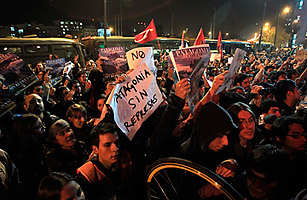
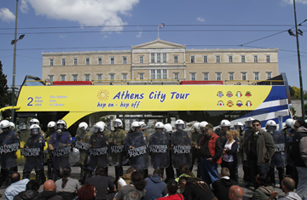
Konstantinos Sourmelis, a 56-year-old technician for OSE, Greece’s state-owned railway, marched to central Athens on Wednesday to send parliament a simple message: Stop selling out the country. Like the thousands of other demonstrators who protested in the country’s latest general strike, Sourmelis accuses the government of scapegoating OSE and public utilities as part of its proposed privatization plan, the next in a string of attempts to raise the billions that Greece owes foreign creditors. “In the long run, it’s going to hurt workers,” says Sourmelis, who makes about $2,000 a month and is worried about losing his job. “I don’t see the austerity measures working, so what difference will it make if we sell off our assets? Won’t we just be giving away our autonomy for nothing?”

The demonstration on Wednesday was mostly peaceful, though at one point at least three people were injured in clashes between police and left-wing protesters. But Greeks still live with the ghosts of the protests that were held last May, when fringe anarchists firebombed a bank and killed three employees, including a pregnant woman. Earlier that month, Greece’s government had received more than $150 billion in loans from the European Union and International Monetary Fund to avoid defaulting on $400 billion in sovereign debt. To get the loan, the government had to introduce tough austerity measures that would hurt in the short term but eventually, it was hoped, put the nation back into the black. At the time, some responded with violence. One year on, most Greeks are still not convinced that the pain will pay off. And neither are the international markets that Greece so badly needs on its side.

The mixture of cuts and tax hikes has succeeded in trimming the deficit by 5% — an impressive performance in a time of recession, economists say. But the austerity measures have also worsened the recession, now in its third year. And because of slumping output and rising unemployment, currently at 15.1%, the markets are still jittery, worried that Greece won’t be able to pay back the loans it took out a year ago. European Union leaders had been discussing another bailout for Greece, but are backing off for now. Still, E.U. leaders are international inspectors are pressing Greece to make stronger reforms. “The results of the past year have actually been mixed, with both good and bad developments. The markets react to the debt, which is still high,” says George Pagoulatos, a professor of political economy at Athens University of Economics and Business. “We have a long way to go before we recover.”

On Monday, the ratings agency Standard & Poor’s downgraded Greece’s rating again, making it the lowest-rated country in Europe along with Belarus. The move followed a weekend of media speculation around an incendiary — and largely inaccurate — report on the website of German newsweekly Der Spiegel that said Greece was planning to leave the euro zone. European leaders and the Greek government have categorically denied the report, with the Greeks calling it “nearly criminal.”

Have You Seen the Horse Sex Movie?

Have You Seen the Horse Sex Movie?
The sex scene in the documentary Zoo, which premiered at the 2007 Sundance film
festival, lasts less than 10 seconds. The grainy footage follows lush shots of
nature set to moody music and a thoughtful voiceover discussion of the nature of
love. Drinks are mixed. Stories are shared. Both parties appear to consent. The
fleeting seconds would seem unlikely to raise an eyebrow among the liberal
audience of film lovers who rush to Sundance each year in search of edgy,
independent fare. The thing is, the scene stars a man and a horse.
Unsettling precisely because it is more atmospheric than graphic, more
romantic than journalistic, Zoo examines the culture of zoophiles, people with
an erotic attraction to animals. Seattle filmmaker Robinson Devor tells the true
story of “Mr. Hands,” a 45-year-old man who died shortly after being anonymously
dropped at an emergency room in rural Washington in 2005. Police investigating
the case followed clues to a nearby horse farm, where they found buckets of
videos of the man and others having sex with Arabian stallions. Mr. Hands’ cause
of death was a perforated colon. Because bestiality wasn’t illegal in Washington
State at the time, no charges were filed, but the scandal made national news.

Via reenactments with actors and voiceover interviews with the dead
man’s zoophile friends, Devor picks up where the news stories left off. “A lot
of people advised us not to do the film, artistically and from a business
standpoint,” says Devor, whose last movie, Police Beat, was a little-seen but
critically lauded film in Sundance’s 2005 dramatic competition. “But filmmakers
investigate all sorts of subcultures and individuals who are clearly more evil
than these.”

Maybe so, but Zoo, which has notes of Werner Herzog’s 2005 documentary
Grizzly Man, caused festival goers to launch into heated debates on the shuttle
buses and in the cafes of Park City about such unlikely subjects as whether a
stallion can actually give consent and precisely how he might do so. Taxi
drivers in town asked their passengers, “Have you seen the horse sex movie?” At
a Q&A following one screening, the Seattle actor who plays Mr. Hands, John
Paulsen, who is a priest, admitted that after hearing he had gotten the role, he
wasn’t quite sure he wanted it.

Devor studiously avoids judging the men in his film, depicting them as
regular guys who hold down regular jobs and attend regular parties. No talking
heads appear on camera to explain the psychological sources of zoophilia. The
closest thing Zoo has to a moral guide is the woman charged with finding a new
home for the dead man’s horse, and even she, by the end, is compassionate.
“Michael Moore’s first movie was about a group of Nazis and they were having a
picnic,” says Devor. “The left was very p—– off at him because he didn’t
clearly say, ‘This is bad.’ I don’t think art is supposed to give messages. It
can be enigmatic and push buttons.”

Asked who his audience might be when Zoo is released by ThinkFilm later
this year, Devor rattles off an eclectic group: “Crazy art house lovers.
18- to 24-year-old guys. Conservatives who would condemn it.” OK, so it’s not the
same crowd who will be racing the see Shrek the Third, but, as a friend of
Devor’s told him, ‘Finally you made a commercial movie.'” Those curious about
zoophilia may be disappointed by the, er, logistical questions that Zoo fails
answer. But it won’t be hard to find people curious about zoophila. You did read
this far, didn’t you?
See pictures of animals that can think.
See the top 10 movie performances of the year.

Consumer Technology: What Gadget News to Expect in 2011

Consumer Technology: What Gadget News to Expect in 2011
First, a disclaimer: unlike some of my tech-pundit peers, I don’t claim to be uncannily prescient. Actually, I revel in the industry’s glorious unpredictability. One of 2010’s biggest stories involved a tech blog buying the top-secret, next-generation iPhone after an Apple engineer left it behind at a bar. In another, Microsoft canceled a much publicized line of phones two months after it introduced it. If you’d predicted either of these fascinating sagas a year ago, I would have chortled in contemptuous disbelief.

That said, the short-term future isn’t an utter mystery. Certain product lines follow predictable release schedules, some rumors come from reliable sources, and quite a few companies are already hyping hardware and software that won’t show up for months. It’s therefore possible to sketch out a fuzzy, incomplete — but still interesting — picture of next year’s tech developments right now.

iPad Rivals Galore
Industry types keep referring to an alleged “tablet market,” but for most of 2010, there has been only one real contender: Apple’s iPad. Competitor No. 2 — Samsung’s Galaxy Tab — arrived in November. Early 2011 is when the deluge starts. The vast majority of upcoming tablets will run the upcoming Honeycomb version of Google’s Android operating system. HP plans one based on webOS, which it bought along with the rest of Palm in 2010, and RIM is cooking up a new software platform for its BlackBerry PlayBook. I’m looking forward to the flurry of competition even though I’m skeptical that any tablet-come-lately will shove the iPad out of the spotlight anytime soon.

iPad, Take 2; iPhone, Take 5
Right now, it seems entirely possible that 2011’s most impressive advance on the iPad will be another iPad. Everyone is already assuming that Apple will release a second-generation model with a camera on the front for FaceTime video calls by the spring. And guessing that the company will ship a new iPhone in June or July almost doesn’t count as a prediction: it has done so every year since the first iPhone came out in 2007.

Pay Phone

Pay Phone
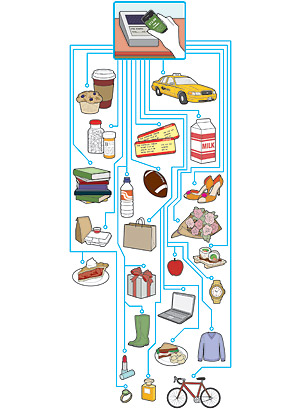
Which are you more likely to have with you at any given moment — your cell phone or your wallet? Soon you may be able to ditch your billfold altogether and pay for things with a quick wave of your smart phone over an electronic scanner. In January, Starbucks announced that customers could start using a bar-code app on their phone to buy coffee in some 6,800 of its stores. This is the first big pay-by-phone initiative in the U.S., but we’re likely to see more wireless payment options as something called near field communication gets embedded into America’s consumer electronics. In December, Google unveiled its Nexus S smart phone, which contains an NFC chip. The next iPhone is rumored to have one too, as are several BlackBerry models that are due out this year. Already in use in parts of Asia and Europe, NFC allows shoppers to wave their phones a few inches above a payment terminal — a contact-free system built for speed and simplicity. But before NFC becomes widely adopted in the U.S., a few kinks need to be worked out, like who will get to collect the lucrative transaction fees from retailers. Although Visa and MasterCard have been experimenting with wave-and-pay systems that use NFC-enabled credit or debit cards, cellular-service providers may try to muscle their way into the point-of-sale market. Three of the big four providers have formed a joint venture that is set to roll out over the next 15 months. Its goal, “to lead the U.S. payments industry from cards to mobile phones,” is hardly a subtle shot at Visa and MasterCard, but the consortium also seems to have hedged its bets by making Discover part of the venture. Meanwhile, Google claims it will be content to partner with payment processors to handle purchases made with its smart phones — even though the company has its own payment platform, Google Checkout. And who knows? If the next iPhone does come with NFC, the device may route mobile payments through Apple’s iTunes store. The other big NFC issue, aside from how payments will be processed, is security. For instance, what’s to stop a sophisticated thief with a concealed payment terminal from digitally pickpocketing you? “We’re still not at the point where an attacker can just brush against you in a crowd and steal all the money out of your phone,” says Jimmy Shah, a mobile-security researcher for McAfee. Although NFC-eavesdropping devices exist, he says, they “tend to require the attacker to play the man in the middle between your NFC-enabled phone and the cash register.” To protect consumers, NFC apps can encrypt data transmissions. Users may be able to set transaction limits as well, perhaps requiring a pass code to be entered for larger purchases. Still uneasy about this digital-wallet business? Keep in mind that if you lose your smart phone, it can be located on a map and remotely deactivated. Plus, your phone can be password protected. Your wallet isn’t.This article originally appeared in the Feb. 21, 2011 issue of TIME. See the latest geek culture stories at Techland.com.
See the ALL-TIME 100 Gadgets.

In Search of Energy, A Booming Chile Chooses to Dam Its Rivers

In Search of Energy, A Booming Chile Chooses to Dam Its Rivers
Under an azure Patagonia sky, a few dozen conservation-minded citizens and their children took part in a puppet show recently in the town square of Cochrane, a tiny hamlet in southern Chile nestled between ancient forests and winding rivers. In the story, a purple otter sought guidance from the mystical forest spirit about the malevolent plans of a gravelly-voiced developer who wants to dam the river, a scheme that would disfigure the landscape and, with it, the otter’s home.

The program, hosted by the Patagonia Without Dams campaign, was a small but illustrative part of what has grown this year into a nationwide protest movement against a real-life proposal: a $3.2 billion project to build five hydroelectric dams along the nearby Baker and Pascual Rivers, and to stretch 1,200 miles of high-tension wires across national parks and other protected lands to transmit the electricity out of Patagonia and up to central Chile, where most of it will be used. “Compared to a thermoelectric plant, this is clean energy,” Patagonia resident and radio station employee Claudia Torres, 36, conceded. “But on the scale they mean to implement this project, it will have a tremendous environmental and social impact.”

Still, puppet shows — and polls that show a majority of Chileans opposed to the plan, many of them taking to the streets en masse in recent weeks — were apparently no match for the energy needs of one of Latin America’s fastest-growing and most developed economies. This week a federal environmental commission, appointed by pro-dam President Sebastin Piera, approved the Patagonia project headed by HidroAysn, a joint venture between Chile’s largest electrical utility, Endesa, and another, Colbn. By the time the HidroAysn project is up and running in 2026, according to the company, the dams could generate a total of 2,750 megawatts. That’s almost a third of the current 10,000-megawatt capacity of Chile’s central power grid, where the capital, Santiago, is located, and almost a fifth of the nation’s total 15,000-megawatt capacity.

The problem for HidroAysn’s opponents is that Chile needs to double that national capacity by the end of this decade to keep its tiger-like economy, a mining- an export-driven model for Latin America, humming and growing. And hydropower, given the prodigious supply of rain and rivers in regions like Patagonia, is one of the most abundant and affordable sources to tap.”Sometimes governments have to take hard decisions,” Piera, a conservative, said after the commission’s vote. “But if we don’t take these decisions today, we’re condemning our country to blackouts down the road.” The more liberal Eduardo Frei, a former President and current Senator, agrees. In Chile, which has scant oil and gas reserves, “the greatest energy wealth [is] water,” Frei insisted recently, and little can dissuade governments right now from pursuing it. In neighboring Brazil, in fact, hydropower accounts for 80% of total electricity.

But the problem for governments like Chile’s is that hydro-electricity is also becoming one of the most controversial energy sources in regions such as South America. On that continent, large protests have met not just the HidroAysn proposal but also the Belo Monte hydro-dam project in Brazil, which is slated to be the world’s third-largest. Among environmentalists and ordinary citizens alike, there is a growing fear that countries have grown too reliant on water power, whose dam complexes can cause significant eco-disruption in pristine swaths like Patagonia, a paradise of glaciers, lakes, woodlands, fjords and rivers like the Baker, Chile’s largest in terms of water volume. The HidroAysn dams would flood 14,000 acres , carve up forests and threaten eco-tourism attractions like white-water rafting.

Duped Dads Fight Back

Duped Dads Fight Back
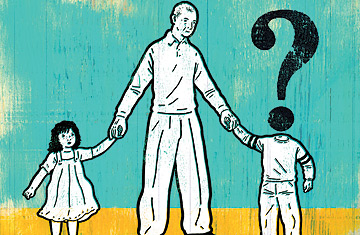
It was the lawyers of ancient Rome who came up with the modern definition of fatherhood: Mater semper certa est; pater est quem nuptiae demonstrant . The Romans, however, didn’t have access to genetic testing. Dylan Davis did. A few months after his divorce in 2000, Davis, 36, a software engineer in Denver, took a DNA test to confirm a nagging suspicion that he was not the biological father of his 6-year-old twins. The negative test results led him to give up partial custody of the boy and girl–“The anger grows and grows, and it just keeps chipping away at your love for those children,” he says–and since his ex-wife moved to another state, he has had no contact with the twins. But under Colorado law, he is still required to pay $663 a month in child support. So Davis is lobbying to change the statute so that he and others like him won’t be held financially accountable for children who aren’t biologically theirs. Advocates for these so-called duped dads say such men should be treated as victims of fraud and liken the need for paternity-disestablishment amendments to truth-in-lending laws. They point to many an egregious case in which the law’s marital presumption of fatherhood has ended up enslaving a divorced dad, like the Michigan man who proved he had not sired his son but was still ordered to send child-support payments directly to the boy’s biological father, who was granted custody after the mom moved out of his place and left the kid there. Increasingly, policymakers across the country are turning a sympathetic ear to such complaints. Florida last year joined Georgia and Ohio in allowing a man to walk away from any financial obligations regardless of how many years he may have been acting as a minor’s father if he discovers he was deceived into parenthood. Fathers’ rights groups in Colorado, Illinois and West Virginia are pushing for similar legislation that would remove or extend existing time limits for challenging paternity. Spearheading the legislative movement is Carnell Smith, a Georgia engineer who found out shortly after he broke up with his girlfriend that she was pregnant and spent the next 11 years believing he was the girl’s father. Then, in 2000, after his visitation time had been cut back around the same time that a court order nearly doubled his monthly child-support payments, he took a test that showed he was not the biological parent. Three years and about $100,000 in child support and legal fees later, Smith, 46, managed to disentangle himself from any responsibilities for the girl, and says he walked out of court “a broke but free man.” He successfully lobbied his home state to pass its paternity-fraud law in 2002 and now runs a DNA-testing company. Its slogan: “If the genes don’t fit, you must acquit!” But justice for a disillusioned dad can clash with the best interests of a child raised to think of him as a father. “These cases get cast as the duped dad vs. the scheming wife,” says Temple University law professor Theresa Glennon, who has examined the changing legal landscape. “This is really about men deserting children they have been parenting.” She points out that severing paternal ties could devastate a child depending on the length and quality of his relationship with the nonbiological father.

War on Korean Peninsula: High Tension Prompts Scenarios

War on Korean Peninsula: High Tension Prompts Scenarios
“A symphony of death.” That’s the chilling phrase that Kurt Campbell, who is now Assistant Secretary of State for East Asian and Pacific Affairs in the Obama Administration, once used to describe the likely outcome of any military encounter on the Korean peninsula between the U.S., its ally South Korea and their mutual enemy across the 38th parallel in the North. The possibility of war breaking out once again in Korea is so unthinkable that a lot of people in various military establishments — the Pentagon, South Korea’s armed forces and China’s People’s Liberation Army — actually spend a lot of time thinking about it. The truce between North and South has lasted for 57 years, but a peace treaty has never been signed, and now, in the wake of the North’s attack on a South Korean naval vessel — and the South’s formal accusation that the Cheonan was sunk by a North Korean torpedo — tensions are at their highest level since 1994, when North Korea threatened to turn Seoul into a “sea of fire.”

Seoul has already made it clear that it will not seek military retaliation, and Washington and Beijing have said all the right things about trying to ensure that “cooler heads” prevail, as China’s State Councilor, Dai Bingguo, said in talks with U.S. Secretary of State Hillary Clinton in Beijing on Tuesday. But all concerned parties understand that at a moment of high tension, the possibility of hot war breaking out is not negligible.

Study: 48 Women Raped Every Hour in Congo

Study: 48 Women Raped Every Hour in Congo
— The African nation of Congo has been called the worst place on earth to be a woman. A new study released Wednesday shows that it’s even worse than previously thought: 1,152 women are raped every day, a rate equal to 48 per hour.
That rate is 26 times more than the previous estimate of 16,000 rapes reported in one year by the United Nations.

Michelle Hindin, an associate professor at Johns Hopkins’ Bloomberg School of Public Health who specializes in gender-based violence, said the rate could be even higher. The source of the data, she noted, is a survey that was conducted through face-to-face interviews, and people are not always forthcoming about the violence they have suffered when talking to strangers.
“The numbers are astounding,” she said.
Congo, a nation of 70 million people that is equal in size to Western Europe, has been plagued by decades of war. Its vast forests are rife with militias that have systematically used rape to destroy communities.
The analysis, which will be published in the American Journal of Public Health in June, shows that more than 400,000 women had been raped in Congo during a 12-month period between 2006 and 2007.
On average 29 Congolese women out of every 1,000 had been raped nationwide. That means that even in the parts of Congo that are not affected by the war, a woman is 58 times more likely to be raped than a woman in the United States, where the annual rate is 0.5 per 1,000 women.
Previous estimates of the number of rapes were derived from police and health center reports in the nation’s troubled east where the conflict is concentrated. The authors of the study used figures from a government health survey and pooled data from across the country.
The highest frequency of rape was found in North Kivu, the province most affected by the conflict, where 67 women per 1,000 had been raped at least once.
“The message is important and clear: Rape in has metastasized amid a climate of impunity, and has emerged as one of the great human crises of our time,” said Michael VanRooyen, the director of the Harvard Humanitarian Initiative.
Margot Wallstrom, the U.N. special representative for sexual violence in conflict, welcomed the study.

“Conflict-related sexual violence is one of the major obstacles to peace in the DRC,” she said in statement, using the initials for Congo. “Unchecked it could disrupt the entire social fabric of the country.”
Wallstrom said the figures in the study are higher than the U.N.’s because it covers all sexual violence — including domestic and intimate partner violence — not just from military actors.
U.N. figures tend to be conservative because they must be verified by the organization itself, she said.
Wallstrom said she consistently stresses that “the number of reported violations are just the tip of the iceberg of actual incidents.”
Associated Press writers Saleh Mwanamilongo in Kinshasa, Congo, Edith Lederer in New York and Mike Stobbe in Atlanta contributed to this report.
See TIME’s Top 10 of Everything of 2010.
See TIME’s most unforgettable images of 2010.

Pakistani Intelligence: Friend or Foe?

Pakistani Intelligence: Friend or Foe?
— The twin towers in New York were still smoldering in September 2001 when Pakistan spy chief Gen. Mahmood Ahmed went to Afghanistan with the task of urging the Taliban to hand over al-Qaeda leader Osama bin Laden.
The message he actually gave Mullah Mohammed Omar was quite different: “Protect Osama. Hide him. We will help you,” according to former Taliban deputy interior minister Mullah Mohammed Khaksar. His version has been confirmed by U.S. officials and former Pakistani spies.

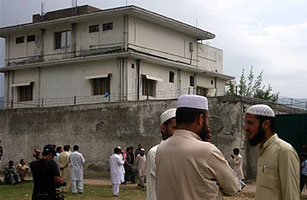
A decade later, the U.S. has raised a stinging question: Did Pakistan’s premier spy agency, the ISI, know that bin Laden had been living for at least five years near a military garrison in Abbottabad?
The answer is quite likely yes, according to ex-ISI agents, military men and analysts, but the issue is really who knew and how close they might have been to the top.
A week after Navy SEALS killed bin Laden, the U.S. has demanded the names of ISI operatives from Pakistan to investigate what dealings they may have had with al-Qaeda. An ISI official, who spoke on condition of anonymity, said no formal inquiry was being held, and that it was “no one’s concern” whether Pakistan investigated how bin Laden had lived under the nose of the military without detection.
At the heart of the matter is the long, complicated relationship between the ISI and various militant groups.
The ISI, which is part of Pakistan’s military, has a history of spawning and funding jihadi groups to fight India, in particular for the disputed territory of Kashmir. Pakistan’s military relies heavily on these groups in the absence of the conventional might to take on India, said defense analyst Ayesha Siddiqua. For example, Pakistan has hosted training camps for militants and has sent them across the border into India, according to U.S. intelligence reports.
“How else do you fight?” Siddiqua asked. “It is the Pakistan version of private security guards.”
However, some of these jihadi groups have links to al-Qaeda and share with it a militant Islamic philosophy. Harakat-ul-jihad-Islam, the leader of the Illyas Kashmiri group against India, is also believed by Western intelligence to be al-Qaeda’s operational chief in Pakistan. And Lashkar e-Taiba, which the U.S. calls a terrorist group, is thought to have close funding and operational ties to al-Qaeda.
Former President Pervez Musharraf long ago promised to cut off close ties with militants, but there is no evidence that he followed through. Pakistan also claims that it has purged religious extremists from the ISI over the past decade. The ISI did drop Gen. Ahmed soon after the 9/11 attacks, at the insistence of the United States, and Musharraf has handed over senior al-Qaeda operatives such as Khalid Sheikh Mohammed, Abu Zubayda and Ramzi Binalshib to the United States.

In a WikiLeaks diplomatic cable dating to May 12, 2008, a U.S. delegation asked Musharraf for his views on reports that the Pakistan army and ISI were complicit in allowing militant activities to continue. Musharraf did not give a direct response, but talked instead about the job of catching militants. “Musharraf said that it wasn’t as easy as it appeared,” the cable notes. “The mountainous terrain, poor communications, and local supporters impeded efforts to capture and kill these militants.”
Despite his protests, experts say, Musharraf grew up under a religious regime and understands the power of religiously motivated uprisings. If anything, the ISI may be as fundamentalist as ever, partly because military personnel from a time when the army was openly involved with militants still work in operations, Siddiqua said.
The ISI also falls under suspicion because bin Laden went undetected despite the many security guards and officers in Abbottabad, a leafy city of 400,000 people close to Islamabad. Al-Qaeda has a history in the area: Senior Indonesian al-Qaeda operative Umar Patek was arrested there in January, based on information from a captured al-Qaeda member, an intelligence official said. And in 2003, raids were conducted in Abbottabad looking for al-Qaeda senior lieutenant Abu Laith al-Libi, who was eventually caught not far away in Mardan in 2005.
Retired military officer Lt. Gen. Talat Masood conceded that some people within the establishment were likely suspicious about the occupants of the whitewashed, three-story house in a middle-class area of Abbottabad. However, Masood said, most would not have considered bin Laden their first suspect, and some may have been bribed to keep prying eyes away. Security officers at airports and border crossings in Pakistan are often bribed to ignore suspicious movements.
“The most charitable explanation you can give is that it was at the local level of the police, or some local authority, or someone who carried a lot of weight and influence in the area,” Masood said. “He was paid handsomely to ignore who was living there.”
The least charitable version, Masood said, is that bin Laden was given safe haven by former military ruler Musharraf, who was waiting until the appropriate moment to announce his capture. Civilian critics in Pakistan accused Musharraf of secretly aiding Taliban militants on both sides of the border, even as militants routinely accused him of siding with the West.
Some analysts and intelligence officials questioned whether top ISI officials would have a good motive to hide bin Laden. It would not in any way help Pakistan, said Brig. Asad Munir, former ISI head for the frontier until 2003.
“You at least have to look at motive…what does bin Laden have to offer?” Munir asked. “It doesn’t make sense.”
Christine Fair, an academic expert who studies Pakistan and militant groups, agreed that the top leadership of the ISI was likely ignorant rather than complicit in the hiding of bin Laden.
“I really don’t believe they knew,” said Fair, assistant professor at the Center for Peace and Strategic Studies at Georgetown University in Washington, who has done extensive research in the region.
However, lower-level ISI operatives may well have been aware of bin Laden’s presence, Fair said.
She cited the example of the 2008 Mumbai attacks, in which two junior ISI spies were disciplined for knowing about and possibly being involved in the operation. There is no evidence that knowledge of the attacks, which killed 166 people, extended higher up in the ranks.
Mosharraf Zaidi, a private consultant in Pakistan who advises governments on public policy, said essentially the same thing.
“I think there are people who would have known, but did the leadership know? The prime minister, the president, the army chief and intelligence chief?” he asked. “I don’t believe so.”
If the top officials really did not know, that suggests an incompetence on the part of the ISI shocking to many in Pakistan.
The agency is thought to have about 30,000 people, under six major generals and one lieutenant general. Its financial numbers are secret, but it doesn’t have the budget for sophisticated listening devices, for example. In some parts of the country Pakistan doesn’t even have the technology to monitor cell phones.
“In general the ISI has an exaggerated profile of its capabilities,” wrote Shuja Nawaz, director of the South Asia Center at The Atlantic Council, in an email. “It is best in penetrating India. Worst at handling domestic politics.”
The latest episode increases the strain between the ISI and the United States, already at a high because of the case of a U.S. contractor accused of killing Pakistanis. In past meetings, Washington has accused Pakistani leaders of harboring terrorists.
“There was certainly a lot of finger-pointing, a lot of accusing us, both in meetings here and in Washington, of being in bed with the bad guys,” retired Gen. Mahmud Durrani, Pakistan’s former national security adviser, told the AP. “On one or two occasions they were very, very harsh.”
Durrani refused to divulge details, such as whether bin Laden was mentioned, citing national security reasons.
The ISI was born more than 60 years ago, with the job of gleaning information, mostly about India, from the army, air force and navy — thus the name, the InterServices Intelligence, or ISI.
In the early 1970s, then-Prime Minister Zulfikar Ali Bhutto created a political cell within the ISI to keep tabs on his political opponents. Bhutto was overthrown in 1977 and hanged two years later.
Gen. Mohammed Zia-ul Haq came to power and, as an Islamic zealot, created a clerics corps in the army. Officers who had once sipped alcohol at the army messes were competing with each other to be seen by Zia at mosques praying, ex-military officers said.
When the Soviet Union invaded Afghanistan in 1979, the ISI worked with the CIA and Islamic rebels. The same rebels later would become Taliban, or join al-Qaeda, or be redeployed by the ISI to India, and today some belong to U.S.-declared terrorist groups like Lashkar-e-Taiba.
The answer about whether the ISI really knew about bin Laden’s location may finally come from an unlikely source: Bin Laden himself, or rather, his documents. The U.S. is just starting to process a trove of information taken by commandos from the compound occupied by bin Laden, which may be key to many of the puzzles.
— _
Kathy Gannon is AP special regional correspondent for Pakistan and Afghanistan. AP staff writer Sebastian Abbot contributed to this report.
See TIME’s Top 10 of Everything of 2010.
See TIME’s most unforgettable images of 2010.
Brewing Battle: Starbucks vs. McDonald’s

Brewing Battle: Starbucks vs. McDonalds
Over my morning coffee , I read the news this week that a battle is brewing between Starbucks and McDonald’s. According to the story, McDonald’s is planning to capitalize on the public’s willingness to pay $4 for a cup of coffee by hiring baristas and dropping espresso machines in 14,000 of their fast-food outlets. Meanwhile, Starbucks, with business lagging, is fighting back with an “if you can’t beat ’em, join ’em” strategy, by offering heated breakfast sandwiches and adding drive-thru windows to some of their locations.

I’ve always thought of these two chains as polar opposites — one designed as a sophisticated faux living room where customers could get a decent coffee drink and read their newspapers; the other, a riot of plastic-and-vinyl booths and bright fluorescent lighting where meals are counted in billions served. I wondered if it was really possible for these two worlds to collide. If McDonald’s built its own version of a grande nonfat latte, would Starbucks customers come?

To determine whether Starbucks and McDonald’s customers are the same or different species, I turned to Hitwise data. With the assumption that I’d glean some information about each camp’s patronage by investigating who visited the fast-food chains’ respective websites, I compared their demographics. Here’s what I found. Visitors to Starbucks.com skew female: Starbucks’ website has 8.3% more female visitors than does the McDonald’s site. While McDonalds.com visitors cluster in the 18-to-34 age range, Starbucks owns the 35-to-44-year-old group. There’s also a clear income gap between the two: McDonald’s visitors tend to live in households earning less than $60,000 per year; Starbucks customers lean toward households earning over $60,000.

To add further depth to the profiles, I used Mosaic, a system that divides the U.S. into 50 different behavioral groups, to figure out which segments of our society visit the two websites. I identified the strongest Starbucks and McDonald’s types: For Starbucks, it’s segment B03, the Urban Commuter Family, described as “college-educated households containing dual income couples.” These folks favor golfing as their exercise of choice. The segment that visits McDonald’s is type J03, the Struggling City Centers, described as “lower-income households living in city neighborhoods in the South.”

The interesting point, though, is the difference in demographic trends between each restaurant’s clientele over the last two years. The Big Mac customer base has remained relatively stable, while Starbucks’ coffee-drinkers have diversified. It used to be that Starbucks attracted customers from a small, elite segment of the country; now, its visitors pervade many more segments across America. But, as I finish my latte, I still can’t fully envision the collision of these two worlds. Just imagine one of those annoyingly finicky coffee-orderers requesting a burger just-so at McDonald’s: “I’ll have a grande, extra hot Big Mac with one pump ketchup.” It just doesn’t seem to fit.