
— The Postal Service is continuing to hemorrhage money, reporting a loss Tuesday of more than $2 billion over the first three months of the year and warning it could be forced to default on federal payments.
Such a default would not interrupt mail service to millions of Americans, but it could further hobble an agency struggling with a sharp decline in mail because of the Internet and a tough economy.
The agency says the $2.2 billion loss covers Jan. 1 to March 31, 2011 — sharply higher than the net loss of $1.6 billion for the same period last year. The post office also said it will have reached its borrowing limit, set by Congress, of $15 billion by the end of the fiscal year.
Unless Congress intervenes, the Postal Service said, the agency won’t have the cash for certain payment to the government, such as billions for a trust fund to provide health care benefits for future retirees.
“The Postal Service continues to seek changes in the law to enable a more flexible and sustainable business model,” said Postmaster General and CEO Patrick R. Donahoe. “The Postal Service may return to financial stability only through significant changes to the laws that limit flexibility and impose undue financial burdens.”
Total mail volume, about 41 billion pieces, was down 3.1 percent for the January to March period, compared to the same time a year earlier, the Postal Service said. A modest increase in revenue from standard mail wasn’t enough to offset the revenue loss from fewer pieces of first-class mail.
In the last three years, the agency has cut over 130,000 jobs. And it’s making more cuts, with the elimination of about 7,500 administrative jobs in regional offices.
The Postal Service does not receive tax money for its operations.
See TIME’s Pictures of the Week.
Nanotechnology could be very big
When a U.S. alternative energy company signed a technology license contract last month to enable China’s largest coal company to build a $2 billion plant to liquefy coal in Inner Mongolia it may have been sealing the future of OPEC. If the technology lives up to its promise and can economically transform coal into diesel and gasoline it may tip the geopolitical scales by reducing the dependence on oil of coal-rich countries like China, the U.S. and Germany. At the same time it could significantly decrease pollution blamed for global warming and acid rain.
Many countries don’t use imported oil for power generation, but depend on it for transport. That will change if the cost of converting coal directly into liquid fuels can compete with that of refining crude oil. Nanotechnology may be the long-awaited breakthrough. “It has improved the economics of the process by $5 to $10 a barrel,” says Theo Lee, CEO of Hydrocarbon Technologies Incorporated, a subsidiary of Headwaters, a Draper, Utah-based alternative-energy company. “Direct coal liquefaction is now economically attractive in China at today’s international crude-oil price [of about $28]; a $4 to $8 a barrel increase in the price would make it economically attractive in the U.S.”
Nanos for Novices
Picture a millimeter-sized pinhead — a nanometer is one-millionth
of that. Down at this scale, different laws of physics come
into play. When particles get small enough to be nanoparticles,
their mechanical properties change. Thanks to recent advances,
industry is better able to take advantage of this. Adding nanoparticles
to materials used to build, say, car bumpers or airplane bodies
increases strength and reduces weight. It also improves resistance
to heat and chemicals.
When used with fossil fuels, nanoparticles can unleash the power
of nearly all the atoms involved in the catalytic process, cutting
costs and increasing efficiency. — J.L.S.
This breakthrough is but one example of the ripple effects that nanotechnology
is expected to have on industry, says Tim Harper, founder of the European NanoBusiness
Association and of Madrid-based CMP Cientifica, which does research on the business
applications of nanotechnology. The technology is already starting to change energy
generation and distribution, computer memory and storage, and the aerospace, automotive,
textile and pharmaceutical industries.
“The 1990s was all about E-everything, the next decade will be all about N-everything,”
says an official at the European Commission, which has set aside ?1.3 billion
for research into nanotechnology, new materials and production processes.
IBM, Motorola, Hewlett-Packard, Lucent, Hitachi, Mitsubishi, NEC, Corning, Dow Chemical and 3M have either launched nanotech initiatives through their own venture-capital funds or as a result of their own R and D, according to a CMP Cientifica report. Oil companies are busy with R and D projects of their own, says Nathan Tinker, a cofounder of the U.S.’s NanoBusiness Alliance.
The oil industry, already applying nanotechnology to refining petrochemicals, is looking at how it will be used to produce alternative energy. For example, nanotechnology is starting to make solar-energy cells cheaper and more efficient. The next challenge is to figure out how to store the electricity produced for later use. Nanotechnology promises to help by getting batteries to charge faster and making cells more commerically viable. To this end, Samsung, Sony and NEC have separately announced that they will use nanotechnology to make more efficient fuel cells to power laptops and mobile phones. These could be 20% more efficient and have a 10 times better power-to-weight ratio than lithium-ion batteries. The first products may be on the market by Christmas.
Later, cost-efficient fuel cells, running on hydrogen or a hydrocarbon such as methane, could transform both energy production and distribution. Many countries already have natural gas-delivery networks, and cost-effective fuel cells produced with the help of nanotechnology might shift demand from electricity grids. Fuel cells might eventually power cars. If the economics work out, we might even see cars parked in garages providing energy to houses.
If the pundits are right, the impact of nanotechnology on the energy sector will be nothing less than, well, electric.
Enemies Of the State?
The men with the poison-filled syringe arrived two days before Li Juan’s due date. They pinned her down on a bed in a local clinic, she says, and drove the needle into her abdomen until it entered the 9-month-old fetus. “At first, I could feel my child kicking a lot,” says the 23-year-old. “Then, after a while, I couldn’t feel her moving anymore.” Ten hours later, Li delivered the girl she had intended to name Shuang . The baby was dead. To be absolutely sure, says Li, the officials–from the Linyi region, where she lives, in China’s eastern Shandong province–dunked the infant’s body for several minutes in a bucket of water beside the bed. All she could think about on that day last spring, recalls Li, was how she would hire a gang of thugs to take revenge on the people who killed her baby because the birth, they said, would have violated China’s family-planning scheme. Since 1980, when China began fully carrying out what is commonly known as the one-child policy, officials in the provinces have often resorted to draconian measures–forced sterilizations and late-term abortions among them–to prevent the country’s population of 1.3 billion from expanding into a Malthusian nightmare. Government leaders credit China’s stringent population control with helping spur economic growth by reducing the number of mouths that must be fed. But in 2002, as personal freedoms proliferated in other areas of life, parliament voted to ease the deeply unpopular policy. Instead of forbidding extra children outright, the new law, among other reforms, allowed couples to have multiple offspring if they were willing to pay big fines. The costs can be exorbitant for peasants like Li–$365 or more for the first additional child in Linyi, around four times the average annual net income in this impoverished region. But at least the Chinese now possess a modicum of choice in family matters, which they lacked a few years ago. The Communist Party bureaucracy, however, doesn’t seem to have caught up with the new law. Despite laxer regulation, the career advancement of local leaders, especially in rural areas, still often depends on keeping birthrates low. “One set of bad population figures can stop an official from getting promoted,” says Tu Bisheng, a Beijing legal activist who has helped document abuses related to the one-child policy. At a provincial meeting last year, Linyi officials were castigated for having the highest rate of extra births in all of Shandong, according to lawyers familiar with the situation. The dressing-down galvanized what appears to be one of the most brutal mass sterilization and abortion campaigns in years. Starting in March, family-planning officials in Linyi’s nine counties and three districts trawled villages, looking to force women pregnant with illegal children to abort, and to sterilize those who already had the maximum allotment of children under the local family-planning policy. According to that regulation, which exists in a similar form in most rural areas, women with a son are not allowed to bear more children, whereas mothers whose first child is handicapped or a girl are allowed to have a second baby.
Nanotechnology: Very small Business
Technologist Eric Drexler envisioned a future in which machines far smaller than dust motes would construct everything from chairs to rocket engines, atom by atom; in which microscopic robots would heal human ills, cell by cell. Sixteen years after the publication of Drexler’s book Engines of Creation, the molecular-scale technologies most immediately available to consumers are somewhat less fantastic: stain-resistant khakis and more durable tennis balls. Much of the hype is gone from nanotechnology, the term Drexler popularized for his world of very small wonders. But something more interesting has crept in: sales. The khakis and tennis balls are bringing in money, as are dozens of other new products made and enhanced through nanotechnology. To be sure, most nanotech companies are still investing more in R. and D. than they are collecting in revenue. But many commercial applications are in advanced stages of development or already on sale: handheld devices that can sense anthrax spores, hand cream that can protect us from them and computer chips that are faster, cheaper and cooler
Nerd World: Why Facebook Is the Future
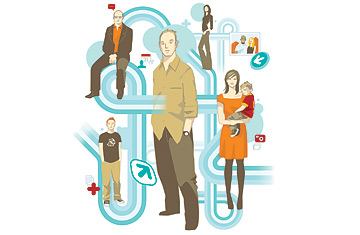
On Aug. 14 a computer hacker named Virgil Griffith unleashed a clever little program onto the Internet that he dubbed WikiScanner. It’s a simple application that trolls through the records of Wikipedia, the publicly editable Web-based encyclopedia, and checks on who is making changes to which entries. Sometimes it’s people who shouldn’t be. For example, WikiScanner turned up evidence that somebody from Wal-Mart had punched up Wal-Mart’s Wikipedia entry. Bad retail giant. WikiScanner is a jolly little game of Internet gotcha, but it’s really about something more: a growing popular irritation with the Internet in general. The Net has anarchy in its DNA; it’s always been about anonymity, playing with your own identity and messing with other people’s heads. The idea, such as it was, seems to have been that the Internet would free us of the burden of our public identities so we could be our true, authentic selves online. Except it turns out–who could’ve seen this coming?–that our true, authentic selves aren’t that fantastic. The great experiment proved that some of us are wonderful and interesting but that a lot of us are hackers and pranksters and hucksters. Which is one way of explaining the extraordinary appeal of Facebook. Facebook is, in Silicon Vall–ese, a “social network”: a website for keeping track of your friends and sending them messages and sharing photos and doing all those other things that a good little Web 2.0 company is supposed to help you do. It was started by Harvard students in 2004 as a tool for meeting– or at least discreetly ogling–other Harvard students, and it still has a reputation as a hangout for teenagers and the teenaged-at-heart. Which is ironic because Facebook is really about making the Web grow up. Whereas Google is a brilliant technological hack, Facebook is primarily a feat of social engineering. Facebook’s appeal is both obvious and rather subtle. It’s a website, but in a sense, it’s another version of the Internet itself: a Net within the Net, one that’s everything the larger Net is not. Facebook is cleanly designed and has a classy, upmarket feel to it–a whiff of the Ivy League still clings. People tend to use their real names on Facebook. They also declare their sex, age, whereabouts, romantic status and institutional affiliations. Identity is not a performance or a toy on Facebook; it is a fixed and orderly fact. Nobody does anything secretly: a news feed constantly updates your friends on your activities. On Facebook, everybody knows you’re a dog. Maybe that’s why Facebook’s fastest-growing demographic consists of people 35 or older: they’re refugees from the uncouth wider Web. Every community must negotiate the imperatives of individual freedom and collective social order, and Facebook constitutes a critical rebalancing of the Internet’s founding vision of unfettered electronic liberty. Of course, it is possible to misbehave on Facebook–it’s just self-defeating. Unlike the Internet, Facebook is structured around an opt-in philosophy; people have to consent to have contact with or even see others on the network. If you’re annoying folks, you’ll essentially cease to exist, as those you annoy drop you off the grid. Facebook has taken steps this year to expand its functionality by allowing outside developers to create applications that integrate with its pages, which brings with it expanded opportunities for abuse. But it has also hung on doggedly to its core insight: that the most important function of a social network is connecting people and that its second most important function is keeping them apart.
Economy Adds 244k Jobs, Rate Ticks Up to 9%

— Employers added more than 200,000 jobs in April for the third straight month, the biggest hiring spree in five years. But the unemployment rate rose to 9% in part because some people resumed looking for work.
The Labor Department says the economy added 244,000 jobs last month. Private employers shrugged off high gas prices and created 268,000 jobs — the most since February 2006.
The gains were widespread. Retailers, factories, financial companies, education and health care and even construction companies all added jobs. Federal, state and local governments cut jobs.
The data suggests businesses are confidence in the economy despite weak growth earlier this year.
Still, unemployment increased slightly from the 8.8% in March. It was the first increase since November.
See the 2011 TIME 100
See the 140 Best Twitter Feeds
Tylenol’s Miracle Comeback
A year after the poisonings, public confidence is restoredOne year ago last week, James Burke made a decision that will probably
be studied in business schools for a long time to come. Going against
the advice of Government agents and some of his own colleagues, the
chairman of Johnson & Johnson decided to spend whatever millions it
would cost to recall 31 million bottles of Tylenol capsules from store
shelves across the U.S. Officials at the Food and Drug Administration
feared that the recall would increase the panic already touched off by
the poisoning deaths of seven Chicago-area residents who had taken
capsules that had been laced with cyanide. The FBI argued that such an
expensive action would demonstrate to potential terrorists that they
could bring a $5.9 billion corporation to its knees. But Burke
prevailed, and his move proved to be decisive in a remarkable and
unparalleled win-back of public confidence in his company's product.By last week, Tylenol had regained more than 80% of the market share it
held before the still unsolved poisonings. “It's a miracle, pure and
simple,” said Joseph Riccardo of the Bear, Stearns investment banking
firm. “The consensus among shrewd advertising executives on Madison
Avenue was that the brand name would never recover.” Indeed, after the
deaths the nonaspirin drug's share of the $1.2 billion painkiller
market fell from 35% to 7%. In a poll, a majority of Tylenol users said
they probably would never return to the capsules.Against such odds, though, Johnson & Johnson and its McNeil Consumer
Products subsidiary, the manufacturer of Tylenol, seemed to do
everything right. Instead of becoming defensive about the deaths, the
company opened its doors and its checkbook. Chairman Burke appeared on
Donahue and 60 Minutes. The company fully dedicated itself to the
investigation, says Tyrone Fahner, who headed the probe during his
term as Illinois attorney general. Said he: “Anything we wanted from
them, we got. The president of the company called and asked if I
thought a reward might help. Before I could raise the possibility of
$20,000, he was asking if $100,000 would be enough.”Following the recall, which cost $50 million after taxes. Burke started
the campaign to relaunch the red-and-white capsules. In just ten weeks
the company managed to begin putting them back on store shelves in new,
triple-sealed packages. To break the ice with consumers, Johnson &
Johnson gave away 80 million $2.50 coupons redeemable toward any
Tylenol product.Even before the appearance of the repackaged capsules, Burke was host at
a pep rally for the company's 2,250 sales representatives. The theme:
“We're coming back.” Burke exhorted them to call on physicians and
pharmacists to aid the company in reassuring consumers. By the end of
the year, 1 million such calls had been made. Testimonial-style TV ads
were aired. In one, a woman professed her trust, saying, “My first
experience with Tylenol was in a hospital, after my son Christopher was
born. Since then it's become one of the things we can count on.”
Can the Chevy Volt Recharge General Motors?
The documentary who killed the Electric Car? accused General Motors of conspiring with the oil industry and politicians to shelve its popular and promising EV1 in the 1990s. How things have changed. Soon electric cars will be whirring through your neighborhood, and some of them will be made by GM. These battery-powered vehicles, charged in your wall outlet like some oversized cordless power tool, will revolutionize not only the auto industry but also the way Americans live and drive.
At least that’s what major automakers are betting billions on. Tesla’s high-performance $101,000 roadster is already the must-have toy for Silicon Valley boys. This fall, more-affordable cars will roll out. GM is launching its long-awaited and much hyped electric Volt for about $40,000, with federal tax rebates that knock the price down to $32,500. Around the same time, Nissan will begin selling its all-electric Leaf, a $32,780 compact that the Japanese carmaker says will average 100 miles on a charge, and Daimler will lease an all-electric version of its Smart Car. Not to be outdone, BMW, Chrysler, Ford and Mitsubishi, among others, will have electric models within a year or so. Even Toyota, long a proponent of hybrids, announced in May a venture with Tesla to develop electric-car technology in California.
The fossil-fueled internal-combustion engine that’s now powering your car isn’t going away anytime soon. But automakers understand that the technology, in place since the 19th century, is unsustainable. With the world’s population slated to jump from 6.8 billion to 9 billion by 2050, the number of cars will outstrip the supply of oil that currently drives them. Tony Posawatz, who heads GM’s Volt project, says, “Everyone agrees we have to get off of oil. In 10 years, the number of cars around the globe will rise from 800 million to 1.1 billion. We know the price of oil will go up again.”
Plug-in cars will help the U.S. kick its oil addiction and address crude’s familiar litany of problems: the BP spill in the Gulf of Mexico, greenhouse-gas emissions and a dependence on petro-punk dictators who don’t always have America’s best interests at heart. That’s something not lost on the Obama Administration, which has allocated billions in stimulus funds to support electric-car makers and build a national infrastructure of charging stations.
Should you buy an electric car this year? Huge roadblocks remain. How many drivers will be willing, or able, to charge their cars 7 or 8 hours a day for only 100 or so miles of driving? More than a few will surely suffer from the dreaded “range anxiety” — worrying that they’ll run out of juice in the middle of nowhere. Price is an issue too. Electrics cost considerably more than comparable gasoline-powered cars and are too expensive for the average buyer.
The good news is that, unlike in the mechanical world, where improvements are incremental, electric-car technology is advancing quickly, and the price is dropping as it does. The key is lowering the cost of the lithium-ion battery. The Nissan Leaf battery costs an estimated $15,000, about half the car’s sticker price. The cost of making these power packs, however, will drop — according to some experts, by half in a few years. And charging the car? The U.S. now has only about 1,000 battery-charging stations, mostly in California. Department of Energy grants will help fund at least 10,000 more of them in selected cities nationwide by the end of 2011.
Bringing Hope to DetroitOf all the automakers in this electrifying game, the one for which the stakes are highest is GM, a.k.a. Government Motors, the taxpayer-controlled company that is struggling back from bankruptcy. So far, GM has invested $700 million to tool up for the Volt, not including countless millions in R&D spending. Mark Reuss, president of GM North America, looks at the Volt as a small step in the right direction: “The car is not do or die for GM, but it is a demonstration of our technical prowess.” In other words, if electrics are the future, GM can’t afford to be left behind.
See pictures of American muscle cars in movies.
See the world’s most influential people in the 2010 TIME 100.
Study: Gay Men, like Women, Better at Remembering Faces

There are few men in the world who haven’t muttered a quiet word of thanks to the anonymous man who invented the name tag, that “Hello, my name is” accessory that can be such a lifesaver at cocktail parties. It’s not certain, of course, that a man invented it, but the odds are good, since so many males — far more than females — would be helpless without it.
It’s long been an accepted truth among married couples that it’s usually the wife who must steer the pair through social gatherings, reminding her husband that he’s meeting someone for the first, second or 15th time — and science backs up that observation. In lab settings, women routinely outperform men in facial-recognition skills, both in terms of speed and reliability. Imaging scans have shown that part of the reason is that men rely only on the right side of the brain in summoning up images of a face they’ve seen before, while women recruit from both hemispheres — literally doubling the brainpower.Now, research from York University in Toronto has added a wrinkle to the existing wisdom. It’s not just women whose brains are so nimble, the investigators have determined; it’s gay men too.
In the Canadian study, psychologist Jennifer Steeves recruited a sample group of homosexual men, heterosexual men and heterosexual women. Significantly, she took care to include both left- and right-handed people among the subjects. All the volunteers were shown pictures of 10 faces and given time to try to memorize them. The photos were black and white, and digitally edited to remove ears, hair and blemishes. This eliminated physical landmarks people often use to remember faces and forced the subjects to rely on major features alone, which was the skill Steeves and her team were trying to test. Finally, those 10 faces were mixed with similarly edited images of 50 other people and flashed on a screen for just milliseconds apiece. The subjects’ job was to press a key when they saw a face they’d seen before.
The results confirmed what the investigators suspected they’d find: the gay men and straight women scored about equally well in the test, and both did better than the straight men. What’s more, within the straight-male group, lefties outperformed righties. The explanation is rooted mostly in the genes.
All people are born with genetic coding that regulates body symmetry and asymmetry. This includes not just handedness but also which way the whorl in the hair at the crown grows and which hemisphere of the brain will be dominant for processing language. Gender and orientation can sometimes get mixed up with this, since a closely linked suite of genes controls them as well: gay men are 39% likelier to be left-handed than straight men, for example, and likelier to have a counterclockwise hair whorl — by a factor of nearly four, according to one study.
“Characteristics like this are determined very, very early on,” says Steeves. “A baby’s handedness can sometimes even be observed in utero.”If sex and symmetry get mixed up this way, there’s no reason the phenomenon should sidestep the brain, and Steeves does not think it does. Gay men, she believes, probably do so well at recognizing faces because, like women, they’re putting both hemispheres to work at once. Greater crosstalk between the two halves via the corpus callosum — the cable of nerve fibers that serves as sort of a superhighway between left and right — probably contributes to this too. That, however, is not something Steeves and her colleagues have been able to demonstrate conclusively yet, since they have not had the chance to rerun their study while simultaneously scanning the brains of their subjects with a functional magnetic resonance imager . “The university just doesn’t have one,” she says. “But we’re getting one soon, and we’ll be able to take that next step then.”
None of this means that it will ever be possible simply to take an fMRI of a brain and tell from that alone if it belongs to a homosexual or heterosexual — and given privacy concerns and the risk of bias, Steeves wouldn’t even want to try. “I would hesitate to do post-hoc analysis,” she says. “There are scary things that could happen with that.” What it does mean, however, is that science’s understanding of the roots of sexuality, so long shrouded in misinformation, is steadily edging into the light — and there’s nothing scary about that.
See TIME’s Pictures of the Week.
See the Cartoons of the Week.
Power Shifts
As Americans wrestle with the
implications of revolutions in the
Middle East as well as the rise of
China in Asia, we need a better understanding
of what it means to have power
in world politics. Traditionally, the mark
of a great power was its ability to prevail
in war. But in an information age, success
depends not just on whose army wins but
also on whose story wins.
Americans need to cope with two
types of historical power shifts that are
occurring in this century: power transition
and power diffusion. Power transition,
from one dominant state to another,
is a familiar historical event, but power
diffusion is a more novel process and
more difficult to manage. The problem
for all states in today’s global information
age is that more things are occurring
outside the control of even the most
powerful states.
Information revolutions have happened
before, but the current revolution
is based on rapid technological advances
that have dramatically decreased the cost
of creating, finding and transmitting
information. Computing power doubled
every 18 months for 30 years, and by the
beginning of the 21st century it cost one thousandth
of what it did in the early
1970s. The key characteristic of this revolution
is not just the speed of communications
but also the enormous reduction
in the cost of transmitting information,
which has reduced the barriers to entry into the information marketplace.
What this means is that world politics
will no longer be the sole province of
governments. Individuals and private
organizations — ranging from WikiLeaks
to corporations to NGOs to terrorists to
spontaneous societal movements — are all
empowered to play direct roles in world
politics. The spread of information means that power will be more widely distributed
and informal networks will undercut
the monopoly of traditional bureaucracy.
The speed of Internet time means all governments
have less control of their agendas.
Political leaders enjoy fewer degrees
of freedom before they must respond to
events, and then they must communicate
not only with other governments but
with those in civil society too: witness the
difficulties of the Obama Administration in trying to fine-tune its responses in the
Middle East. The Administration had to
use its hard power of military aid to the
army in Egypt while simultaneously
promoting a soft-power narrative that
appealed to the information-empowered
generation of civil society. And next door,
in Libya, it used hard, military power
to generate a humanitarian narrative of
protecting
civilians.
When it comes to power transition —the other great historical shift — we have
been misled by traditional narratives of a
supposed U.S. decline and facile historical
analogies to Britain and Rome. But
Rome remained dominant for more than three centuries after the apogee of Roman
power, and even then, it did not succumb
to the rise of another state but died a death
of a thousand cuts inflicted by various barbarian
tribes. Indeed, for all the fashionable
predictions that China, India or Brazil
will surpass the U.S. in the next few decades,
the greater threats may come from
modern barbarians and nonstate actors.
Today it is far from clear how we measure
a balance of power, much less how
to develop successful strategies to survive
in this new world. Most current projections
of a shift in the global balance of
power to China are based primarily on
one factor: linear projections of growth
in China’s gross national product. They
ignore the military and soft dimensions
of power, not to mention the policy
difficulties of combining them into
smart strategies. For example, while
Hu Jintao told the 17th Congress of
the Chinese Communist Party that
China needs to invest more in its
soft power, such power is limited
by a domestic authoritarian regime
that puts people like the dissident
Liu Xiaobo in jail. In an information
age, the ability to mobilize networks
of others through soft power will
be as important as mobilizing them
through hard power. One cannot
manage cybercrime or climate
change with military means.
In the years to come, states will
remain the dominant actors on
the world stage, but they will find the
stage far more crowded and difficult
to control. A much larger part of the
population both within and among
countries has access to the power that
comes from information.
It is true that China is growing rapidly,
but the diffusion of power may be
as consequential as power transitions between
major states. America’s soft power
and its open society may give the U.S.
new power advantages.
Nye is a University Distinguished Service
Professor at Harvard and the author of
The Future of Power
See TIME’s Pictures of the Week.
See the Cartoons of the Week.