Winners and losers in the final stimulus bill

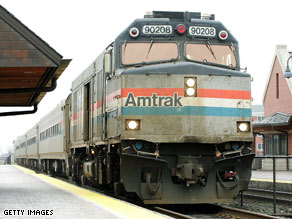
Amtrak gaines funding in the compromise version of the economic stimulus bill.
Here is a breakdown of who gained, who lost and who survived in the final economic stimulus bill that the House and Senate are expected to vote on Friday:

Winners High-speed and inner-city rail: Went from $300 million in House bill to $2.25 billion in Senate to $8 billion in final version. There also is a $6.9 billion provision for public transit. Amtrak: Picked up $500 million from both House and Senate versions to total $1.3 billion. The bill stipulates that no more than 60 percent can go to the Northeast Corridor. National Institutes of Health: Ends up with $10 billion in the final bill. The House proposed $3.5 billion and the Senate wanted $10 billion — $8.2 billion goes to the NIH director for his discretion. Government oversight: Board to oversee stimulus bill spending will get $84 million to do the job. House bill allocated $14 million while the Senate bill called for $7 million. There is also more than $100 million more for various inspectors general in different agencies. NASA: Banked just more than $2 billion, including $400,000 for science/global-warming research. Watch congressional comments on the stimulus bill »

CNN Money Summit

Ali Velshi and sharpest minds in money dissect the economic stimulus bill.
Tuesday, 11 p.m. ET

see full schedule »

Losers Veterans: Nearly all items for Veterans Affairs were reduced and the $2 billion the Senate wanted for VA construction was wiped out altogether. The VA did get one thing: $1 billion for medical facilities renovation and retooling. Military construction: Cut and put into a general pot, a change from targeted money for each branch of the services. Army construction alone went from $600 million in the Senate and $900 million in the House to $180 million in the final bill. But negotiators compromised over a general military construction fund — the House wanted $3.75 billion while the Senate allocated $118 million and settled on $1.45 billion for all services. FBI: Senate had allocated $475 million but all was cut out of final bill.

Don’t Miss
Obama makes 11th-hour stimulus push

House, Senate to vote on stimulus bill

In depth: The 44th President

Survivors Pandemic flu research: Although senators agreed it wouldn’t produce jobs, it’s getting $50 million in the final bill, down from nearly $900 million. Watch the latest on the stimulus bill » Damage control Foreclosures: $2 billion is set for a neighborhood stabilization program that helps areas plagued with foreclosures by buying back properties and preventing blight. Homeless: $1.5 billion is directed to homelessness prevention. Passports: $90 million is going to the State Department to deal with domestic facilities that deal with passports and training. Social Security: $500 million goes to replace its 30-year-old computer system. Tax breaks Car buyers: Anyone who buys a new car in 2009 gets to deduct the sales tax. To qualify, buyer must make less than $125,000 individually or $250,000 jointly. Cost is $1.7 billion. Homebuyers: First-time homebuyers who purchase this calendar year get an $8,000 tax credit which does not have to be repaid like a similar measure last year. This phases out for people making more than $75,000 individually or $150,000 jointly. “First-time homebuyer” is defined as someone who has not owned a home for the past three years. Cost: $6.63 billion. Paying for college Pell grants: will increase to a maximum of $5,350 per student in 2009-2010 year thanks to two provisions in the stimulus. Tax credits: Individuals making less than $80,000 or families making less than $160,000 can get up to $2,500 in tax credits for college tuition. 40 percent ($1,000) of the credit is refundable. Cost: $13.9 billion over 10 years.

Making work pay Tax credits: Anyone making $75,000 individually or $150,000 as a family will get refundable tax credit up to $400 per person or $800 per family.

Stimulus bill expected to pick up a GOP vote in House


The stimulus bill likely has picked up the vote of one House Republican, with Rep. Anh "Joseph" Cao of Louisiana saying he’s "leaning yes" on the $787 billion economic package.

Cao, who voted against the House version last month, said he’s still reading the bill but thought some aspects of the legislation could help rebuild efforts in his New Orleans district. Despite direct lobbying by the Obama administration in the last couple of weeks, many moderate House Republicans still firmly oppose the bill. The House of Representatives is expected to pass the stimulus bill Friday afternoon. No Republicans supported the House version of the plan earlier. Final Senate approval is expected as early as Friday evening. Before the House originally voted on the stimulus measure in January, 11 House Republicans attended a meeting at the White House with Chief of Staff Rahm Emanuel to discuss their possible support. Rep. Jim Gerlach, R-Pennsylvania, said he got calls from two Cabinet members Thursday — Housing and Development Secretary Shaun Donovan and Transportation Secretary Ray LaHood — but said the bill didn’t include the “fundamental change I think is needed.” Another Republican, Rep. Candice Miller of Michigan, said she believes the compromise between the House and Senate is worse than the original House bill.

Don’t Miss
CNN/Money: How stimulus may affect your wallet

iReport.com: Your thoughts on the stimulus

Stimulus bill: Part one

Stimulus bill: Part two

“I really wanted to get to ‘yes’ because Lord knows we need the help in Michigan,” she said. Miller said she asked for more direct help for the ailing auto industry and was disappointed the tax credit for auto buyers was reduced. On the House floor, representatives expressed frustration over how little time they had to read the 1,000-plus page bill. The bill came out around 11 p.m. Thursday. “You can’t be serious. This would be humorous if it wasn’t so sad,” said Rep. Tom Price, R-Georgia. “What’s in it Have you read it” President Obama made an impassioned final plea earlier Friday for passage of the plan, arguing that it is a critical first step on the road to economic recovery. “I don’t need to tell you that we are in tough economic times,” Obama said to a group of business leaders at the White House hours before the most important congressional vote of his young administration. The stimulus package is likely to land on Obama’s desk by the Democratic leadership’s self-imposed deadline of Presidents Day on Monday. Watch Obama say it’s time for Congress to act » Taking no chances, the Democratic National Committee and Obama’s Organizing for America also are using Obama’s vast e-mail list to contact the president’s political supporters and point them to a new Web page for stories of people affected by the economic downturn. The goal is to drum up public support for the measure as Congress prepares to vote on it. CNNMoney: How the stimulus may affect your wallet The stories were collected last weekend from Obama supporters who attended one of 3,600 meetings held across the country to discuss the situation, according to the DNC. In all, 31,030 stories were submitted to the DNC and Organizing for America, a grass-roots movement that grew out of the campaign. Read the stories The House, which had originally planned to vote on the package Thursday, was forced to wait until Friday after many rank-and-file Democrats who were unhappy with some spending cuts demanded time to read the compromise measure. iReport: Your thoughts on the stimulus The Senate vote will be held open for the arrival of Sen. Sherrod Brown, D-Ohio, who will be attending a wake for his mother until about 8 p.m. Friday, said Majority Leader Harry Reid, D-Nevada. Despite the grumblings of some House Democrats unhappy with the spending measures, House Speaker Nancy Pelosi, D-California, said Thursday she was pleased with the outcome of the negotiations. Read the compromise: Part 1 | Part 2 The stimulus deal was struck Wednesday after a furious day of negotiations on Capitol Hill involving House and Senate leaders, administration officials and the three moderate Republicans: Sens. Susan Collins and Olympia Snowe of Maine and Arlen Specter of Pennsylvania. Of the 219 Republicans in Congress, they were the only ones who backed the bill. Reid on Thursday was calling on other Republican centrists in an attempt to persuade more of them to vote for the measure, an aide said. The Senate’s version of the bill narrowly passed Tuesday by a 61-37 vote — one more than needed. Reid was looking for additional votes out of an abundance of caution, the aide said, after learning that Sen. Edward Kennedy, D-Massachusetts, who returned to Capitol Hill for votes earlier this week, will not be present for the final vote because he returned to Florida to continue his recovery from brain cancer. Reid was concerned that if a Democratic senator gets sick or has some other unforeseen obligation, he could have trouble getting the bill passed, the aide said. Reid also was concerned because the three GOP moderates suggested they did not want to provide the decisive 60th vote for passage, the aide said. Here’s how the compromise bill is expected to affect individuals: Most individuals will get a $400 tax credit, and most couples will get an $800 credit. That amounts to an extra $13 a week in a person’s paycheck, starting in June. That’s less than what Obama campaigned on — $500 for individuals and $1,000 per couple. Many students will get $2,500 tuition tax credit. First-time home buyers may qualify for a tax credit of up to $8,000.

People who receive Social Security will get a one-time payment of $250. The overall package is estimated to be 35 percent tax cuts and 65 percent spending, Democratic sources said.

Lloyds shares plunge following HBOS losses

Although Lloyds TSB has seen a pre-tax rise in profits, HBOS is expected to register a loss.
Lloyds Banking Group saw its share price tumbled Friday after reporting worse-than-expected profits for its subsidiary HBOS.

Shares for the UK-based banking group tumbled almost 35 per cent by the close of London trading Friday, Reuters.com reported. The Lloyds Banking Group, formed following the merger between HBOS and Lloyds TSB, began trading for the first time last month. Lloyds TSB traded “satisfactorily” in 2008 and is expected to report a pre-tax profit of around £1.3 billion ($1.9 billion) , Lloyds Banking Group said in a statement Friday. But HBOS is expected to report an underlying loss of an estimated £8.4 billion ($12.1 billion) last year — much of it lost through exposure to the meltdown in the property and credit markets. The HBOS sum is some £1.6 billion ($2.3 billion) higher than the bank forecast to shareholders last November, the statement continued. The UK government took a stake in both HBOS and Lloyds TSB last October as part of the bailout of banks hit by toxic debt.

Don’t Miss
UK bank shares plummet despite new bailout plan

Lloyds TSB penalized over U.S. sanctions breach

UK government takes stake in three banks

Eric Daniels, Group Chief Executive, Lloyds Banking Group, said in a statement Friday that HBOS’s trading had been “further impacted by increasingly difficult market conditions” since a statement on December 12, including “an acceleration in the deterioration of credit quality and falls in estimated asset values. “HBOS’s 2008 results have been adversely affected by the impact of market dislocation, which accelerated significantly in the last quarter of 2008, and the additional impairments required on the HBOS corporate lending portfolios,” Daniels continued. “These impairments primarily reflect the application of a more conservative recognition of risk and the further deterioration in the economic environment. “Whilst we recognise that the short term outlook is more challenging, Lloyds Banking Group has the largest UK financial services franchise, with excellent long-term earnings potential. Daniels added that the group is already making good progress on its merger, which the UK Press Association previously reported would result in annual savings of at least £1.5 billion by the end of 2011. Lloyds Banking Group has an estimated 145,000 staff and 3,000 branches in the UK. The group will next provide an update on February 27.

Witnesses saw and heard plane going down

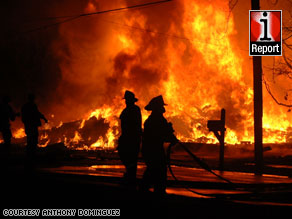
iReporter Anthony Dominguez saw nothing but flames and smoke when he arrived on the scene.
The plane that crashed Thursday night near Buffalo, New York, had its nose down and wings tilted to the left just before impact, a witness told CNN on Friday morning.

“The plane was nose down — not as steep as is being reported but steep enough that it didn’t look right,” said Tony Tatro, who lives next to the crash site in Clarence Center. “The left wing was tilted lower than the right, so it was pitched and it was headed down.” The crash of Continental Connection Flight 3407 about seven miles shy of Buffalo Niagara International Airport killed all 49 people aboard and one person in a house. The plane, which officials said was on a landing approach, was headed away from the airport but may have been simply making a turn, Tatro said. “I was able to see the underbelly of the plane,” said Tatro, who was arriving home from a gym when the crash occurred about 10:15 p.m. “It was only about 75 feet above me when it crossed the road, and it was literally within seconds of impact.” Watch Tatro’s description of the crash » The plane’s engines “didn’t sound typical,” he said. “I can’t say there was engine failure or anything like that, but it didn’t sound typical,” he said. The steep trajectory of the flight — though “it wasn’t going straight down and it wasn’t spinning” — probably minimized destruction on the ground, Tatro said.

“Had it been on a flatter trajectory it would have impacted more than just the one house,” he said. “The two homes on either side … are relatively close to the home that was hit. Had the plane been any flatter it would have hit either or both of those homes.” The plane was loud as it came in, as if for a takeoff rather than for a landing, said David Luce, who lives 300 feet from the crash site.

Don’t Miss
Crash near Buffalo kills 50

9/11 widow apparently aboard flight

Plane model has good safety record

More crash-related videos

“The engines sounded like they were revving at very high speed, an unnatural sound,” he said. “… Then the engine cut out — stopped. And within a couple of seconds, there was this tremendous explosion. “It was an enormous explosion. It sounded like it hit frankly right in our backyard. … The house shook, the windows shook, the ground shook. It was a real blast.” Watch Luce give his account » A mix of light rain, drizzle and freezing rain was falling in the Buffalo area at the time, Luce said. After the impact, flames reached twice the height of the houses, Luce said. “You wanted to get closer to see if you could help someone, but you didn’t dare,” said his wife, Mary Jane Luce. Neighbors were running from house to house to check on one another, she said. “There was no approaching the fire.” The house the plane struck was “nothing but a pile of rubble” less than two minutes after impact, David Luce said. When local TV stations broke the news of the crash, iReport contributor Nicole Komin said she and some friends hurried to the scene. They could smell smoke and aircraft fuel from miles away, Komin said. “The closer to the actual crash, the harder it was to see anything or breathe,” she said. The area was swarming with first responders by the time iReporter Anthony Trigilio arrived in his pajamas and a hoodie. “I saw people pouring out from all sorts of neighborhoods and stuff like that. There were tons of firetrucks, tons of fire sirens, more than I’ve ever heard in my life. Lots of people all over the place. It was pretty chaotic,” Trigilio said.

30 year old seen for first time in 3,000 years

The mummy known as Meresamun was entombed nearly 3,000 years ago.
The beautiful singer was about 30 years old when the world forgot about her. But now we know what she looks like for the first time in nearly 3,000 years.

It’s all thanks to one of the most sophisticated CT scanners in the world. Without even cracking open the Egyptian casket, you can now see the smallest details of the woman’s features. Her skin, muscles and bones are intact. “Her eyes are set far apart, and she has a very full mouth and high cheek bones. You know, I think I could recognize this individual if I saw her in life,” said Michael Vannier, a radiologist at the University of Chicago Medical Center. Egyptologist Emily Teeter recruited Vannier to help her get a look at the mummy no one had seen. Teeter is a researcher at the Oriental Institute, a small museum on the University of Chicago campus where the mysterious mummy was first brought in 1920. See animation of the mummy unveiled » Researchers had long wanted to know more about the looks of the mummy locked in the coffin. But opening the coffin was not an option. “It’s impossible to open it without destroying it,” Teeter said. “A major concern of archeology is preserving evidence intact, and so CT technology is ideal for studying a coffin and mummy like Meresamun,” she said. “It’s so astounding with the advances of CT technology — that with this newest generation of scanner, we can learn so much more about her life, her health and the way she was mummified.” Teeter had looked at the mummy’s coffin nearly every day over the past 19 years. Through this project, she said, she now looks at the mummy “as an individual instead of just an artifact.” Today, the mummy is the museum’s star, the highlight of a new exhibit. She’s undergone a high-tech unwrapping in breathtaking detail on film clips produced by Vannier, using a CT scanner normally used for patients who are still alive. “The first patient we scanned was this mummy,” Vannier said. Watch a mummy’s face revealed » He’s taken about 100,000 images. The images border the beautiful and the creepy: an up-close look at someone who died hundreds of years ago. CT scans have been used on mummies before, but they rarely generated such an amazing set of data, Vannier said.

Don’t Miss
Darwin still makes waves 200 years later

The Oriental Institute

“Many of the mummies had been taken out of their casket for scanning. In this particular case, this casket’s never been opened,” he said. “So everything we’re seeing there has never been seen before — at least not in 2,800 years.” The mummy was discovered in Luxor, Egypt, and sold to the Oriental Institute in the 1920. Teeter said the coffin, painted and carved to look like the figure of a beautiful woman, is an archeological marvel. She said singers who served in Egyptian temples were traditionally young, beautiful women from high-ranking families. Hieroglyphs on the front of the coffin tell researchers more about the mummy’s life. The woman’s name was Meresamun, which means “Amun Loves Her,” and she was a singer in the temple of the Egyptian god Amun. Teeter also said the Oriental Institute’s exhibit highlights the fact that Meresamun was not just another pretty face. “She was a working woman. She had her job at the temple, and she’d come home,” she said. Meresamun’s multitasking lifestyle, she said, makes “connections between modern day and ancient life.” Teeter believes that Meresamun would be pleased that modern medical science has given her new fame. “One of the ideas in ancient Egypt is to live forever and be remembered by people. She has her wish,” Teeter said. The only thing that remains a mystery is how she died. Vannier said there are no signs of trauma to the body, and his only theory is that she died of some kind of infectious disease. He’s most surprised by how perfect her teeth are, suggesting that she didn’t follow our modern-day high-sugar diet. She didn’t have a single cavity.

“I think the thing that we learned that was very surprising, at least to me, was the fact that our dental disease is obviously related to our diet,” he said. “She obviously had no refined sugars. A lot of the things that they ate were grain and more fresh materials.” He said what they’ve learned is astonishing. “We had some expectations, but they’ve all been so far exceeded. We’re really not sure where the limit of all of this is.”

Zimbabwe arrests new government minister

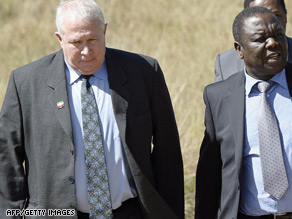
Roy Bennett, left, pictured with MDC leader Morgan Tzvangirai, is also the party's treasurer.
A Zimbabwean opposition party member was arrested just before he was to become the troubled country’s deputy agriculture minister, the opposition Movement for Democratic change said.

Roy Bennett, who is also the party’s treasurer, was pulled from an aircraft Friday at the airport in the capital, Harare, as he was about to fly to South Africa, the MDC said. Zimbabwean police spokesman Wayne Budzijena told CNN he was still trying to confirm Bennett’s arrest. The incident happened the same day that all MDC ministers in the new unity government took their oaths of office. The swearing-in eventually took place but was delayed, the MDC said, because President Robert Mugabe and his ZANU-PF party wanted to appoint more ministers than they were allowed in the new government. Under the power-sharing deal signed in September, the ruling ZANU-PF party gets 15 cabinet posts and the MDC gets 13. Mugabe brought a “bloated” list of 22 Cabinet ministers to the swearing-in ceremony, seven more than permitted under the agreement, the MDC said. Proceedings were delayed after MDC leadership insisted Mugabe stick to the 15 agreed Cabinet posts, the opposition party said. On Thursday MDC leader Morgan Tsvangirai spent his first full day as prime minister and called it “hectic.” Tsvangirai met union leaders and political detainees at a maximum-security prison, and planned to talk later to donors, he told journalists. He was sworn in as head of government Wednesday under a power-sharing agreement with Mugabe.

Don’t Miss
Zimbabwe PM meets political prisoners

Tsvangirai sworn in

Tsvangirai met the media in an office with new furniture and freshly painted walls, while painters and carpenters down the hall were still busy renovating the offices of his deputy prime ministers. The unity government is the result of a power-sharing agreement reached in September between Tsvangirai and Mugabe after months of squabbling about the results of elections earlier in the year.

A cholera epidemic has claimed close to 4,000 lives and infected about 65,000 people since August, aggravated by a lack of water-treatment chemicals and a problem with waste disposal in much of the country. The United Nations says more than 5 million people are in need of food aid, in a country that has shortages of all essentials, including fuel, electricity and cash.

50 killed in crash as plane hits Buffalo house

Smoke rises from the tail section of the Continental turboprop at the crash site near Buffalo on Friday.
A Continental Airlines plane crashed into a house near Buffalo, New York, late Thursday, killing all 49 people aboard and a person in the home, authorities said.

“This is easily the saddest day in the history of our airline,” said Philip Trenary, CEO of Colgan Air, which operated the flight for Continental. Continental Connection Flight 3407, a Bombardier Dash 8 Q400 74-seat turboprop, was en route from Newark, New Jersey, to Buffalo when it went down at around 10:20 p.m. ET, about seven miles from Buffalo Niagara International Airport. A National Transportation Safety Board official said Friday morning the plane’s voice and cockpit data recorders had been recovered from the wreckage and were being taken to Washington, D.C., for analysis. Firefighters finally subdued a blaze at the crash site late Friday morning, more than 12 hours after the crash. Officials blamed a natural gas leak for the fire’s persistence. Dave Bissonette, Clarence Center’s natural disaster services coordinator, said it was “clearly a direct hit” on the house. See what’s left of the plane » Four people were injured at the crash site, including a mother and daughter inside the house that was hit. They suffered minor injuries and were treated and released from a Williamsville hospital, a spokeswoman said. Two firefighters also were brought in for treatment of smoke inhalation and minor injuries. iReport.com: Flames rise from crash site

A Colgan Air spokesperson identified the crew as pilot Capt. Marvin Renslow, first officer Rebecca Shaw and flight attendants Matilda Quintero and Donna Prisco. An off-duty pilot, Capt. Joseph Zuffoletto, was also aboard. CNN has listened to a tape of communications between air traffic control and the flight crew. The first officer was calm. The plane was cleared for approach. About two minutes later, the air traffic controller came back, his voice full of stress. Radar contact was lost. The question goes out: Can other planes see anything No one responds. The controller says they might have a plane down. The pilot’s last comment was “Colgan Flight 3407.” There were no sounds of distress. It was not clear whether the mix of sleet and snow in the area played any role in the crash of Flight 3407. Watch what weather was like when disaster happened »

Airline information
Continental Airlines’ statements

Relatives helpline 800-621-3263 

Other planes continued to arrive and land safely at Buffalo about the time the flight went down. Delta Flight 1998, an MD-88 jet, landed at 10:17 p.m. The Delta crew did not see Flight 3407. The Delta flight reported rime icing, a condition in which ice quickly builds up on the leading edge of the wings. A US Airways flight also reported icing. Watch pilot explain how ice affects plane wings » Authorities said the plane went down near a fire hall, so firefighters were quick to respond to the crash site. At least nine volunteer fire departments responded. iReport.com: Are you there Let us know Witness Tony Tatro was on his way home from the gym when the plane flew about 75 feet above him. The craft’s nose was lower than usual and and the left wing was tilted, he told CNN. “The engines didn’t sound typical, didn’t sound normal,” he said. Watch witness describe how plane went down » The plane was loud as it came in, as if for a takeoff rather than for a landing, said David Luce, who lives 300 feet from the crash site. “The engines sounded like they were revving at very high speed, an unnatural sound,” Luce said. “… Then the engine cut out — stopped. And within a couple of seconds, there was this tremendous explosion.

Don’t Miss
Witnesses saw, heard plane go down

Turboprop plane one of safest

iReport.com: Share your photos, video, stories

WIVB:  Man was supposed to be on downed flight

“It was an enormous explosion. It sounded like it hit frankly right in our backyard. … The house shook, the windows shook, the ground shook,” he said. “It was a real blast.” Other witnesses told CNN they saw the plane nose-dive toward the ground. Twelve people were evacuated from scene. Law enforcement officials are asking people not to go to the crash site in fear they may hinder the investigation. “I felt the impact … sounded like a large explosion,” said Brendan Biddlecom, who told CNN he lives two blocks from where the plane crashed. Watch report from witness: “All I saw was flames” » Biddlecom ran out of his home to within a couple hundred yards of the crash. The smoke was thick and acrid, and the heat was intense, he said. Chris Kausner, who had a sister on the flight, rushed to the Clarence Municipal Center, where he waited for information after emergency teams turned him back from the scene. “My parents are on vacation in Florida and I had to call down there and tell my father what was going on,” he told CNN affiliate WIVB-TV. When asked how his parents were handling the news, a shaken Kausner responded “To tell you the truth, I heard my mother make a sound that I have never heard before.” Watch as Kausner talks about telling his mother about the crash » The Erie County Medical Examiner’s Office established a command post at the scene and had investigators there, a statement from the office said. Officials said relatives of passengers aboard the flight should call 800-621-3263 for information. Watch what iReporter captured on film Thursday’s incident is the first fatal crash of a commercial airliner in the United States since August 2006 when Comair Flight 5191 crashed when it attempted to take off from the wrong runway.

Comment: Obama loses some of his magic

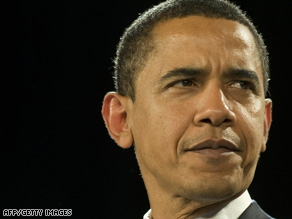
President Obama has spent weeks trying to convince Congress to quickly pass a stimulus plan.
You can tell right away when a magician loses his touch. Even if the tricks work, you see the effort involved.

Barack Obama was traveling the US this week, trying to pull more than $800 billion out of his hat to boost the economy. It worked and the Congress is preparing to give him the money for an enormous stimulus plan that has become a test of his new administration. But for the first time in months, Obama lost his magic. The euphoria that had surrounded him seemed to have evaporated. Obama is still astoundingly popular. The latest CNN-Opinion Research poll found that 76 percent of Americans approve of how he’s handled his three weeks in the presidency. But things have changed, for both Obama and his opponents. The remarkable man who made history is now in the more routine position of a president, a working politician who doesn’t automatically get his way. The Republicans have a freer hand. Instead of being forced to defend the unpopular Bush presidency, they attacked, criticizing the new president’s stimulus plan as wasteful and unwise. The battleground is the U.S. Congress, because it’s the Congress that controls spending. Obama’s majority is slim and he needs the support of both Democrats and Republicans to get his policies adopted. He was hoping for a broad bi-partisan consensus, but he was forced to plead for the stimulus money instead.

Don’t Miss
Special:  First 100 Days

Latest:  Political Ticker

He left Washington for visits to Indiana, Florida and Virginia, trying to pressure Congress by appealing directly to the American people. For a few days, he was more like a candidate running a campaign than a president running the country. The authority of the Oval Office, the mandate of the November election and the enormous excitement that is still attached to him hardly seemed to matter. In the end, Obama will get the money. But it was much harder than you might have expected just a few weeks ago, when America was so excited about its new president. America is still excited, but either Obama has lost some of his magic of may need a little more practice with his wand.

Obama makes 11th hour push for stimulus package

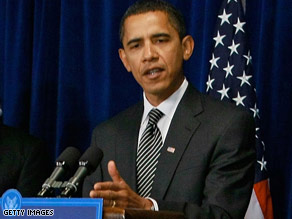
President Obama is highlighting stories of people affected by the economy.
Taking no chances, President Obama is exerting last-minute pressure on Congress to approve his stimulus plan by highlighting stories of people affected by the economic downturn.

The Democratic National Committee and Obama’s Organizing for America are using Obama’s vast e-mail list Friday to contact the president’s political supporters and point them to a new Web page, where several of these stories can be viewed. The goal is to drum up public support for the measure as Congress prepares to vote on it. “These stories show why an economic recovery plan is needed immediately to address the hardship Americans are experiencing right now,” the site says. The stories were collected last weekend from Obama supporters who attended one of 3,600 meetings held across the country to discuss the situation, according to the DNC. In all, 31,030 stories were submitted to the DNC and Organizing for America, a grass-roots movement that grew out of the campaign. Read the stories “The stories we’ve collected put a human face on the economic crisis and underscore the urgent need for action,” Virginia Gov. Tim Kaine said in a statement. CNNMoney: How the stimulus may affect your wallet Kaine, who heads the DNC, said that “Congress needs to move swiftly toward final passage of the economic recovery plan so the president can sign it into law and we can prevent this economic crisis from becoming a national catastrophe that costs millions more Americans their jobs, homes and health care.” With the support of a three Republican centrists in the Senate, the $789 billion bill is expected to be approved by Congress as early as Friday and then head to the White House to be signed into law by Obama. Watch Obama say it’s time for Congress to act »

Don’t Miss
CNN/Money: How stimulus may affect your wallet

iReport.com: Your thoughts on the stimulus

Stimulus bill: Part one

Stimulus bill: Part two

The House of Representatives, which had originally planned to vote on the package Thursday, was forced to wait until Friday after many rank-and-file Democrats who were unhappy with some spending cuts demanded time to read the compromise measure. The Senate plans to vote on the compromise late Friday, said Majority Leader Harry Reid, D-Nevada. iReport: Your thoughts on the stimulus The vote will be held open for the arrival of Sen. Sherrod Brown, D-Ohio, who will be attending a wake for his mother until about 8 p.m., Reid said. Despite the grumblings of some House Democrats unhappy with the spending measures, House Speaker Nancy Pelosi, D-California, said Thursday she was pleased with the outcome of the negotiations. Read the compromise: Part 1 | Part 2 The stimulus deal was struck Wednesday after a furious day of negotiations on Capitol Hill involving House and Senate leaders, administration officials and the three moderate Republicans: Sens. Susan Collins and Olympia Snowe of Maine and Arlen Specter of Pennsylvania. Of the 219 Republicans in Congress, they were the only ones who backed the bill. Reid on Thursday was calling on other Republican centrists in an attempt to persuade more of them to vote for the measure, an aide said. The Senate’s version of the bill narrowly passed 61-37 Tuesday — one more vote than needed. Reid was looking for additional votes out of an abundance of caution, the aide said, after learning that Sen. Edward Kennedy, D-Massachusetts, who returned to Capitol Hill for votes earlier this week, will not be present for the final vote because he returned to Florida to continue his recovery from brain cancer. Reid was concerned that if a Democratic senator gets sick or has some other unforeseen obligation, he could have trouble getting the bill passed, the aide said. Reid also was concerned because the three GOP moderates suggested they did not want to provide the decisive 60th vote for passage, the aide said. Here’s how the compromise bill is expected to affect individuals: Most individuals will get a $400 tax credit, and most couples will get an $800 credit. That amounts to an extra $13 a week in a person’s paycheck, starting in June. That’s less than what Obama campaigned on — $500 for individuals and $1,000 per couple. Many students will get $2,500 tuition tax credit. First-time home buyers may qualify for a tax credit of up to $8,000.

People who receive Social Security will get a one-time payment of $250. The overall package is estimated to be 35 percent tax cuts and 65 percent spending, Democratic sources said.

A Better Bank Fix: Cut Every Mortgage’s Principal

A Better Bank Fix: Cut Every Mortgages Principal

Treasury Secretary Timothy Geithner has unveiled a new plan to combat the financial crisis: convincing private financial institutions to buy up “toxic assets” with the government’s backing. While this is a step up from former Secretary Henry Paulson’s original bailout plan—in which the government itself would buy up the bad securities—it is still not the right approach.

Instead, there is a better, cheaper, less risky, more direct way to improve banks’ balance sheets and restore confidence. Here’s how:

Reduce the outstanding principal on every single mortgage to, say, 70% of the original value. Yes, you read that correctly: Lower every single American’s mortgage debt by a fixed percentage.

If homeowners owe less money on their mortgages, they will be less likely to stop making their payments. The plan is equivalent to a universal renegotiation of terms that improves the situation for both homeowners and banks. As a bonus, mortgage-backed—and, indeed, all mortgage-based—securities will become less “toxic” by virtue of a trickle-up effect.

Experts have pointed to a $30.6 billion deal between Merrill Lynch and the Lone Star group of private equity funds as a model for the new government plan. Lone Star purchased that amount of Merrill Lynch’s portfolio of asset-backed securities. Merrill Lynch reduced Lone Star’s risk by financing three-quarters of the purchase. Therefore, Lone Star had limited risk, similar to how funds would have limited risk buying the bad securities with government backing. But the most important part of the deal was not Lone Star’s risk; it was the price. Lone Star paid 22 cents on the dollar. This means that Merrill Lynch had priced its asset-backed assets somewhere around 22% of their original value.

Geithner hopes to encourage private investors to buy these asset-backed securities, giving the banks cash and eliminating further downside risk to their portfolios. But why not try to actually make the securities more valuable, in reality, so that investors want to buy them from the banks, without the need for government support

Thus far, the government has focused on trickle-down solutions: dealing with complicated assets like mortgage-based securities in the hopes of stabilizing the values of more concrete assets, such as homes. In contrast, my approach addresses the root of the problem. Thus, the government would help ensure that the mortgage-based securities find a stable price via a trickle-up effect. After all, it would take an inconceivable number of foreclosures at 70% of principal to justify the assets’ trading down to 22% of their face value.

This plan costs the government—and the American taxpayer—nothing but a trivial amount, the operating costs. Again, it is nowhere near as complex as what the government has done so far. It carries a small price tag compared to the massive, mostly ineffectual spending that has been the basis of the current policies.

Why lower the principal of the mortgages instead of reducing the interest rate of the loan Because it creates far more incentive for homeowners to continue mortgage payments. Moreover, with all the “exotic” loans out there, many with adjustable rates, the principal component is the only standard across all mortgages. Adjusting the remaining principal, then, is the most general way to renegotiate all mortgages as equitably as possible.

Further, there is currently a crisis of confidence in the banking world. Because of the uncertainty surrounding the future of asset values and the prices of complicated derivatives like mortgage-based securities, the banks are hoarding money. They lack trust even to lend to each other. Reducing mortgage principals addresses both of those problems directly. By stabilizing the mortgage markets, much of the uncertainty will vanish. Banks’ balance sheets could stabilize. And confidence may very well return.

Implementation is the most difficult part of this proposal. While many financial institutions would immediately discount the plan, ultimately convincing them to accept it is not unreasonable. It is true that for those institutions that hold physical mortgages, their maximum potential profit will go down by the discount. For a 30% decrease in principal, the math works out to some $3 trillion potentially lost on residential mortgages, as of mid-2008, according to the Federal Reserve. But if Americans keep defaulting on these mortgages, and asset values continue to crash, the total loss to the financial world will be far greater than $3 trillion.

It is also true that the banks will probably want to discriminate: Why should they lower the principal on “good” mortgages Why not just on those most likely to foreclose Thanks to tranches, the “good” have been rolled together with the “bad”, and specialized renegotiation is easier said than done. That is why banks have not already renegotiated loans on a large scale. But with the government’s pressure, lowering the remaining principal on every mortgage could easily become a reality.

The only banks that could legitimately lose on this are those that hold nothing but “good” mortgages or tranches of “good” mortgages, with no “bad” assets. Since TARP has attracted such interest from virtually every bank, we can conclude that such “good”-mortgage banks exist only in small number.

Other advantages of this solution are that it is universal and non-discriminatory: every mortgage holder in the United States gets a break. Homeowners without mortgages also benefit, as foreclosures directly lead to deflated home values, and foreclosures will be reduced considerably. At the same time, the banks’ assets will have a greater inherent value: their balance sheets will improve, and they are likely to begin loaning sooner than with the government plans.

Unlike Geithner’s plan, this solution is simple and transparent. It does not require the government to price complicated derivatives. It requires only one decision: by what uniform percentage to reduce mortgages. And unlike all of the other plans out there, it does not require significant government spending. It is also politically palatable, as it does not discriminate and does not rescue certain institutions over others. Homeowners get the most direct benefit, and the solution is efficient because of its flat-tax-like nature. Just about everybody wins.

See pictures of the global financial crisis.

See pictures of the Top 10 scared traders.