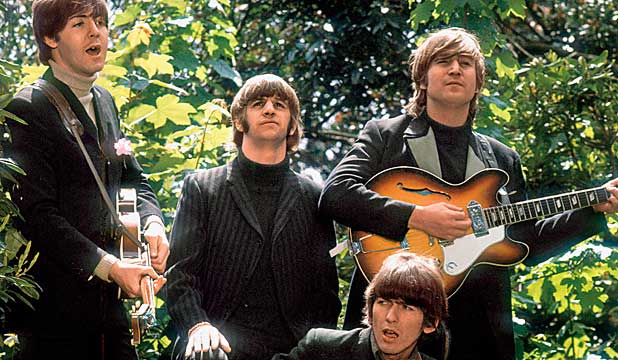
On 22 November 1963 two very good things happened along with one unspeakably awful thing.
The fact that both A Christmas Gift for You From Philles Records (later renamed A Christmas Gift for You From Phil Spector) and With the Beatles both came out on the same day as the assassination of President John F. Kennedy is one of the most twisted ironies in the history of popular culture.
Christmas Gift is the iconic Christmas pop record for all time and one of the most ebullient collections of music ever assembled. With the Beatles is one of the most important albums by the most important band in history. Not a bad day, except that it was the worst day.
Beatles literature contains a long tradition of linking the band’s American breakthrough to the aftermath of the Kennedy assassination. Lester Bangs, in a famous essay on the British Invasion from The Rolling Stone Illustrated History of Rock and Roll, wrote that “[i]t was no accident that the Beatles had their overwhelmingly successful Ed Sullivan Show debut shortly after JFK was shot,” a choice of words that might as well put John and Paul in the book depository.
Ian MacDonald, whose Revolution in the Head is the gold standard in Fab Four criticism, argued that “When Capitol finally capitulated to Epstein’s pressure and issued I Want to Hold Your Hand [in December of 1963], the record’s joyous energy and invention lifted America out of its gloom, following which, high on gratitude, the country cast itself at the Beatles’ feet.”
History is more fun if it happens in turning points. Dylan goes electric, The Velvet Underground and Nico starts 30,000 bands, Michael Jackson moonwalks on Motown 25 – all are Moments When Everything Changed.
No event has endured more of this than the Beatles’ arrival in the United States in February of 1964, where they performed before 70-some million Americans on the Ed Sullivan Show, soothed an injured nation in the wake of the assassination, and saved rock and roll in the process.
As Bob Spitz, the author of a celebrated and enormous biography of the band, put it a while back, “The Beatles changed music forever. They took rock ‘n’ roll from a medium that was about cars and girls and gave it context, interesting chord changes and true musicianship.” Variations on this abound in Beatle hagiography.
The Beatles absolutely changed music forever, but the rest of that statement is utterly ludicrous. The “true musicianship” bit is barely even worth debunking, but every second of Chuck Berry’s Johnny B. Goode (1958), Ben E. King’s Stand by Me (1961), or Booker T andf the MG’s Green Onions (1962) should suffice.
As for the “cars and girls” claim, the first Beatles song that was definitely not about cars or girls was Nowhere Man, which appeared in Britain on “Rubber Soul” in late 1965 and in America in early 1966. Here are three extremely famous songs that came out before then: Martha and the Vandellas’ Dancing in the Street (1964), Sam Cooke’s A Change Is Gonna Come (1964), Bob Dylan’s Subterranean Homesick Blues (1965). Not one is about cars or girls.
Ad Feedback
The problem with these turning-point narratives, which often invoke the Kennedy assassination for its epochal gravitas, is that they’re willfully dismissive of all that came before.
They imply that the Beatles rendered a whole pre-existing world of popular music instantly obsolete or – even more insidiously – turned it into primitive source material for them to improve upon.
And in case you’ve started to wonder, most of the writers making these claims are white men; most of the artists they’re so blithely uninterested in are not.
Which brings us to Philles Records, which released one of the great rock and roll albums of all time in the United States the same day the Beatles did so in Britain, a day when the world’s eyes, ears and thoughts were squarely focused on Dallas.
Throughout 1963 Phil Spector’s label, most famous for young African-American female singers like the Ronettes, the Crystals and Darlene Love, had been making electrifying art. Just two months prior to the Kennedy assassination Philles had released the Crystals’ Then He Kissed Me, which isn’t about cars but is most certainly about a girl (the incomparable LaLa Brooks) and is one of the finest songs about romantic anticipation ever written.
Christmas Gift was Spector’s pi